
How to Write Your Own Tea Tasting Notes
Tea tasting notes are structured observations that record a tea's appearance, aroma, flavor, mouthfeel, and aftertaste. Writing them is one of the most effective tools for palate training — and one of the quietest ways to deepen a lifelong relationship with tea.
Picture a slow Tuesday afternoon. The kettle has just come off the boil. You pour the first infusion of a Menghai ripe pu-erh — the liquor settles into the cup a deep, clear auburn — and before you drink, you pause to write three words: camphor, dried plum, warmth.
That pause is the whole practice. Not the notebook. Not the right vocabulary. Just the act of paying close enough attention that a Tuesday afternoon becomes, in retrospect, something you can return to.
Tea tasting notes have a practical side, too. When you commit observations to paper, you're doing active palate training — forcing your brain to distinguish between "floral" and "fruity," between astringency and bitterness, between a thick mouthfeel and a clean one. Over months of notes, patterns emerge. You learn what you actually like, rather than what you think you should like. You notice when the same tea tastes different brewed at 95°C versus 100°C, or when your tap water is dulling the brightness of a perfectly good Dian Hong.
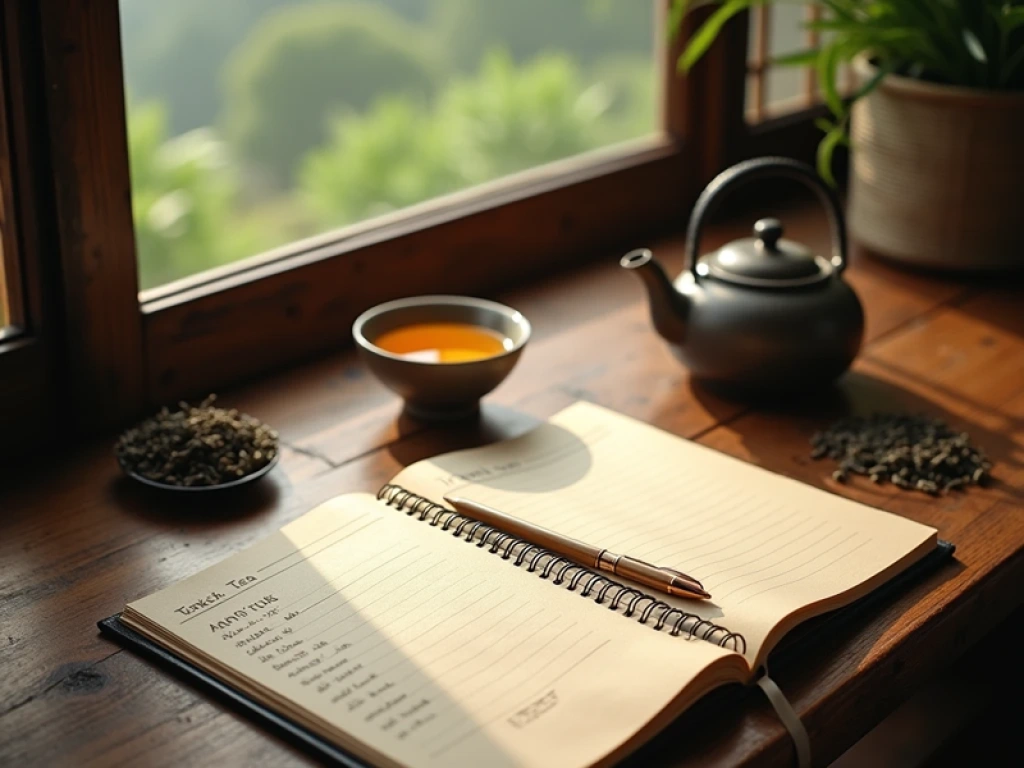
We've made a simple, printable template — no instructions required, just space to write. Download the Free Tea Tasting Notes Template (PDF)
Why Write Tea Tasting Notes?
The short answer: because tea is more interesting when you pay attention to it, and writing forces attention.
The slightly longer answer involves how memory and sensory perception actually work. Aromas are among the most volatile of experiences — present for a moment, gone within seconds. A good oolong's high-note florals peak in the cup's first ten seconds. Without a note, that detail evaporates with the steam. With one, you can compare it six months later against a different harvest of the same cultivar and understand something you couldn't have understood otherwise.
There's also the matter of building a personal flavor profile library. Professional tasters describe flavor in reference to accumulated experiences — "this reminds me of lychee," "this has the texture of cold butter." Those associations don't arrive automatically. They're built, cup by cup, through the discipline of looking for something to say about what you're drinking.
"The tea reveals itself the moment you give it your full attention. Writing is just what you do to prove you were present."
— Adrian, brewing notes journal, 2023The Five Dimensions of a Tasting Note
A complete tasting note captures five sensory dimensions. You don't need to address every one in every session — but knowing the framework helps when you're searching for what to write about.
Appearance
Start before the kettle. Look at the dry leaves — their shape, size, and color. After brewing, note the liquor: its depth, clarity, and any shift across infusions.
e.g. "tightly wound jade spirals," "golden-amber liquor, clear as honey," "leaves open to full single buds"Aroma
There are at least three distinct aroma moments: the dry leaf, the wet leaf after rinsing, and the cooled empty cup (the "hui xiang," or returning fragrance). Each tells a different part of the story.
e.g. "dried apricot and hay," "rainy forest floor," "roasted chestnuts with a thread of orchid"Flavor
What arrives first? What follows? Flavor has sequence — an entry, a mid-palate, and a finish. A young raw pu-erh might open bright and astringent, then soften toward apricot by the end of the sip.
e.g. "green plum, stone fruit, then a long mineral finish," "toasted rice, dark chocolate, lingering earthiness"Mouthfeel
This is often the hardest dimension to articulate for beginners — and the most rewarding once you can. It's the physical sensation: weight, texture, dryness, coating. A full-bodied aged pu-erh feels genuinely different from a light spring green tea.
e.g. "velvety, coats the tongue," "thin and bright, like cold water," "dry finish that tightens the jaw," "silky, almost oily"Aftertaste
What happens after you swallow? The hui gan (回甘) — the returning sweetness common in quality oolongs and pu-erh — is one of the most distinctive sensations in Chinese tea. Some teas finish and vanish; others linger for minutes.
e.g. "strong hui gan — sweetness rises in the throat 20 seconds after swallowing," "clean and brisk, gone quickly," "a warmth that settles in the chest"A Vocabulary Reference — Use It or Ignore It
The following descriptors are drawn from professional tasting practice and from notes written by Steeped Roots community members. They're starting points, not rules. Your description of "grandma's kitchen" is as valid as "caramelized malt."
| Dimension | Example Descriptors | Found In |
|---|---|---|
| Aroma | Orchid, honey, roasted barley, mushroom, camphor, dried rose, vanilla, forest floor after rain | Oolong, Dian Hong, aged pu-erh |
| Flavor | Dried apricot, green plum, dark chocolate, toasted rice, bittersweet, lychee, smoke, mineral, cedar | Raw pu-erh, Dian Hong, wulong |
| Mouthfeel | Velvety, astringent, silky, thick, light-bodied, drying, coating, effervescent | All teas — varies by type |
| Aftertaste | Hui gan (returning sweetness), clean finish, warming, brisk, lingering floral, woody echo | Pu-erh, Dancong oolong |
| Appearance | Jade-green, golden-amber, deep burgundy, bright copper, hazy, crystalline | Visual — all teas |
Step-by-Step: How to Write Your First Note
You don't need a special occasion. You need a cup of tea, something to write with, and about fifteen minutes of unhurried time.
Prepare the Tea with Intention
Brew your tea carefully, using the recommended temperature for the type: 80–85°C / 175–185°F for green teas, 90–95°C / 195–203°F for oolongs and Dian Hong, and a full 100°C / 212°F for ripe pu-erh. The same tea brewed at the wrong temperature is a different tea. Note your method — gaiwan, flask, or western pot — and the infusion time.
Examine the Dry Leaves — Before the Water
Scoop the dry leaves into the gaiwan and observe before you pour. What color are they? Are they tightly rolled or open and strip-style? Silvery with buds, or dark and compressed? Bend close and inhale. The dry fragrance is the tea's first word.
Smell Three Times
After rinsing the leaves, lift the gaiwan lid and inhale — this is the "lid aroma," one of the most complex and fleeting notes in the session. Then smell the liquor in the cup. Finally, set the cup aside and return to smell the empty cup once it has cooled. All three moments differ. Write what you find in each one.
Sip Slowly and With Your Whole Mouth
Don't swallow immediately. Let the tea settle across your whole tongue — the tip (sweetness), the sides (acidity and salt), the back (bitterness). Breathe out gently through your nose as you hold the sip to release volatile aromatics. Then swallow and wait. The aftertaste begins now.
Write Freely — Don't Edit Yourself
Write what actually arrived, not what you think should be there. If a 1990s ripe pu-erh tastes like a root cellar full of old books, write that down. If a high-mountain Dancong oolong smells like your grandmother's flower garden, write that too. Personal associations are more useful for palate training than borrowed technical vocabulary, because they're anchored to your real sensory memory.
Track Over Time — And Trust the Process
The same tea brewed in winter will taste different in summer. The same tea will taste different with softer water, or after a meal, or on a day when you're tired. When you return to notes from months ago, you'll notice two things: how much your palate has changed, and how specific your earlier observations already were. Both are worth knowing.
A note on pressure: none of this is required. Tea tasting notes exist to serve the drinker, not to perform expertise. Some of our most experienced community members keep no notes at all — they carry their palate training in sensory memory rather than on paper. Others fill notebooks with every session. Neither approach is more correct.
The template below is a blank space, not a checklist. Use it if you find it useful. Set it aside if it gets in the way. Tea remains tea either way.
If you are someone who likes to quietly record aromas, textures, and how a tea changes over time — we've prepared something simple for you.
Our Tea Tasting Notes Template (PDF) is not a standard to follow. It is merely a blank space — a place to leave traces of your encounters with tea, should you ever wish to look back.
Quick Brewing Reference for Your Notes
Record these parameters at the top of each note — they matter more than most people expect.
| Tea Type | Temperature | Leaf per 100ml | First Infusion | Key Flavor Marker |
|---|---|---|---|---|
| Green Tea | 80–85°C / 175–185°F | 3–5g | 20–30 sec | Fresh, grassy, sweet |
| Dian Hong (Yunnan Black) | 90–95°C / 195–203°F | 4–5g | 20–30 sec | Malt, honey, golden |
| Oolong (light roast) | 85–90°C / 185–195°F | 6–8g | 10–15 sec | Floral, orchid, creamy |
| Oolong (heavy roast) | 90–95°C / 195–203°F | 6–8g | 15–20 sec | Roasted, caramel, mineral |
| Raw Pu-erh (young) | 90–95°C / 195–203°F | 4–6g | 10–15 sec | Bitter, green plum, hui gan |
| Ripe Pu-erh (Shu) | 100°C / 212°F | 5–7g | 15–20 sec | Earthy, camphor, dark fruit |
Common Questions About Tea Tasting Notes
Do I need to use professional terminology?
No. The most useful tasting notes use the language that's actually anchored in your memory. If a tea smells like "a rainy forest" or "a warm bookshop," write exactly that. Over time, those personal descriptors become highly reliable reference points — often more reliable than borrowed technical vocabulary, because they're yours.
How often should I note the same tea?
As often as the tea interests you. Trying the same pu-erh across different seasons, different water sources, or different infusion temperatures reveals more about how the tea works than any single session can. If you're committed to a particular tea, brewing it monthly for a year and comparing the notes is one of the most instructive things you can do for your palate.
Can I keep my notes digitally instead of on paper?
Absolutely. Many Steeped Roots community members use simple digital documents, spreadsheets, or dedicated tea apps to maintain a searchable archive. The format matters less than the consistency. The one advantage of paper: you can smell the old pages and sometimes reconstruct the session from that alone.
What if I can't taste anything beyond "bitter" or "earthy"?
That's exactly where everyone starts. Palate training is a skill that develops with repetition, not a talent you either have or don't. The single most effective exercise: taste two teas side by side and write about the difference. The comparison creates contrast, and contrast is what the brain needs to build sensory categories. Start with something easy — a Dian Hong next to a ripe pu-erh. The difference will be obvious and give you material to work with.
What does hui gan (回甘) actually feel like?
It's a sweetness that rises in the throat and back of the mouth 10–30 seconds after swallowing — not a taste on the tongue, but a sensation in the throat. It's most pronounced in high-quality raw pu-erh and certain high-mountain oolongs. When you notice it for the first time, you'll recognize it immediately. After that, you'll notice its absence in lower-quality teas and understand something important about what you're paying for.
🌿 Continue Your Tea Education
- Raw vs Ripe Pu-erh: Complete Guide & Flavor Comparison Chart
- Pu-erh Tea Taste Guide: From Earthy Notes to Dealing with "Fishy" Smells
- Mastering the Brew: From Gaiwan to Mug — The Complete Beginner's Handbook
- What Is Cha Qi? Understanding the Energy You Feel in Tea
- Sun, Time, and Leaves: The Secret Life of Shai Hong (Sun-Dried Black Tea)
- The Legacy of Pu-erh Tea: From Ancient Trees to Modern Cups