How to Brew Tea with a Gaiwan: A Beginner-Friendly Guide
What Is a Gaiwan?
The gaiwan (盖碗), or “lidded bowl,” is a timeless Chinese teaware used to brew teas like oolong, raw Pu’er, and green tea. Crafted from porcelain or glass, it comprises a bowl, lid, and saucer—no spout, no handle, just pure elegance. Steam curls like a Yunnan mist, carrying the essence of ancient tea trees, as explored in People of Menghai.
☯️ More than a vessel, the gaiwan offers control over steeping time, water flow, and aroma release, making it ideal for beginners and connoisseurs alike.

Why Use a Gaiwan?
- 🌸 Aroma First: The wide mouth and lid amplify the tea’s fragrance, inviting you to savor its aroma before tasting.
- 🔁 Multiple Infusions: Perfect for gongfu cha, gaiwans allow multiple brews of the same leaves, revealing evolving flavors, as detailed in How to Drink Tea Like a Master.
- 📏 Precision & Control: Adjust steeping time to avoid bitterness, ensuring a perfect cup every time.
- 🌱 Minimal & Sustainable: No filters, no waste—just a gaiwan, a mug, and the Hani artisans’ craft. The only challenge? Sourcing 100°C boiling water! 😄
What You’ll Need
- A porcelain or glass gaiwan (100–150ml, ideal for beginners)
- Loose-leaf tea—try raw Pu’er, Tieguanyin oolong, or Yunnan green tea
- Filtered hot water (85–100°C / 185–212°F, depending on tea type)
- A fairness pitcher (optional) and drinking cup
Tip: Porcelain gaiwans are beginner-friendly, retaining no flavors and cleaning easily, per Choosing the Right Teaware.
Step-by-Step: How to Brew with a Gaiwan
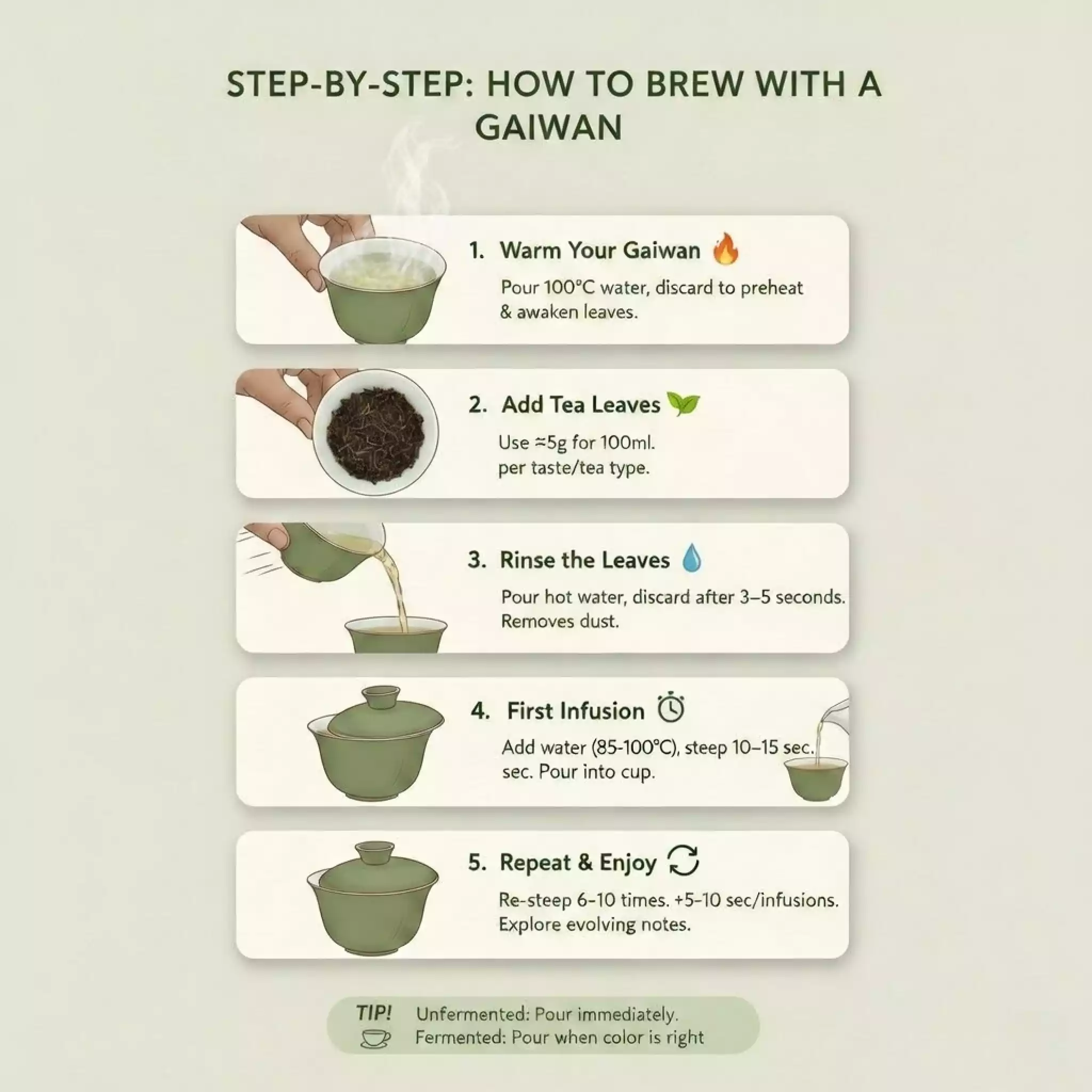
- Warm Your Gaiwan 🔥
Pour boiling water (100°C / 212°F) into the gaiwan and discard to preheat the vessel and awaken the tea leaves.
- Add Tea Leaves 🍃
Use 5g for a 100ml gaiwan (e.g., raw Pu’er or Fengqing Dianhong). Adjust for taste or tea type.
- Rinse the Leaves 💧
Pour hot water over the leaves and discard after 3–5 seconds to remove dust and prime flavors.
- First Infusion ⏱️
Add water (85°C / 185°F for green tea, 100°C / 212°F for Pu’er or oolong), cover, and steep for 10–15 seconds. Pour into a pitcher or cup.
- Repeat & Enjoy ♻️
Re-steep the leaves 6–10 times, adding 5–10 seconds per infusion. Explore evolving notes, from floral to earthy. 👉 How to Drink Tea Like a Master
Tip: Brewing is simpler than it sounds! For unfermented or semi-fermented teas (e.g., raw Pu’er, green tea, white tea, red tea), pour out the tea immediately after adding water. For fully fermented teas or weight-loss teas, pour when the tea reaches your desired color.
How to Hold a Gaiwan (Without Burning Your Fingers!)
Mastering the pour is as much about the vessel as it is about technique. Follow these professional adjustments to protect your fingertips:
- One-Handed Grip: Thumb and middle finger hold the bowl’s rim; index finger tilts the lid to pour smoothly.
- Two-Handed Pour: One hand holds the bowl, the other tilts the lid—ideal for beginners seeking stability.
🔥 Expert Tip: The 80% Rule
Never fill your gaiwan to the very top. Aim for 80% capacity, leaving the water line just below the curve of the rim. If the water reaches the edge, the porcelain will conduct heat directly to your fingers, making the pour nearly impossible.per Choosing the Right Teaware.
Common Mistakes to Avoid
- 🚫 Using boiling water (100°C / 212°F) for delicate teas like green tea, which needs 85°C / 185°F.
- ⏳ Oversteeping, causing bitterness—keep initial brews at 10–15 seconds.
- 💦 Leaving liquid in the gaiwan, leading to overbrewing; pour completely.
- 🧼 Not rinsing leaves after brewing, risking flavor residue in the gaiwan.
Sensory Chart for Gaiwan Brewing
Discover the sensory profiles of teas brewed in a gaiwan, highlighting Yunnan’s terroir, as detailed in How Terroir Shapes Tea Flavor:
| Tea Type | Appearance | Aroma | Taste | Aftertaste |
|---|---|---|---|---|
| Tieguanyin Oolong | Pale golden liquor | Orchid, creamy floral | Smooth, sweet, slightly roasted | Lingering floral sweetness |
| Raw Pu’er | Light green-golden liquor | Floral, grassy, mineral | Vibrant, slightly astringent, sweet | Refreshing, orchid-like finish |
| Yunnan Green Tea | Bright green liquor | Fresh, herbaceous, nutty | Crisp, vegetal, mildly sweet | Clean, refreshing clarity |

Frequently Asked Questions
What teas are suitable for gaiwan brewing?
Any tea works in a gaiwan, from raw Pu’er to Fengqing Dianhong, except powdered teas like matcha or yerba mate. Herbal or weight-loss teas are great too, revealing unique flavors, as noted in How Terroir Shapes Tea Flavor.
How do I prevent my fingers from burning when using a gaiwan?
To avoid burns, fill the gaiwan to only 80% capacity to keep the rim cool. Additionally, choose a gaiwan with a flared, wide rim to create more distance from the hot water, and always grip the rim rather than the body of the bowl.
What size gaiwan should a beginner use?
A 100–150ml gaiwan is ideal for beginners. It’s easy to handle and perfect for 1–2 servings, allowing precise control over steeping.
How do I clean a gaiwan properly?
Rinse with hot water after each use and avoid soap to preserve the porcelain’s neutrality. Dry thoroughly to prevent residue, per Choosing the Right Teaware.
Can I use a gaiwan at my desk?
Yes, a gaiwan is perfect for simple brewing at your desk. For detailed techniques, see our guide on Wet and Dry Brewing Methods.
Why is rinsing tea leaves important in gaiwan brewing?
Rinsing removes dust, primes leaves for flavor release, and enhances aroma, especially for Pu’er, as explained in How to Drink Tea Like a Master.
What tools do I need for gaiwan brewing?
The simplest setup is just a gaiwan and a cup. A more complete setup includes a gaiwan, cup, and tea tray. For a fuller experience, add a tea towel or even a tea strainer and other teaware. At Steeped Roots, tools are just aids—the tea and your brewing mindset matter most!
Final Thoughts
“The gaiwan teaches us to listen—not just to flavor, but to the silence of the moment.”
Continue Your Tea Journey
- The Art of Breaking a Tea Cake: A Gentle Awakening
- Water: The Hidden Force Behind Every Great Cup of Tea
- Tips on Water Temperature for Brewing Tea
- How to Use a Yixing Teapot for Brewing Tea
- Difference Between Dry Brewing and Wet Brewing Tea
- Mastering the Brew: From Gaiwan to Mug — The Complete Beginner's Handbook