Tea and Zen: A Beginner's Guide to Mindfulness (Without the Complexity)
Tea and Zen share a 1,200-year relationship rooted in Tang Dynasty monasteries — monks drank tea to maintain awareness during meditation. You do not need to understand Buddhist philosophy to experience this. The 5-minute ritual is simple: one tea, one quiet spot, no phone. Select → Listen → Pour → Sip → Exhale. Any tea you love works. The stillness is the point.
"Tea and Zen are one." You see this phrase on tea canisters, in temples, even in tourist brochures. But honestly, Zen can feel elusive to many of us. I've read about "emptiness," "sudden enlightenment," and "a flower held up in silence," yet these concepts often remain just out of reach. Still, after years of drinking tea, I've learned: Zen doesn't always need understanding — it's something you can feel in a quiet cup.
If you're curious about the cultural roots behind this practice, our guide to the three East Asian tea ceremonies explains how Chinese Gongfu Cha, Japanese Chanoyu, and Korean Darye each embody Zen in different forms. And if you've ever wondered why aged Pu-erh produces such a distinctive body sensation, that's Cha Qi — the energy behind the Zen feeling.
"Though Zen — a form of Buddhist meditation focusing on simplicity and present-moment awareness — may seem abstract, its essence can be felt in the quiet act of brewing a perfect cup."
The Busy World vs. The Tea Cup: A Zen Contrast
The fastest way to understand what Tea-Zen practice offers is to see what it replaces. This is not about escapism — it's about contrast. The table below is the difference between the mode you're probably in right now, and the mode one cup of tea can offer.
| Dimension | 😤 The Busy World (Noise) | 🍵 The Tea Cup (Zen) |
|---|---|---|
| Focus | Multi-tasking and constant distraction | Single-tasking — just the pour, just the cup |
| Sound | Notifications, traffic, background noise | Boiling water, steam, and deliberate silence |
| Goal | Doing more — optimize, produce, achieve | Just being — presence, not performance |
| Relationship to time | Never enough — always behind schedule | Time dilates — 5 minutes feels full |
| Body awareness | Body as a tool to push through tasks | Body as a sensor — warmth, taste, breath |
| Result | Mental fatigue, decision exhaustion | Calm awareness, restored attention |
| Equipment required | High-spec devices, calendar, apps | One cup, one tea, one quiet spot |

You Don't Need to Understand Zen. Just Be Quiet.
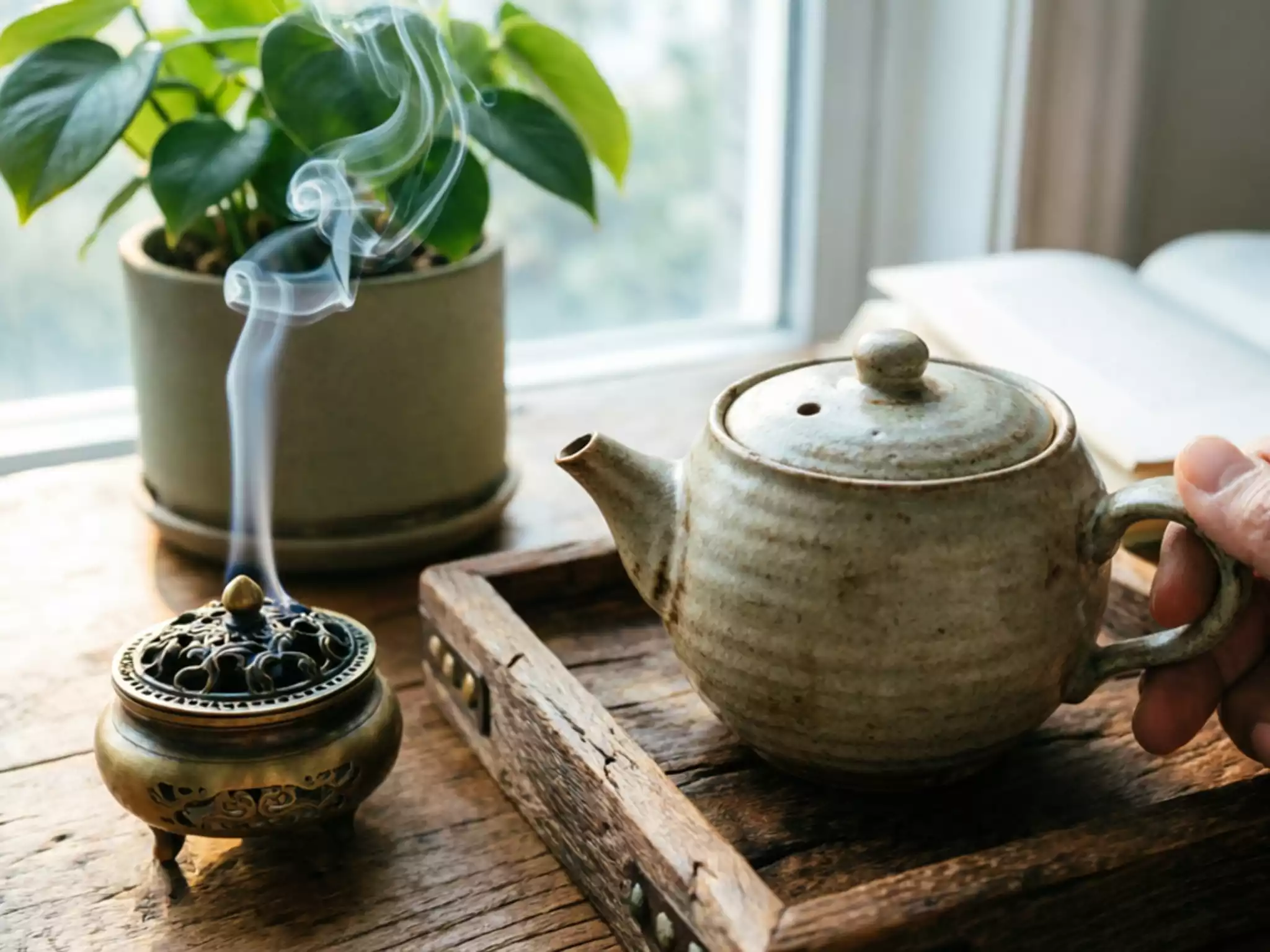
Life is noisy — our minds busy, our schedules crowded. The meeting place of tea and Zen lies in a quiet moment carved out just for you. Choose a peaceful spot: a balcony, a cozy kitchen corner — anywhere will do. Light some incense, let soft music play — perhaps a lo-fi track or gentle guqin (古琴) melodies. Then, pick a tea you love. Aged Pu-erh, high mountain oolong, or even a simple teabag. If it brings you joy, it's already the right tea for Zen.
For tips on creating a mindful tea space without overspending, see our guide to Choosing the Right Teaware.
This Cup Is Your Zen Moment
The sound of water boiling, the leaves slowly unfurling, the warmth of the cup in your hands. In this moment, your senses come alive. You notice the tea's clarity, its aroma, its temperature on the tongue, the heat radiating through the porcelain. The to-do list, the notifications, the rush — it all pauses.
I don't know if that's what eighth-century Zen masters had in mind. But it is a moment of genuine presence, and that's enough. If you want to deepen your sensory awareness of tea over time, our Tea Palate Training Guide offers a structured practice.
"Tea speaks in silence. Zen doesn't explain. But you'll know when you feel it — probably around the second sip."
The 5-Minute Zen Tea Ritual for the Modern Mind
Philosophy is optional. This practice is not. Five minutes, one tea, five actions — each one a small act of presence. No meditation experience required. No incense mandatory (though nice). Phone must stay face-down.
Select — Choose one tea. Look at the dry leaves.
Pick any tea that appeals to you today. Hold the dry leaves in your palm for a moment. Smell them. Notice the color — silver-tipped, dark rolled, flat green needles. This is the beginning of single-tasking: one object, full attention. The selection ritual turns an unconscious habit into a deliberate choice.
Listen — Focus only on the sound of the kettle.
Put the kettle on and do nothing else. Listen to the water move from silence to a faint whisper, to a full rolling boil. In traditional practice, the sound of boiling water is called "pine wind through the pines" (松风). You are not waiting — you are listening. These are different activities. Most people haven't truly listened to water boil in years.
Pour — Watch the steam rise. Don't look at your phone.
Pour the water slowly. Watch the steam catch the light. Watch the leaves uncurl — slowly, in their own time. This is the only moment in your day where something is allowed to happen at its own pace without you optimizing it. Resist nothing. If you're using a Gaiwan, the Gaiwan guide shows proper pouring form. If you're using a mug, pour from a little height — the sound matters.
Sip — Feel the temperature on your tongue before swallowing.
Do not gulp. Let the tea rest on the front of your tongue for a full second before swallowing. Notice: is it hot, warm, sweet, bitter, floral, earthy? Pay attention to the aftertaste — the returning sweetness (called Huigan, 回甘) that blooms in the throat a few seconds after each sip is one of the most remarkable sensations in tea. Most people miss it because they're already reaching for their phone.
Exhale — One slow breath before the next sip.
Between every sip, exhale slowly. This is the full Zen protocol: not years of monastery training, not koans or sutras, just breath + warmth + presence. Repeat for as many infusions as you have time for. If you have five minutes, do one steep. If you have thirty, do a full Gongfu session. The number of steeps doesn't matter — the quality of attention does.
💡 The Historical Root: This ritual is not invented — it's adapted. Tang Dynasty monks (618–907 CE) drank tea before meditation sessions specifically because it produced calm alertness without drowsiness: the L-theanine + caffeine combination that modern neuroscience now measures in alpha brain waves (8–12 Hz). The monks didn't know the chemistry. They knew the feeling. You can too.
Your Tea Space Is Your Dojo
Some find awakening in mountain temples. Others find it in a tiny apartment kitchen with a secondhand kettle at 7 AM. As long as you pour your tea with care and drink it with calm, any space becomes sufficient. You don't need a bamboo-screened teahouse or thousand-dollar artisanal clay pots — Zen doesn't care about décor. The less you chase the "correct" Zen aesthetic, the closer you are to what Zen actually is.
That said, a space you return to reliably helps build the habit. Even placing a small cloth, a cup, and a canister of loose leaf on a consistent corner of your desk creates a visual cue that anchors the ritual. Your $5 thrift-store mug is welcome here.
You Don't Have to "Get" Zen to Brew a Good Cup
You don't need to be a monk or a scholar of Buddhist philosophy. Make space for quiet, pour a good cup of tea, and truly drink it. That's the practice. Every cup is a small act of sanity in a noisy world.
When you're ready to share this peace, our guide on How to Host a Tea Party shows how to extend the practice into community. Peace comes not with answers, but with a warm cup and a few slow breaths.
"You've been looking for Zen in books and temples. It's been sitting in your kettle this whole time."
Start your practice with a tea designed for stillness. Our curated mindfulness teas are a good first step.
Explore Our Mindfulness Tea Collection →Frequently Asked Questions — Tea & Zen 2026
Do I need to be a Buddhist to practice Zen through tea?
Not at all. Zen in tea is about presence, simplicity, and returning your attention to immediate sensory experience — not doctrinal belief. The Tang Dynasty origins involved Buddhist monks, but the practice has always been accessible to anyone willing to slow down. The cup doesn't check your religion. It only asks for your attention.
What tea is best for a Zen brewing session?
Any tea that genuinely brings you joy. Many experienced practitioners prefer aged Pu-erh (for its Cha Qi body sensation and earthy depth across many infusions) or high mountain Oolong (for floral complexity and long Huigan aftersweetness). But a simple green tea or even a quality tea bag can facilitate a mindful moment if your attention is fully present. The tea is the vehicle. The attention is the practice.
How long do I need for a Tea-Zen practice? I'm very busy.
Five minutes is genuinely enough. The 5-step ritual above — Select, Listen, Pour, Sip, Exhale — takes as long as one steep and one cup. You are not building a meditation career; you are building a single daily pause. Research on attention restoration suggests even brief nature-adjacent or sensory experiences (a category tea falls into) measurably reduce cognitive fatigue within 5–10 minutes. Five minutes is not nothing. It's the whole practice at minimum dose.
What is the historical connection between tea and Zen Buddhism?
The connection is documented from the Tang Dynasty (618–907 CE), when Zen (Chan, 禅) Buddhism was flourishing in Chinese monasteries. Monks drank tea specifically to maintain calm alertness during long meditation sessions — the L-theanine + caffeine combination in tea produces exactly this state, which modern neuroscience measures as alpha brain wave enhancement (8–12 Hz). The Japanese Zen master Eisai (1141–1215 CE) brought tea to Japan specifically as a meditative aid, and his text Kissa Yōjōki ("Drinking Tea for Health") established the link that eventually became Chanoyu. The phrase "Cha Zen Ichimi" (茶禅一味 — Tea and Zen share one flavor) became the core teaching of the Japanese tea ceremony.
Does it matter what teaware I use? Do I need a Gaiwan?
No. A mug, a paper cup, a cracked bowl — all work equally well for the practice of present-moment attention. Teaware can be beautiful and adds its own sensory dimension, but Zen specifically resists the idea that enlightenment has a minimum equipment requirement. The wabi-sabi aesthetic at the heart of Japanese tea ceremony celebrates imperfection and simplicity over luxury. Use what you have. The chipped mug with sentimental value may be more useful than a pristine $400 Yixing pot — you won't be distracted by worrying about it.