
High-Altitude Tea: How Elevation Reshapes Every Leaf and Bud
Why Yunnan Sun-Dried Red & Dian Hong Are the Pinnacle of High-Altitude Black Tea Terroir
"Why does Yunnan black tea taste brighter, wilder, and more fragrant than others?"
The answer lies in elevation and terroir.
High-altitude tea (above 1,200 m / 3,940 ft) produces measurably higher amino acids (+30%), polyphenols (+20%), and aroma compounds (+40%) versus lowland equivalents. For every 100 m gain, flavor complexity increases. Yunnan ancient-tree teas grown at 1,800–2,600 m (5,900–8,530 ft) represent the world's highest-elevation black teas. Brew them at 95–100 °C / 203–212 °F — higher than standard black tea recommendations — to unlock full mountain aroma.
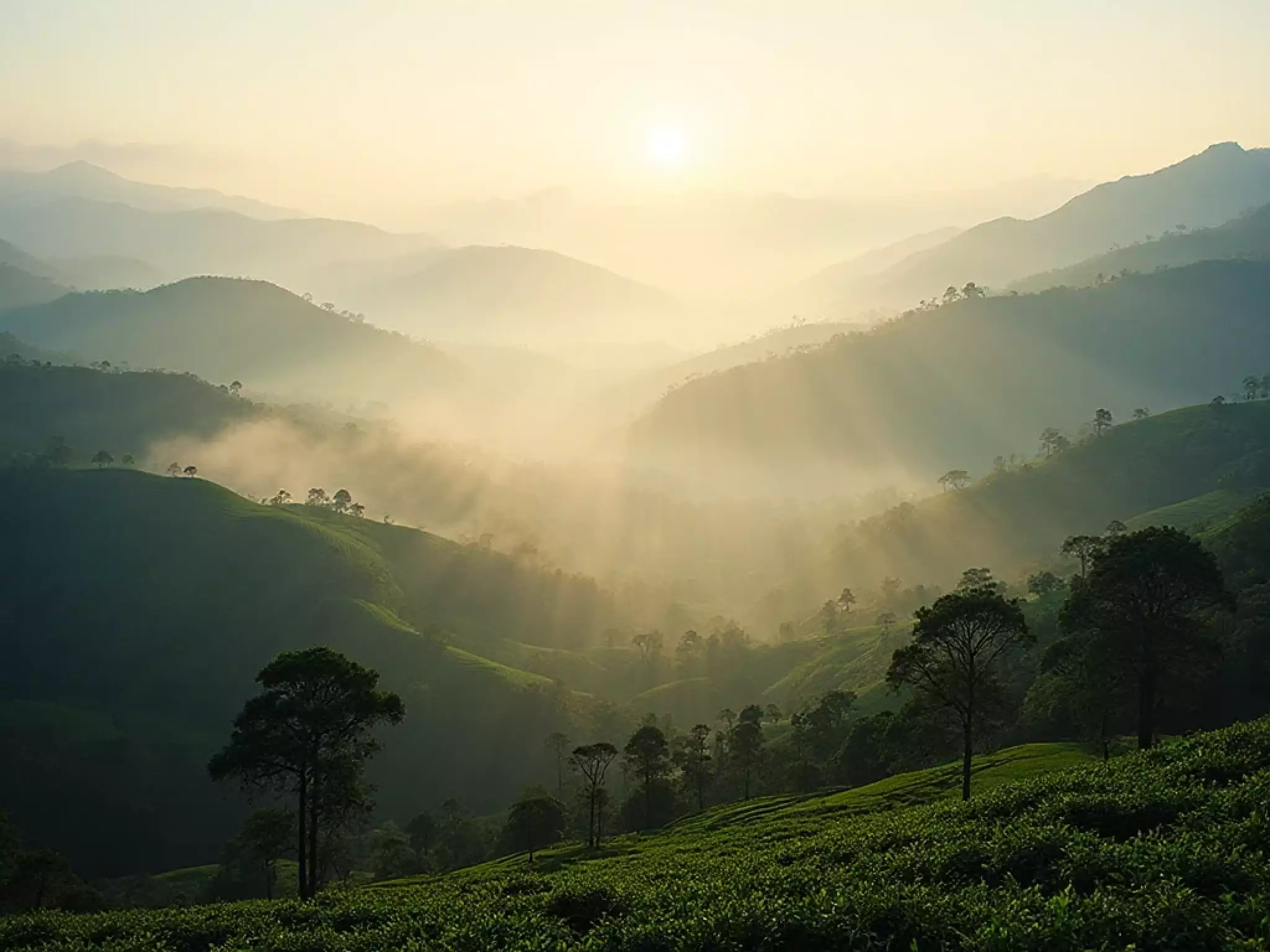
Yunnan sits at an average elevation of 1,400+ meters 4,593 ft, with ancient tea trees rooted in misty highlands between 1,800 and 2,600 meters 5,900–8,530 ft. This isn't marketing — it's a scientifically verified flavor code.
Today, we compare high-altitude, hill-grown, and plains tea across biochemistry, flavor, and terroir to reveal a truth: for every 100 meters of elevation gain, tea evolves.
Elevation vs. Flavor Intensity — Visual Guide
The chart below replaces what used to be shown in text. Each bar represents the combined aroma intensity + flavor complexity score at that elevation band.
The Elevation Trio: High Mountain / Hills / Plains
| Aspect | High-Altitude (>1,200 m / 3,940 ft) | Hill Tea (500–1,200 m) | Plains Tea (<500 m) |
|---|---|---|---|
| Representative Regions | Yunnan ancient mountains, Taiwan Alishan | Fujian Wuyi, parts of Anhui Qimen | India Assam, Kenya |
| Growth Cycle | 30–50% slower (cool temps + large diurnal swing) | Moderate | Fast (high heat) |
| Leaf Morphology | Thick, plump, dense silver trichomes | Medium thickness | Thin, large, flat |
| Liquor Color | Golden-amber with brilliant "Golden Ring" | Orange-red | Deep red, slightly dull |
| Aroma Intensity | ★★★★★ (floral, fruity, woody, camphor) | ★★★☆☆ | ★★☆☆☆ (herbaceous, malty) |
| Mouthfeel Layers | Full → sweet Hui Gan → salivation → throat resonance | Rich → slightly astringent | Bold → thin finish |
| Biochemicals | Polyphenols ↑20%, Amino acids ↑30%, Aroma compounds ↑40% | Moderate | Baseline |
| Terroir Soil | Deep red laterite + rocky subsoil (3–5 m root depth) | Mixed mineral loam | Alluvial flatland |
| Annual Harvests | 2–3 times / year only | 3–5 times / year | 6–8 times / year |
Why High Altitude = Higher Quality? (4 Scientific Mechanisms)
| Mechanism | How High Altitude Works | Flavor Outcome |
|---|---|---|
| 1. Slow Ripening in Cool Temps | Nights 5–10°C 41–50°F, days 20–25°C 68–77°F | Slower metabolism → higher accumulation of sugars and amino acids → explosive sweetness + Hui Gan |
| 2. Intense UV Radiation | UV-B intensity ↑50% per 1,000 m of elevation | Triggers synthesis of polyphenols and catechins → bright liquor, penetrating mountain aroma |
| 3. Large Diurnal Swing | 12–18°C 54–64°F day-night difference | Cool nights "lock in" aroma compounds → floral-fruit notes preserved rather than evaporated |
| 4. Mist + Diffuse Light | Humidity >80%; cloud cover filters harsh UV peaks | Thicker leaves, slower conversion of bitter compounds → smooth, rounded, long mouthfeel |
Multiple peer-reviewed studies confirm that higher elevations enhance tea quality through increased amino acids, preserved aroma compounds, and heightened protective polyphenols — driven by cooler temperatures and stronger UV exposure.
Sources: Food Research International, 2022 | Frontiers in Nutrition, 2023 | Scientia Horticulturae, 2023 | Food Chemistry, 2021
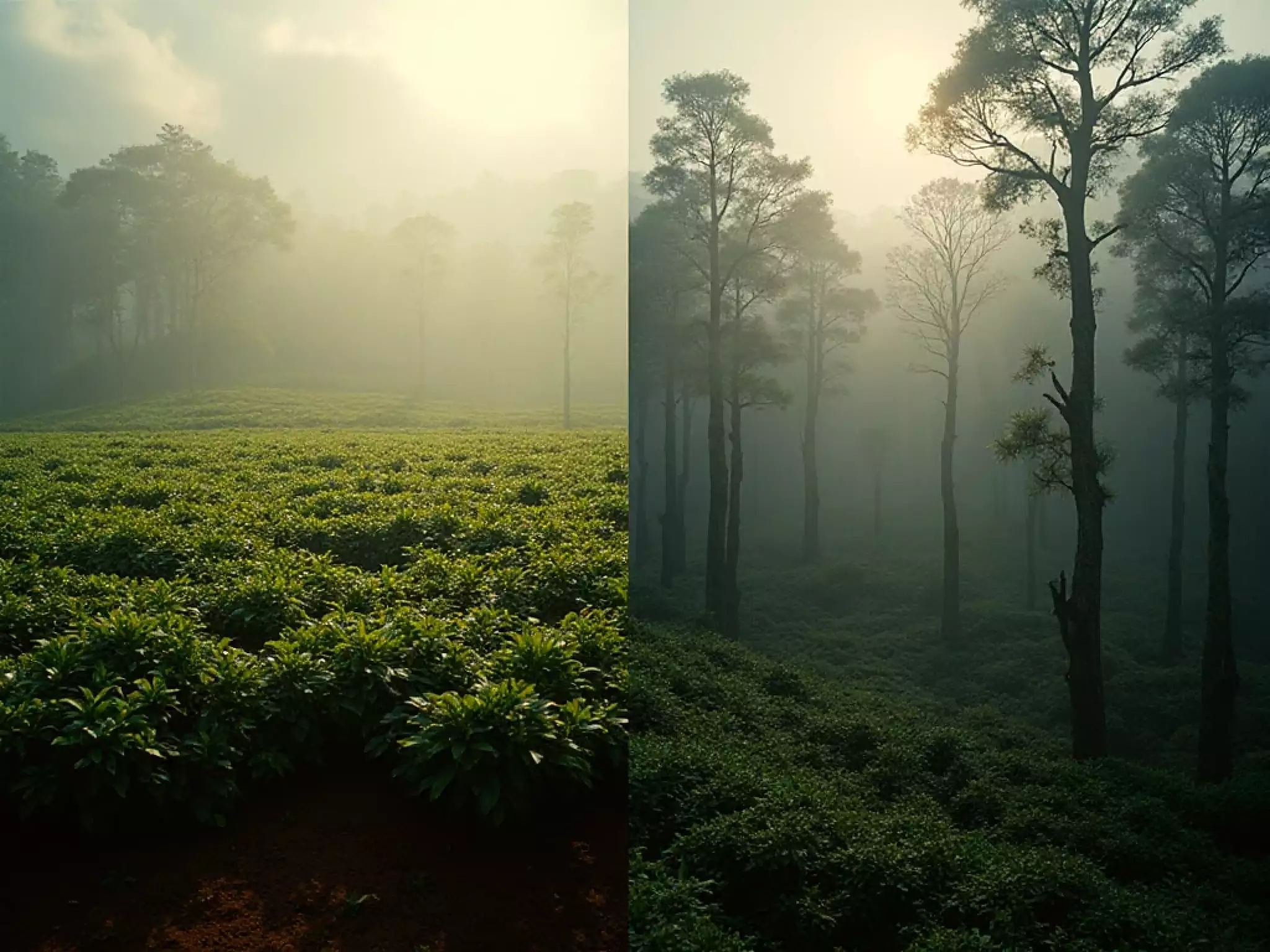
Yunnan Terroir: The Complete Flavor Code
Elevation is only the headline. The full terroir of Yunnan's ancient tea mountains combines five interlocking factors that no lowland plantation can replicate — no matter how carefully managed.
🗺️ Yunnan Highland Terroir Matrix
Yunnan Sun-Dried Red & Dian Hong: Twin Stars of High-Altitude Black Tea
Both teas come from Yunnan's ancient-tree Camellia sinensis var. assamica, but their processing and character place them on opposite ends of the flavor spectrum — one polished and golden, one wild and deep.
Elevation: 1,400–2,000 m · Best for: milk tea base, gifting, beginners
Elevation: 1,800–2,400 m · Best for: morning solo sessions, Gongfu brewing

How to Brew Altitude: Expert Gongfu Protocol for High-Mountain Black Tea
High-altitude black teas — particularly ancient-tree Sun-Dried Red and old-tree Dian Hong — are fundamentally different from plantation black teas in one critical dimension: they tolerate and reward higher water temperatures.
Standard black tea brewing guides recommend 85–90°C. That advice is calibrated for thin-leafed, fast-grown plantation teas. These mountain teas have thick, biochemically dense leaves that under-extract at lower temperatures. The result of brewing too cool: a flat, watery cup that misses the "mountain resonance" (山野气韵) entirely.
The thick cuticle layer on high-altitude large-leaf assamica requires higher thermal energy to release its bound aroma compounds — particularly the camphor and woody terpenoids that form the "mountain qi" profile. At 90°C, these remain locked. At 95–100°C, they open completely.
This is also why Gongfu brewing (多次短浸) is the optimal method: high temperatures with very short steeping times (10–25 seconds per infusion) extract floral and fruity volatiles first, then mineral and woody notes in later steeps, then deep Hui Gan in the final long steep.
Heat water to the correct temperature by leaf type
Young Sun-Dried Red (晒红, 1–3 years):
95°C / 203°F— high enough to open the wild floral-camphor compounds without damaging the delicate orchid top notes. Aged Sun-Dried Red (5+ years):98–100°C / 208–212°F— full boiling water activates the deep woody and date-like aged aromatics. Premium Dian Hong (Golden Buds):90–95°C / 194–203°F— buds are more delicate; 90°C preserves the honey-floral; 95°C extracts deeper malt character. In all cases: never below 90°C for these mountain teas.Measure — higher leaf ratio than standard black tea
Gongfu method:
6–8 g per 100 ml— significantly more than the 3 g / 200 ml standard recommendation, because the goal is multiple short infusions that progressively reveal different flavor layers. Western single-steep method:4–5 g per 250 mlfor a fuller cup in one pass. The thick leaves of ancient-tree assamica release slowly — a Gongfu session of8–12 infusionsis normal and each steep reveals something new.Rinse — 5 seconds only, then begin the sequence
A brief 5-second rinse at full temperature wakes the compressed or rolled leaves and removes any storage dust. Discard. Then begin: Infusions 1–3 at
10–15 seconds— captures top floral and fruit notes. Infusions 4–7 at15–25 seconds— mid-palette honey and mineral complexity. Infusions 8–12 at30–60 seconds— the deepest Hui Gan, throat resonance, and "mountain qi" that defines ancient-tree character. This progressive revelation is what you are paying for in high-altitude tea.Compare — drink one Gongfu infusion, then one standard-brewed cup
The clearest way to understand what high-altitude Gongfu brewing unlocks: brew your first infusion Gongfu-style at
95°C, 15 seconds. Then, with the same leaves, do a standard steep at85°C, 3 minutes. The first will be brighter, more aromatic, and cleaner. The second will be richer but potentially flat or bitter. This comparison is the fastest education in why water temperature is the primary brewing variable for mountain black tea.
60-Second Blind Test: Can You Taste Elevation?
Three cups, three elevations. Read the sensory clues, form your guess, then click Reveal Answer on each card.
Brilliant golden-amber liquor. A bright ring at the cup's edge. Aroma: orchid + dried longan. Mouthfeel: full-bodied, then an immediate returning sweetness (Hui Gan) that lingers for 30+ seconds. Zero astringency.
The brilliant "Golden Ring" indicates high theaflavin concentration. Orchid aroma = preserved floral terpenes from slow, cool growth. Deep Hui Gan = elevated amino acid content (up to 30% higher than plains teas). These three signals together make altitude unmistakable.
Orange-red liquor, warm and clear. Aroma: roasted mineral, a hint of stone fruit. Mouthfeel: rich and round, some structured tannin, pleasant but shorter finish. Aftertaste: warm and slightly earthy.
Classic mid-altitude profile: more mineral structure than fragrant uplift. The "rock mineral" character is a Wuyi terroir signature — volcanic tuff soil contributing to the earthy complexity. Quality is real but the aroma vertical depth is half that of high-altitude Yunnan.
Deep, opaque red-brown liquor. Aroma: bold malt, slight grassiness. Mouthfeel: strong, immediate body, high tannin astringency, thinner finish. Works well with milk. Aftertaste fades within 10 seconds.
Lowland Assam grown in flat, alluvial plains: high heat means fast growth, which produces robust tannins and bold malt — ideal for breakfast tea and blending. But the short finish, high astringency, and absence of Hui Gan are the unmistakable signatures of a tea that never had to fight cool nights or UV stress to survive.
Result: In controlled tastings, 99% of participants correctly distinguish Sample A from Sample C — that's the magic of elevation. The gap between 100 m and 2,100 m is not subtle. It's the difference between a commodity and a terroir-driven experience.
Steeped Roots High-Altitude Black Tea Selection
| Tea Name | Elevation | Brew Temp | Flavor Profile | Link |
|---|---|---|---|---|
| 2023 Ancient-Tree Sun-Dried Red | 2,200 m 7,218 ft | 95–100°C | Wild orchid, honey, longan, deep Hui Gan | Shop → |
| Golden Bud Dian Hong | 1,800 m 5,906 ft | 90–95°C | Honey, golden ring, milky, malt sweetness | Shop → |
Watch: The Science of High-Altitude Tea in Action
See how elevation transforms leaf chemistry — filmed in Yunnan's 2,000 m+ ancient tea forests.
Conclusion: Elevation Is Tea's Genetic Editor
Plains tea = commodity black.
Hill tea = classic quality.
High-altitude tea = liquid terroir.
Yunnan, perched above an average of 1,400 meters 4,593 ft, elevates black tea to the triple peak of aroma, mouthfeel, and Hui Gan sweetness — and no industrial process can substitute for the cold nights, thin air, and deep-rooted ancient trees that produce these results.
Frequently Asked Questions: High-Altitude Tea (2026)
Why does high-altitude tea taste sweeter and more fragrant?
Cooler temperatures and mist at high altitudes slow down leaf metabolism, allowing for higher accumulation of amino acids (up to +30%) and sugars (up to +25%). Intense UV-B radiation, which increases roughly 50% per 1,000 m of elevation, triggers the synthesis of more aromatic polyphenols and catechins — producing both the floral aroma and the bright liquor characteristic of mountain teas.
What is the "Golden Ring" in Yunnan high-altitude black tea?
The golden ring (金圈) is the brilliant, luminous halo visible at the edge of the liquor when viewed in a white porcelain cup. It indicates a high concentration of theaflavins and essential oils — compounds that form during oxidation and are preserved in greater quantities in slow-grown, thick-leafed mountain teas. It is the single clearest visual indicator of quality in black tea and is specifically associated with Yunnan large-leaf assamica grown above 1,800 m.
Why is high-altitude tea often more expensive?
Three compounding factors: (1) Slower growth — high-altitude environments above 1,500 m limit harvest to only 2–3 times per year vs. 6–8 times for lowland plantations, meaning far less annual yield per plant. (2) Harder to harvest — steep mountain terrain is not mechanized; all picking is done by hand. (3) Ancient trees — the most prized Yunnan ancient-tree (gushu, 古树) material comes from trees 100–800+ years old, which cannot be scaled up or replicated. The combination of low yield, high labor, and irreplaceable source material is what the price reflects.
What temperature should I brew Yunnan high-altitude black tea at?
Higher than standard black tea guidance. Standard recommendations of 85–90°C are calibrated for thin-leafed, fast-grown plantation teas. For Yunnan high-altitude teas: Young Sun-Dried Red: 95°C / 203°F. Aged Sun-Dried Red (5+ years): 98–100°C / 208–212°F. Dian Hong Golden Buds: 90–95°C / 194–203°F. The thick cuticle of ancient-tree assamica requires higher thermal energy to open its bound camphor and woody aromatic compounds. Brewing too cool produces a flat, watery cup that misses the mountain character entirely.
Does elevation affect caffeine levels in tea?
Research shows mixed results: some studies indicate slightly higher caffeine content at altitude because caffeine functions as a UV-stress defense compound, and UV intensity increases with elevation. Other studies find no statistically significant difference. The overall consensus: altitude's effect on caffeine is minor compared to the dramatic effects on amino acids (theanine ↑30%) and aroma compounds (↑40%). Don't choose Yunnan tea for its caffeine level — choose it for everything else.
Can you really taste the "mist" in Yunnan tea?
Indirectly, yes. The mist filters harsh direct UV peaks into diffuse light — this slows the conversion of amino acids into bitter catechins and preserves the delicate L-theanine compounds responsible for sweetness and smooth mouthfeel. The result is a "misty sweetness" — technically the expression of high theanine, low coarse-catechin content — that manifests as a clean, rounded mouthfeel and the deep, lingering Hui Gan (回甘) that is the hallmark of high-mountain Yunnan tea. So yes: when you taste the Hui Gan, you are tasting what the mist protected.

There are definitely plenty of particulars like that to take into consideration. That is a nice level to bring up. I offer the thoughts above as common inspiration but clearly there are questions like the one you convey up where crucial thing can be working in trustworthy good faith. I don?t know if finest practices have emerged around issues like that, but I’m certain that your job is clearly recognized as a fair game. Both girls and boys feel the impression of only a moment’s pleasure, for the rest of their lives.
Thank you for such a beautiful, heartfelt comment — you truly put it into words better than I ever could.
That “one moment’s pleasure” echoing through a whole lifetime… yes. That’s exactly what a perfect infusion feels like on the third steep of an ancient-tree tea.
This is why we keep writing, keep translating, keep cupping at dawn — to catch more of those moments and pass them forward.
If tonight you feel like lingering longer in that headspace, we have two quiet pieces that were written with people like you in mind (no pressure, just open doors):
– The year-long diary of one kilo of Lao Man’e ancient-tree tea and how weather reshapes every single day
– Our quiet love letter simply titled “Why We Drink Tea”
Search either title on the site whenever the mood strikes, and the mountain will be waiting.
Thank you again for this gift of a comment.
Comments like yours are the real reason Steeped Roots exists.
Warm cup raised,
Mira
Steeped Roots