
Brewing Tea by the Hearth: A Practical Guide to Fire, Clay, and Winter Gathering
Not About Temperature — But About Fire States
围炉煮茶:读火,而非读温度
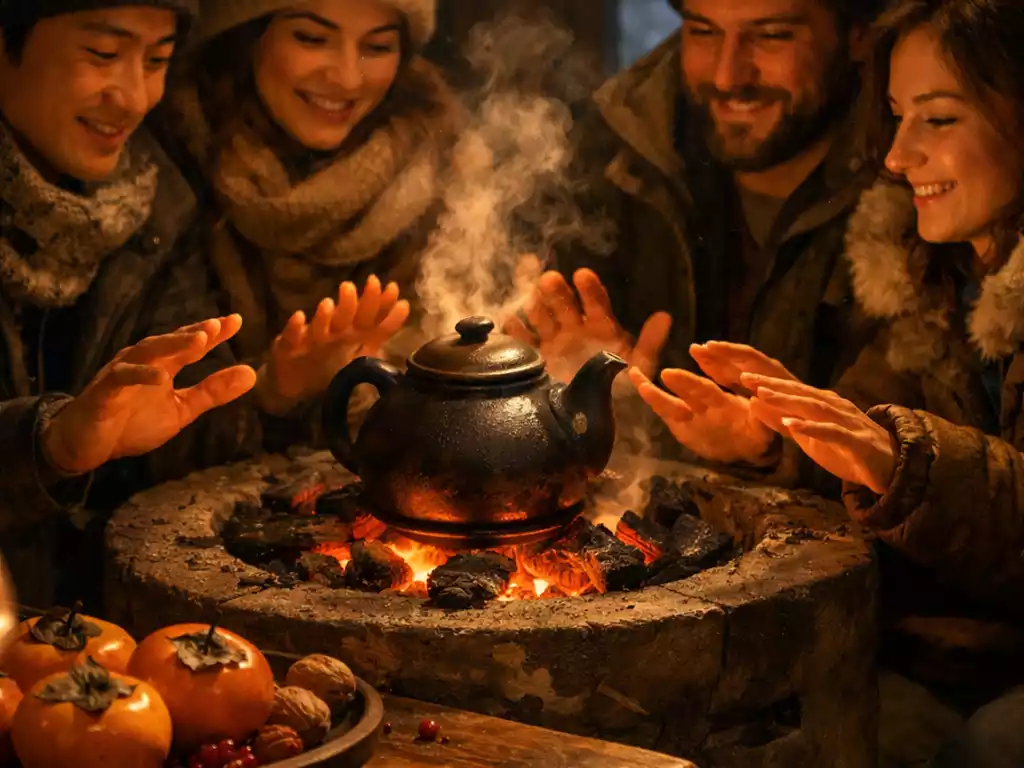
Modern tea brewing obsesses over precision: 95°C for green tea, 100°C for black tea, exactly 3 minutes for the first steep. But traditional charcoal brewing—Wei Lu Zhu Cha (围炉煮茶)—never looked at a thermometer.
In the slow winter ritual of brewing tea by the hearth, you learn a different language. Not degrees Celsius, but the sound of water. Not timer beeps, but the color of flames. Not rigid rules, but responsive observation.
You watch:
- The sound water makes as it heats
- The size and speed of rising bubbles
- The glow and intensity of the charcoal
- The condensation patterns on the pot's exterior
Charcoal brewing is about reading the water, not measuring it.
This isn't vague mysticism. It's a highly practical skill developed over centuries. Before thermometers, Chinese tea masters knew exactly when water reached different stages—not through numbers, but through sensory cues that anyone can learn.
And in our fast-paced, screen-filled lives, this ancient practice offers something profound: an excuse to slow down, to gather close around warmth, and to let time unfold at its natural pace.
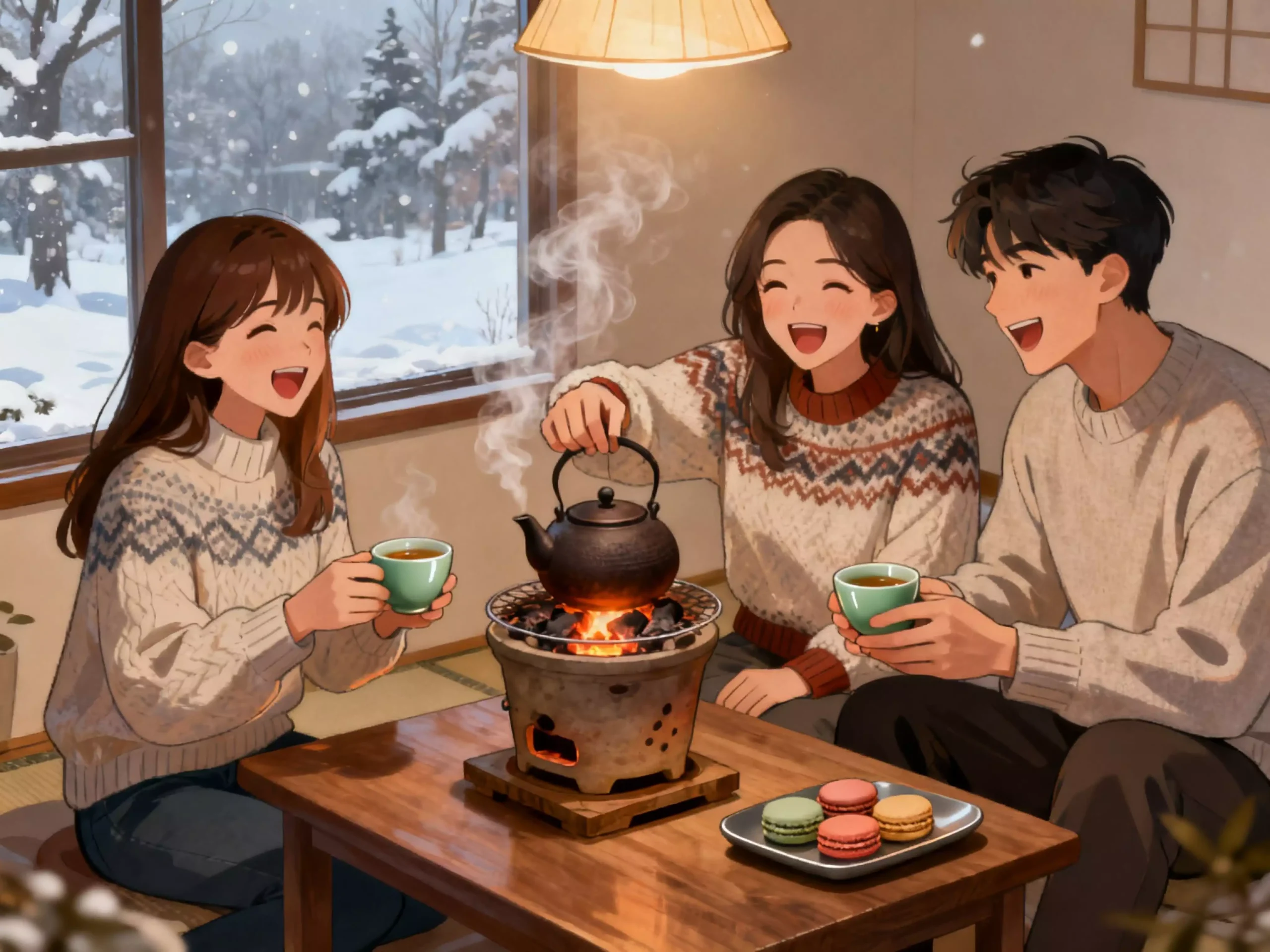
As winter's chill settles in, there's no better setting for meaningful connection than a small circle of friends, hands outstretched toward glowing embers, sharing stories while tea simmers slowly in a clay pot.
Why Charcoal? The Physics of Fire and Flavor
You might wonder: why not just use an electric kettle or gas stove? They're faster, cleaner, more controllable.
The answer lies in infrared radiant heat.
Charcoal burns at around 700-800°C at its core, emitting long-wave infrared radiation. This type of heat:
- Penetrates gradually through clay walls, warming water from all sides simultaneously
- Interacts with ceramic in ways that subtly change water's molecular structure—making it feel softer, rounder
- Creates living heat that breathes with the charcoal, rather than the mechanical on-off of electric elements
- Maintains stable warmth without the sharp temperature spikes of gas flames
The Science Behind "Softer Water"
Studies on infrared heating suggest that long-wave radiation can affect hydrogen bonding in water molecules, potentially creating smaller water clusters. While the scientific community debates the magnitude of this effect, traditional tea culture has long recognized that charcoal-heated water tastes distinctly different—smoother, with less harsh mineral flavor.
Beyond chemistry, there's simple thermal physics: gradual, even heating prevents the "cooked" taste that can come from aggressive boiling.
But perhaps most importantly, charcoal creates atmosphere. The gentle crackle. The warm glow casting shadows on faces. The primal comfort of gathered fire. These aren't incidental—they're central to why hearth tea creates such memorable gatherings.
🔥 The Three Fire States: Reading Water Without Numbers
This is the soul of charcoal brewing. Forget your thermometer. Instead, learn to recognize these three distinct stages:
Stage 1: Silent Heating (静水预热)
Visual Cues:
- Pot walls begin to make very faint clicking sounds
- Water surface remains completely still—no visible bubbles
- Tiny "fish-eye" bubbles cling to the bottom interior (barely visible)
- Steam just beginning to condense on the pot lid
What's Happening: Water temperature approximately 70-85°C. Pot is still absorbing heat; water hasn't begun convection.
Best For:
- Pre-warming your teapot
- Gentle awakening of delicate leaves
- The initial "rinse" if using compressed tea
Stage 2: Pearl Bubbles (鱼眼微滚) ⭐ IDEAL STAGE
Visual Cues:
- Small, pearl-sized bubbles rise steadily from the bottom
- They ascend in a gentle, rhythmic pattern—not chaotic
- Water makes a soft, continuous whisper
- Surface shows gentle undulation but no rolling
- Steam rises in a steady, thin stream
What's Happening: Water temperature approximately 85-95°C. Perfect convection without violence.
Best For:
- This is the golden zone for hearth tea brewing
- Adding your tea leaves
- Long, gentle simmering that keeps tea sweet and smooth
- Extracting depth without harshness
How to Maintain: Adjust fire by moving pot slightly further from the hottest embers, or add a heat diffuser plate underneath.
Stage 3: Rolling Boil (翻滚沸腾) ⚠️ AVOID FOR TEA
Visual Cues:
- Large bubbles breaking surface violently
- Water tumbling and churning
- Loud, aggressive sound
- Heavy steam production
- Water level visibly dropping from evaporation
What's Happening: Water at 100°C+, full boil. Oxygen being driven out rapidly.
Why This Matters:
- Tea becomes rough, astringent, one-dimensional
- Delicate aromatics boil away
- Leaves break apart, releasing tannins aggressively
- Water loses its "life"—traditional tea culture believes over-boiled water is "dead"
Recovery: If you accidentally reach full boil, remove pot from heat entirely. Let it settle 1-2 minutes, then return to a cooler spot over the charcoal.
Practical Exercise: Learn Your Fire
Before your first hearth tea gathering, do this practice run:
- Set up your charcoal and pot with just water (no tea)
- Watch and listen as it heats from cold to boiling
- Note exactly when you hear the first sounds, see the first bubbles, observe the rolling boil
- Practice moving the pot to different positions and observing how quickly the water state responds
This 20-minute investment will make you confident when guests arrive.
🫖 Choosing Your Vessel: Clay, Iron, or Glass
The vessel isn't just a container—it's an active participant in the brewing process. Here's how different materials behave over charcoal:
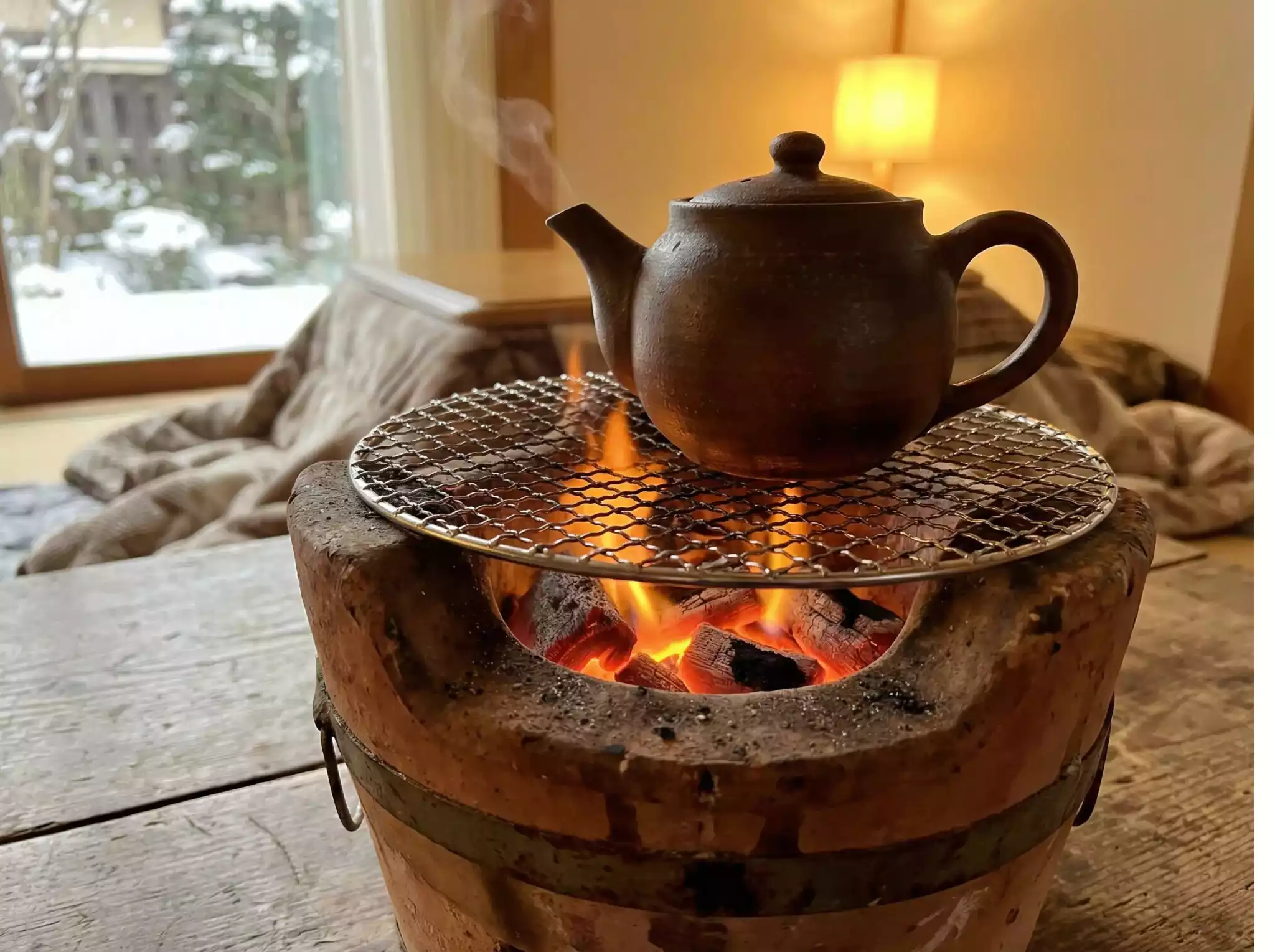
Traditional Clay Pot (陶壶) — Recommended ⭐
Characteristics:
- Slow heat conductor — warms gradually, cools gradually
- Heat retention: Excellent—stays warm for 15-20 minutes off fire
- Water state transitions: Smooth and forgiving
- Flavor impact: Rounds out harsh edges, adds subtle earthiness
Why It's Ideal: Clay pots embody the spirit of hearth brewing. Their thick walls buffer against rapid temperature changes, giving you a wide margin for error. The porous nature of unglazed clay allows minimal gas exchange, subtly mellowing the tea.
Best For: Ripe Pu-erh, aged white tea, Yunnan black tea
Cast Iron Kettle (铁壶)
Characteristics:
- Excellent heat conductor — heats quickly, responds fast
- Heat retention: Superior—stays warm for 30+ minutes
- Water state transitions: Rapid—requires attention
- Flavor impact: Adds mineral depth and weight to water
Why It's Different: Iron leaches trace amounts into water (beneficial iron oxide), giving it a heavier mouthfeel. The quick heat response means you need to be more attentive to fire management.
Best For: Aged ripe Pu-erh, shou mei white tea—teas that benefit from fuller body
Glass Pot
Characteristics:
- Visual transparency — see bubble size and tea color clearly
- Heat retention: Poor—cools quickly once removed from fire
- Flavor impact: Neutral—doesn't add or subtract anything
Why Use It: Excellent for learning and teaching. You can see exactly when pearl bubbles begin, watch tea leaves unfurl, observe color development. The visual feedback accelerates your learning curve.
Limitation: Atmosphere suffers. Glass lacks the rustic, elemental feeling of clay or iron. Fine for practice; less ideal for gatherings.
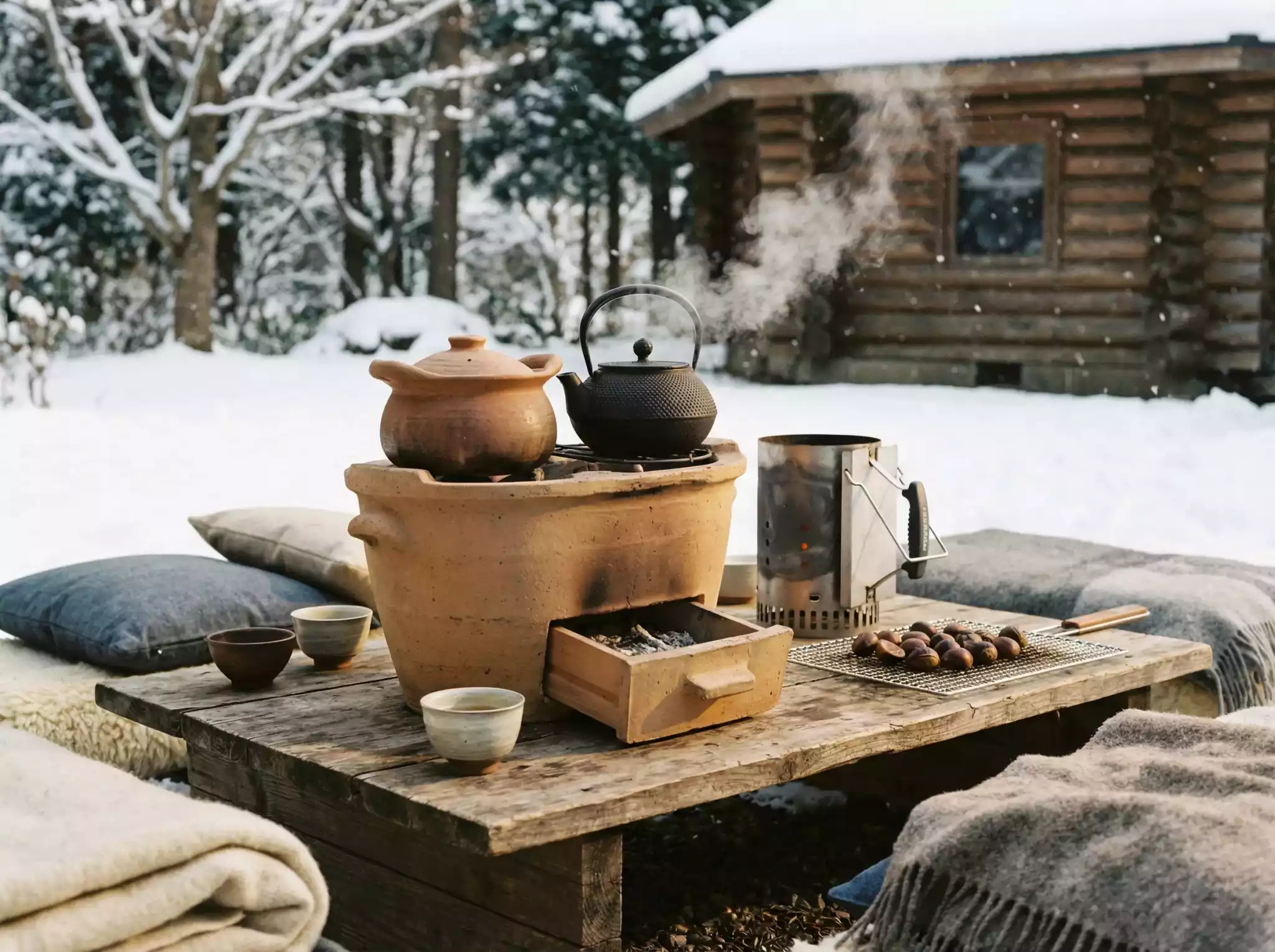
🛠️ Complete Setup Guide: Three Tiers
Choose the level that matches your situation and commitment:
🪵 Basic Tier: Beginner-Friendly Indoor Setup
Investment: $80-150 | Setup Time: 15 minutes | Best For: First-timers, apartment dwellers
Essential Gear:
- Small tabletop charcoal stove (10-12" diameter) — Available on Amazon →
- Smokeless hardwood charcoal (coconut shell or white oak) — 2-3 lbs bag
- Clay teapot (800ml/27oz capacity) — unglazed preferred
- Ripe Pu-erh or Yunnan black tea — 50-100g to start
- Bamboo tea tongs — for handling hot pot
- Heat-resistant mat — protect your table surface
- Ventilation: Open window or use near doorway
Safety Notes: Smokeless charcoal produces much less smoke but still emits carbon monoxide. Adequate ventilation is non-negotiable. Never use in a sealed room.
🔥 Intermediate Tier: Traditional Immersive Experience
Investment: $200-400 | Setup Time: 30 minutes | Best For: Outdoor use, dedicated tea enthusiasts
Full Gear:
- Traditional clay charcoal stove with ash drawer (14-16" diameter)
- Handmade clay pot (1000ml+) from Jianshui or Yixing
- Cast iron kettle (backup for boiling water)
- Charcoal chimney starter — for safe ignition
- Long bamboo tongs & fire poker
- Charcoal ash bucket with lid
- Wire grilling rack — for roasting chestnuts, persimmons, sweet potatoes
- Low wooden tea table (optional but enhances experience)
Tea Selection: Invest in 200-357g cakes of aged ripe Pu-erh (5+ years) or premium Yunnan sun-dried black tea (shai hong)
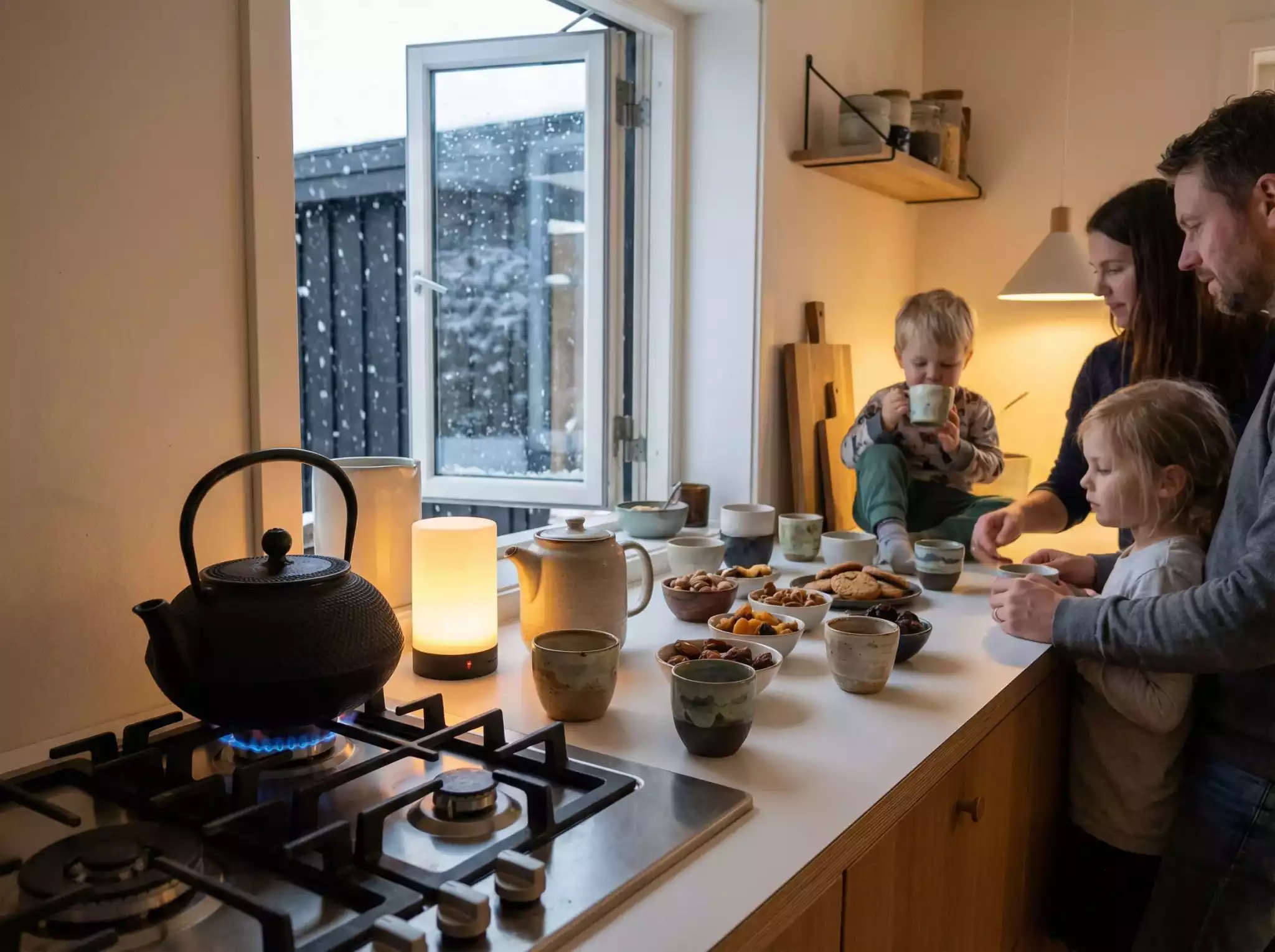
🏡 Modern Hybrid: Safety-First Indoor Version
Investment: $120-250 | Setup Time: 10 minutes | Best For: Families, strict indoor use, maximum safety
Modified Setup:
- High-quality gas burner with simmer setting OR infrared ceramic heater
- Cast iron kettle (better heat retention compensates for gas)
- Thick ceramic pot (2-3mm wall thickness minimum)
- Faux charcoal ambiance light — LED flame effect for atmosphere (surprisingly effective!)
- Open window for air circulation
Honest Assessment: You lose the authentic charcoal aroma and the radiant heat quality. BUT you gain safety, convenience, and year-round usability. The ritual and gathering aspect remains fully intact. For many modern households, this is the most practical choice.
🌿 Tea Selection Logic: Fire-Friendly vs. Fire-Vulnerable
Not all teas tolerate long exposure to heat. Here's how to choose based on fire resistance, not just flavor preference:
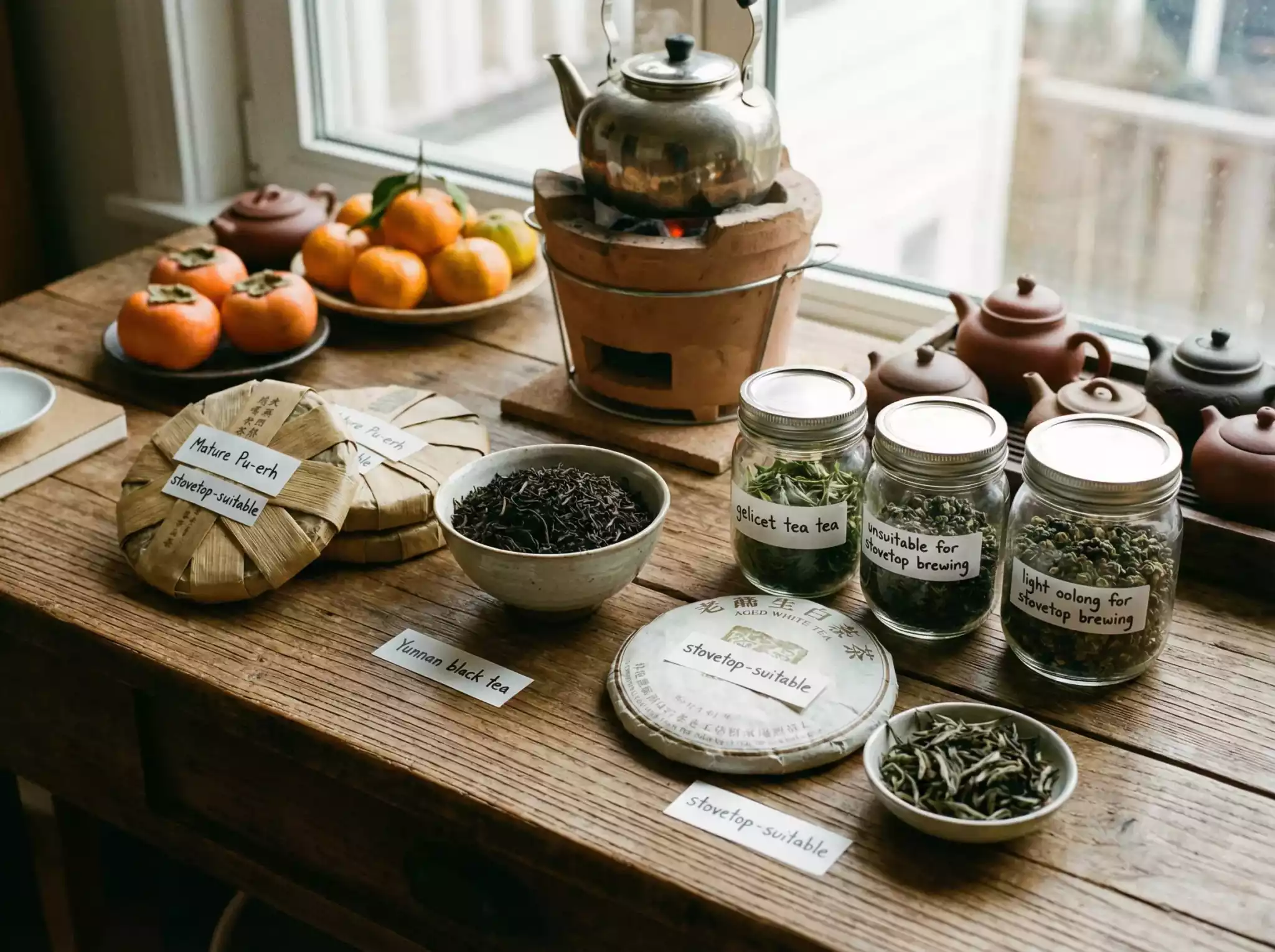
| Tea Category | Fire Suitability | Why It Works (or Doesn't) | Optimal Simmer Time |
|---|---|---|---|
| Ripe Pu-erh (Shou) | ✔ Excellent | Thick leaves, full fermentation. Sweetness deepens with heat; bitterness stays minimal. | 8-15 minutes |
| Yunnan Black (Shai Hong) | ✔ Excellent | Sun-dried processing creates heat-stable leaves. Malty sweetness amplifies under gentle simmer. | 6-12 minutes |
| Aged White Tea (3+ years) | ✔ Excellent | Aging softens leaf structure. Develops medicinal, honey-like depth when simmered. | 10-18 minutes |
| Raw Pu-erh (Sheng) | ⚠ Requires Control | Young sheng turns astringent quickly. Aged sheng (10+ years) works better. Keep to pearl stage only. | 5-8 minutes max |
| High-Roast Oolong | ⚠ Requires Control | Already roasted—additional heat can turn flavors ashy. Use light fire, short duration. | 4-7 minutes |
| Green Tea | ❌ Not Suitable | Thin leaves, no fermentation. Turns bitter and flat almost instantly under prolonged heat. | — |
| Light Oolong | ❌ Not Suitable | Delicate floral aromatics volatilize (evaporate) rapidly. Fire destroys subtlety. | — |
The Golden Rule
Choose teas with: Thick leaf structure + High fermentation/oxidation level + Age
These three factors create "fire armor"—the tea can withstand prolonged heat without turning harsh.
🌙 Crafting the Atmosphere: Social Architecture
Hearth tea is not a brewing method. It is social architecture.
The setting matters as much as the tea itself. Here's how to create an environment where time slows and conversation deepens:
Light: The Glow Becomes the Ambiance
- Turn off overhead lights. Let the charcoal's warm glow become your primary light source.
- Add 1-2 warm Edison bulbs or candles around the periphery—just enough to avoid complete darkness.
- The interplay of shadow and flame on faces creates intimacy impossible under fluorescent lights.
Seating: Close, But Not Cramped
- Arrange seating in a loose semicircle around the stove, not a formal circle.
- Distance: Close enough to extend hands toward the fire comfortably (about 3-4 feet from stove).
- Floor cushions or low stools work better than chairs—creates informal, grounded feeling.
- 3-5 people is the sweet spot. More than 6 and the intimate scale breaks.
Table Layout: Functional Aesthetics
On the table/surface:
- Seasonal winter fruits: persimmons, mandarins, pomegranates (both decoration and snacks)
- Roasted chestnuts in a small bowl
- Dried sweet potato slices (can be grilled on the wire rack)
- Small plates for communal snacking
- Minimal teaware—just cups and one serving pitcher. This isn't Gongfu ceremony.
Sound: Let Fire and Silence Guide
- Charcoal crackle should be audible. Don't drown it with music.
- If you must have background sound: instrumental only—Chinese guqin, Japanese shakuhachi, or acoustic guitar.
- Volume: barely perceptible. Conversation should never compete with music.
- Embrace silence. Hearth tea gatherings often include long, comfortable quiet moments. This is a feature, not a bug.
Duration: Let Fire Set the Pace
- A proper hearth tea session lasts 2-3 hours minimum.
- Don't rush. Don't watch the clock.
- The fire dictates timing: when embers fade to white ash, the gathering naturally concludes.
- Plan for 2-3 rounds of tea (refilling water as needed), interspersed with snacking and story-sharing.
The Magic Threshold
About 45 minutes into a hearth tea gathering, something shifts. Initial pleasantries give way to deeper sharing. Phones stay in pockets. The fire's hypnotic quality combined with shared warmth creates psychological safety.
This is when the real conversations begin.
This is why we gather around fire.
☕ Step-by-Step: Your First Hearth Tea Session
Timing: Allow 15-20 minutes for charcoal preparation before guests arrive.
Preparation Phase
- Ignite charcoal using a chimney starter or fire starter cubes. Never use lighter fluid (leaves chemical taste). Wait until coals glow red with a light ash coating and minimal smoke production.
- Arrange hot coals in your stove, leaving space in the center for air circulation.
- Set out teaware, snacks, and cups within easy reach.
- Fill your pot with fresh, cold water (filtered if possible).
Brewing Phase
- Place empty pot over charcoal for 2-3 minutes to pre-warm.
Watch for: Very faint ticking sounds as clay expands. - Add water and begin heating.
Listen for: The progression from silent to whisper to soft bubbling. - When you reach the Pearl Stage (small steady bubbles), add your tea.
Amount: 6-8 grams per 700-800ml water (slightly more than standard brewing).
Method: Add leaves directly—no need for a rinse if using quality aged tea. - Maintain Pearl Stage by adjusting pot position.
Too hot? Move pot to cooler edge of stove.
Too cool? Slide toward the hottest center spot. - Simmer for your target duration:
• Ripe Pu-erh: 10-12 minutes
• Shai Hong: 6-8 minutes
• Aged White: 12-15 minutes - Pour into a sharing pitcher, then serve in small cups.
Taste together. Discuss. Adjust if needed. - Refill water for second round. Same leaves can typically yield 2-3 rounds of brewing, with each round lasting 8-12 minutes.
Optional: Winter Milk Tea Fusion
For a modern twist that works beautifully over charcoal:
- Use Yunnan black tea as your base (8-10g for 800ml)
- Simmer for 8-10 minutes until deep amber
- Add 200ml warm whole milk
- Stir in 1-2 tablespoons brown sugar or honey
- Optional: cinnamon stick, dried orange peel, or star anise
The charcoal's gentle heat caramelizes the sugars beautifully, creating a drink that rivals any coffee shop creation.
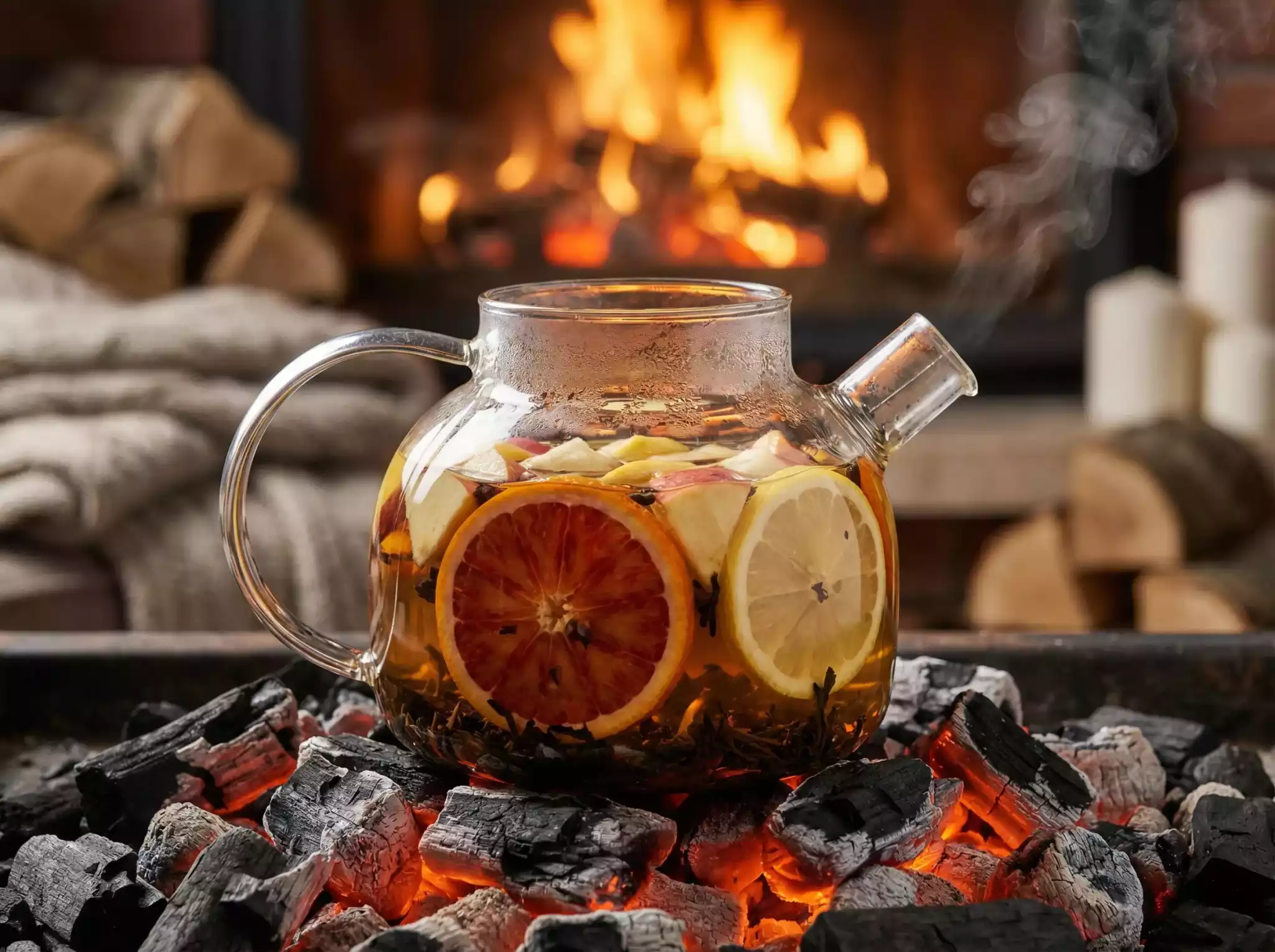
Author Adrian's Personal Tip: Family-Friendly Fruit Tea Variation
If your hearth gathering includes women or children, I highly recommend trying a simple fruit tea — it's gentle, naturally sweet, low in caffeine, and appeals to all ages without becoming bitter even after longer heating.
It's very straightforward to make:
- Use fresh seasonal fruit: oranges, apples, pears, lemons, or citrus varieties — wash and slice thinly or into small chunks (keeping the peel on adds more aroma).
- Place a small amount of black tea in the clay pot (I suggest 3–5g of Yunnan Dianhong or Qimen black tea — keep it light so it doesn't overpower the fruit).
- Add the sliced fruit, fill with water, and place over the charcoal.
- Heat until you reach the pearl bubble stage (small steady bubbles rising), then simmer gently for 5–8 minutes to let the flavors meld beautifully.
- Just before serving or after removing from heat, stir in honey to taste (1–3 tablespoons depending on sweetness preference). Adding honey at the end preserves more of its natural benefits.
The result is a warm, fragrant brew with bright fruit notes and a subtle tea backbone — comforting in winter, easy on the stomach, and loved by kids and adults alike. Many people try it once and it quickly becomes the "must-have" item at family hearth sessions.
— Adrian
Frequently Asked Questions
How do I know if the fire is too strong?
Visual check: If you see large bubbles breaking the surface violently (rolling boil), it's too hot.
Sound check: If water sounds like aggressive boiling (loud, chaotic), it's too hot.
Taste check: If your first cup tastes harsh, one-dimensional, or overly astringent despite using a fire-friendly tea, your water likely boiled too hard.
Fix: Move pot completely off fire for 1-2 minutes. Let water settle back to pearl stage before returning to a cooler position.
What if the charcoal starts dying mid-session?
This is natural and expected. Hardwood charcoal typically burns 45-60 minutes.
Signs: Flames decrease, embers turn white/gray, less heat radiating.
Solutions:
- Add fresh charcoal to the existing bed. Pre-light it separately if possible to avoid smoke.
- Gently stoke with fire poker to expose fresh red embers underneath white ash.
- Accept the natural conclusion. Sometimes a dying fire is the gathering's gentle signal to wind down.
Can I use a gas stove instead of charcoal?
Yes, but understand what you're trading.
What you lose:
- Infrared radiant heat quality (affects water texture)
- The authentic charcoal aroma that permeates the space
- The visual and auditory ambiance of live fire
- The meditative, responsive rhythm of fire management
What you gain:
- Safety (no carbon monoxide concerns)
- Convenience (instant heat, precise control)
- Year-round indoor use
- Predictability (easier for beginners)
For a first-time gatherer or apartment dweller, gas is perfectly acceptable. The ritual and social aspects remain intact. Just know you're experiencing "hearth tea adjacent" rather than the full traditional experience.
How long can one batch of tea last?
With quality aged teas, you can typically refill water 2-3 times:
- First round: Full flavor, 10-12 minutes simmer
- Second round: Slightly lighter but still robust, 8-10 minutes
- Third round: Subtle, mellow, 6-8 minutes
After three rounds (about 90 minutes of total tea time), flavor typically becomes too dilute. This is a good time to switch tea types or conclude the gathering.
Total time from lighting charcoal to final cup: approximately 2.5-3 hours.
What if my tea tastes bitter despite using the right tea type?
Most common causes:
- Water reached rolling boil. Even briefly. Remember: pearl stage only.
- Simmered too long. Even fire-friendly teas have limits. Start with shorter times and extend gradually.
- Tea-to-water ratio too high. Try reducing to 5-6g per 800ml.
- Low-quality tea. Old, improperly stored, or low-grade material won't improve with any technique.
Recovery strategy: If tea is bitter, dilute by adding more hot water. Don't try to "fix" by adjusting fire—damage is done. Learn for next round.
Is hearth tea safe indoors?
With proper ventilation: Yes.
Without ventilation: Absolutely not.
Charcoal produces carbon monoxide (CO), an odorless, deadly gas. You need:
- Open window or door with active airflow
- CO detector in the room (under $20, essential investment)
- Never use charcoal in sealed spaces, basements, or small rooms without windows
If in doubt, use the hybrid setup with gas/electric heat. Safety trumps authenticity every time.
The Spirit of Hearth Tea: Listening Without Numbers
In charcoal brewing, you learn a language older than thermometers. You learn to listen—not to beeps and timers, but to water itself. To watch—not digital displays, but the dance of bubbles and the glow of coals.
This isn't about rejecting precision. It's about relocating precision from instruments to attention.
The fire is controllable. The water is readable. And you—seated close to warmth, hands cradling a cup, surrounded by friends—you are present in a way that's increasingly rare.
In a world of instant everything, brewing tea by the hearth is a quiet rebellion.
It invites us to slow down, to gather close, and to let warmth come from both fire and friendship.
When the embers fade to white ash and the cups are empty, what remains is not only flavor—but memory. The memory of time that moved at its natural pace. Of conversation that went deeper than usual. Of winter's chill held at bay by charcoal's steady glow.
This is the art of brewing by the hearth. Not a technique to master, but an experience to inhabit.
May your winters be warm. May your gatherings be slow. May your tea be simmered with patience.
🍵 Explore More Tea Culture & Brewing
- Complete Guide to Pu-erh Tea: From Ancient Trees to Modern Cups
- Sun, Time, and Leaves: The Secret Life of Shai Hong (Sun-Dried Black Tea)
- What Is Cha Qi? Understanding Tea Energy and Body Sensations
- Mastering the Brew: Tea Brewing Handbook for Beginners
- Pu-erh Tea Taste Guide: From Earthy Notes to 'Fishy' Smells

