
Whole Leaf Tea vs Tea Bags: Why Filter-Free Brewing Is Actually Cleaner
By Adrian Peng · Steeped Roots · 2026 Edition
Loose leaf tea brewing, whole leaf sinking physics, and why the clean-looking cup in the tea bag is the more contaminated one.
The Myth That Keeps People Using Tea Bags
Every week, someone discovers loose leaf tea and immediately raises the same concern. It shows up in comment sections, Reddit threads, and beginner tea forums in almost identical language:
This concern is completely understandable. If your only reference point for loose leaf tea is a bad experience with cheap broken-leaf tea dumped into a mug — or a mental image of fishing soggy leaves off your lips — the instinct is to stick with the tidy, controlled bag.
But here is what those experiences almost always have in common: they involved broken tea, the wrong dose, or no time for the leaves to settle. Not whole leaf tea brewed properly.
Loose leaf tea floats everywhere and ends up in your mouth.
Based on experience with poor-quality broken tea, over-stuffed infusers, or no settling time. Understandable, but not accurate for whole leaf tea.
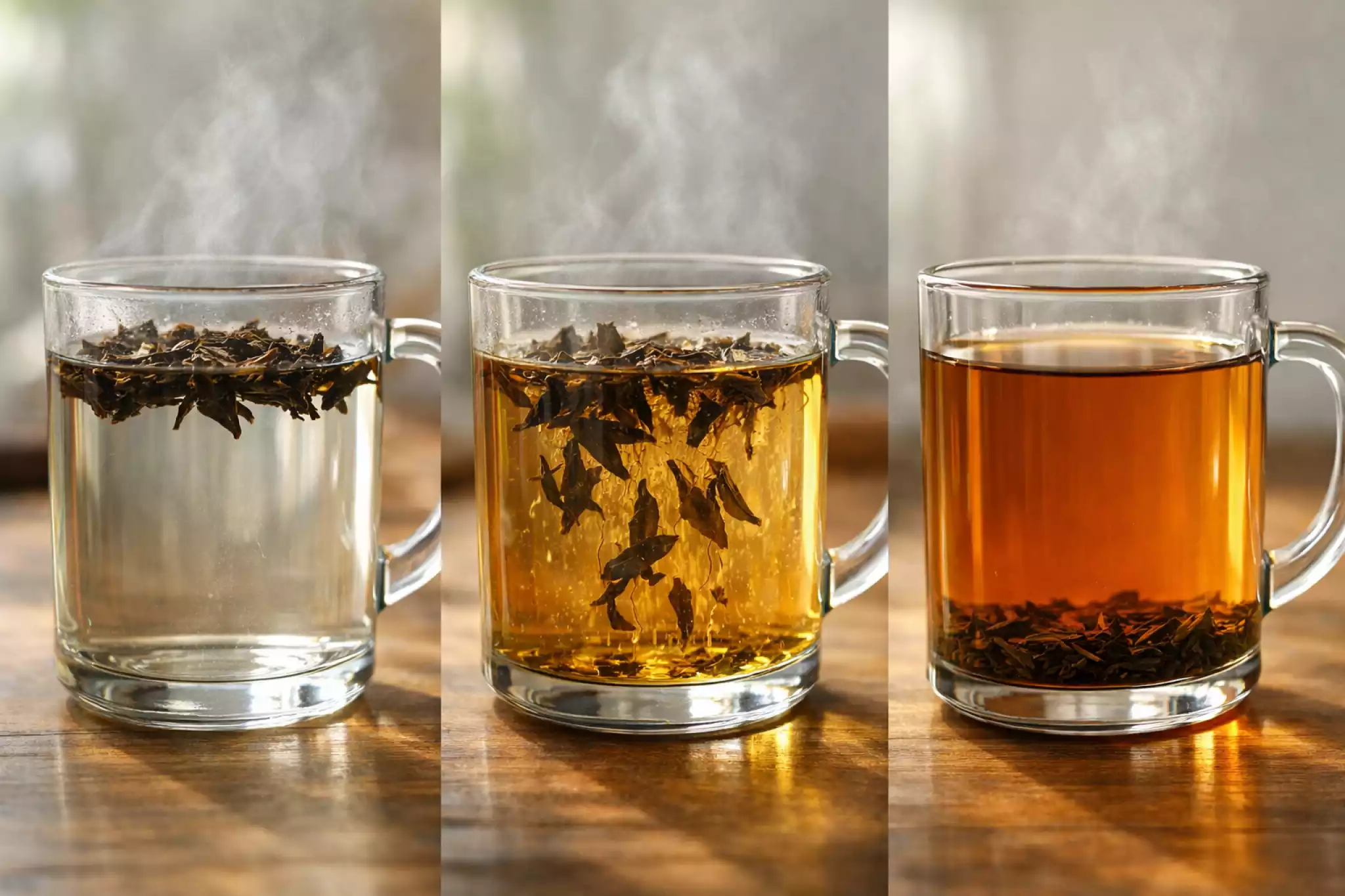
Whole leaf tea rehydrates, becomes denser than water, and sinks.
High-quality large-leaf Yunnan tea, brewed at the right dose with a few seconds of patience, settles into a clean, still layer at the bottom of your cup.
Understanding why this is true — the actual physics of what happens to a dry tea leaf when it contacts hot water — is the most direct way to dissolve the concern permanently.
The Science of Why High-Quality Whole Leaf Tea Sinks (And Tea Bags Float)
This is not about technique or tradition. It is about density, surface area, and the way a dry leaf behaves when it rehydrates. Three distinct mechanisms work together to keep whole leaves at the bottom of your cup.
Rehydration Changes Density
A dry tea leaf is essentially a compressed sponge — low moisture content, low density relative to water. When it contacts hot water, the cells absorb liquid rapidly. This is rehydration: the leaf expands, its cell walls fill, and its density increases past 1.0 g/cm³ — the tipping point at which it becomes heavier than the liquid around it and sinks.
Time to sink: 10–20 seconds for large Yunnan leafLarge Surface Area Stays Below
A fully opened whole tea leaf — particularly the large-leaf assamica varieties used in Yunnan pu-erh — can expand to 3–6 cm in length. That surface area makes it behave more like a fallen leaf in a still pond than a particle in suspension: it lies flat, settles easily, and resists being lifted by gentle currents. It is not sand — it is a soft, broad structure.
Analogy: a wet autumn leaf, not a grain of dustDrinking Motion Draws From Above
When you lift a cup and sip from the rim, you draw liquid from the top third of the cup. The leaves are at the bottom third. Unless you agitate the cup vigorously or tilt it nearly vertical to reach the very last drop, the drinking motion and the leaf position work in opposite directions. Gravity keeps the leaves down; your sip draws from above.
Solution: leave the final 5–10% of liquid in the cupDry Leaf
Low density, compressed, floats on contact with water
10–20 Seconds Later
Rehydration increases density above 1.0 g/cm³ — leaf begins to sink
Settled Cup
Leaf layer at bottom, clear liquor above — drink from the top
"Think of what happens when a large autumn leaf lands on a still pond. It does not submerge instantly, but within moments it is saturated, flat, and settled. The tea leaf is doing the same thing in your cup — at a much smaller scale and a faster pace."
— AdrianThe leaves that cause problems are not the large whole leaves. They are the small, broken fragments — technically called fannings or tea dust — which are so light and small that rehydration does not meaningfully change their behaviour. These are what we will address next.
Proper Brewing Is Already a Natural Filter System
Even with the physics working in your favour, technique creates a cleaner result. Three principles together make filter-free brewing completely controlled:
Leave the Last 5–10% in the Cup
The bottom of the cup is where the leaves concentrate after settling. Do not try to drink every last drop. Stop when the cup is approximately 90% empty and set it down. This single habit eliminates leaf contact on every session. Chinese tea brewing has observed this principle for centuries — controlled pouring is a deliberate part of the technique, not an accident of style.
Use the 2g Golden Ratio — Not More
At 2g of leaf per 250–300ml of water, every leaf has sufficient space to fully expand, hydrate, and settle without competition. When you crowd a mug with 5g or 6g, the leaves have nowhere to go except upward. Crowding creates chaos. The 2g ratio gives each leaf its own "personal space" — and gravity does the rest without any help from you.
Wait 10–20 Seconds Before the First Sip
After pouring, set the cup down and let the rehydration process complete. The initial float of dry leaves becomes a settled layer at the bottom within 20 seconds. This is not a long wait — it is the time it takes to set the kettle down and pick up the cup. Patience here costs nothing and eliminates the concern entirely.
Tea Bag Dust: The Invisible Problem You Are Already Drinking
Here is the part that surprises most people when they learn it: the cup that looks cleaner — the tea bag cup, no visible leaves, clear and contained — is almost certainly delivering more suspended particles into your mouth than a properly brewed whole leaf cup.
The reason is what is inside the bag.
What "Tea Bag Grade" Actually Means
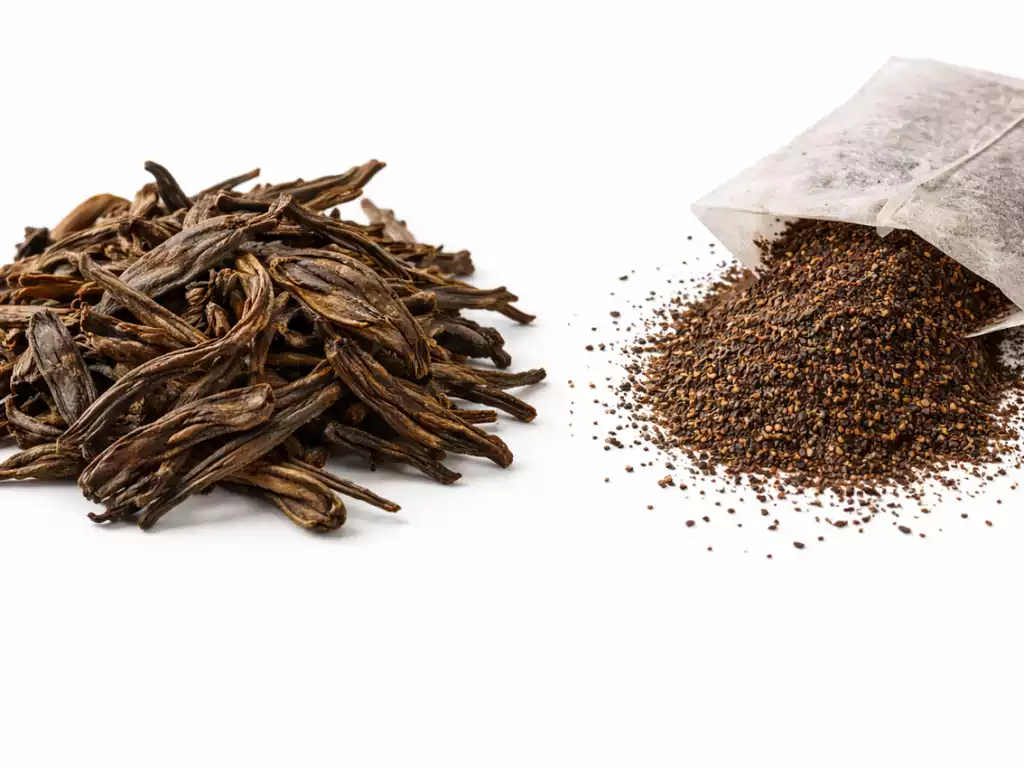
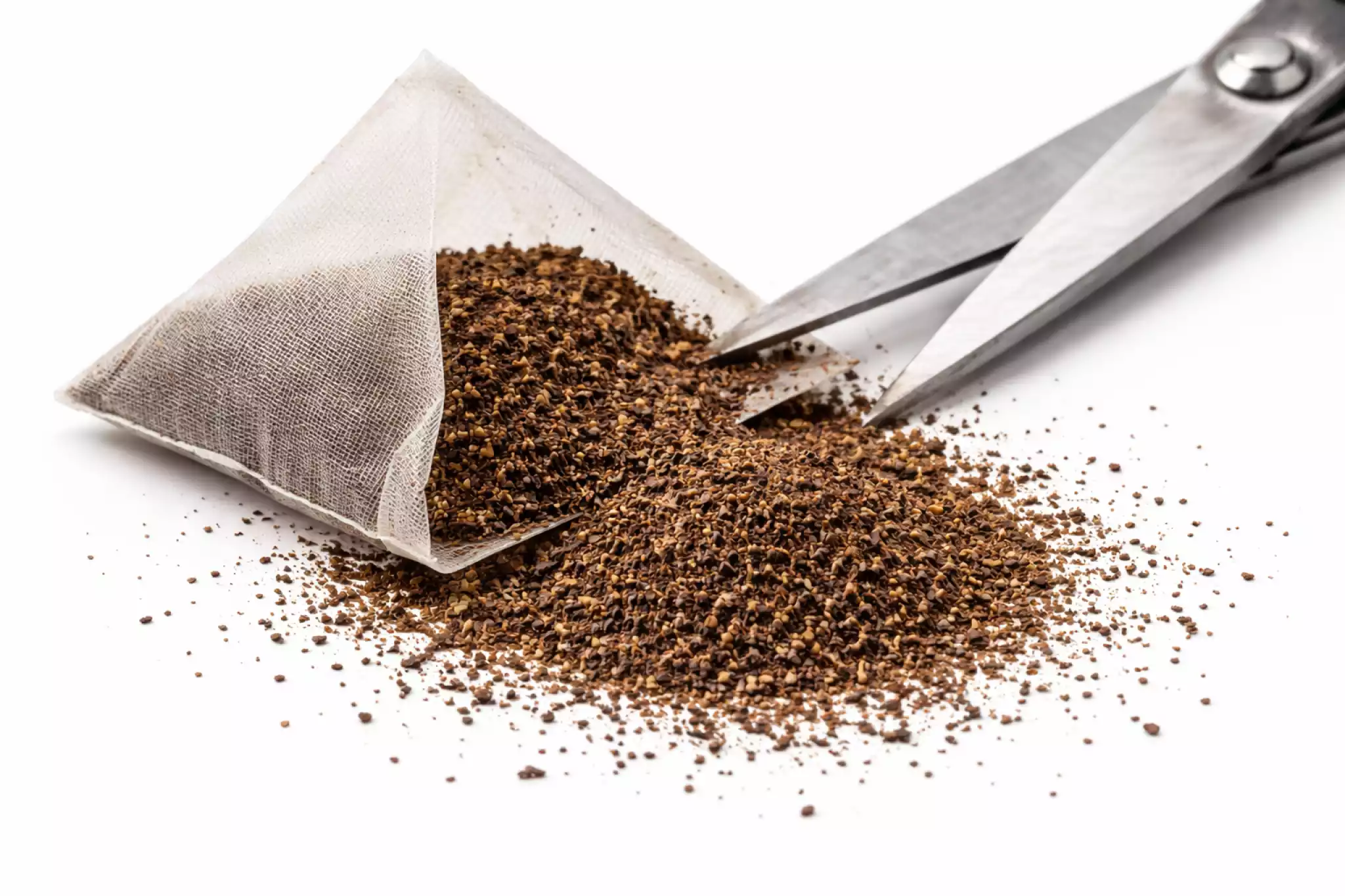
The tea industry grades leaf by size. The highest grades are whole leaves and large broken leaves. The lowest grades are fannings (very small broken particles, approximately 1–1.5mm) and tea dust (sub-1mm powder, the finest fraction produced during processing). These grades are not accidental byproducts. They are specifically produced for tea bags because their extreme surface area allows extraction in 90 seconds — which is the convenience the bag format is built around.
The filtration picture is more nuanced than it first appears. Modern high-quality paper tea bags (effective pore size roughly 20–80 µm) retain most fannings reasonably well under controlled conditions. However, many widely-used woven nylon and polypropylene pyramid bags have considerably larger mesh openings — typically 150–250 µm on average — which allows the finest tea dust particles to pass into the brew. Cheap filter-paper bags at the bottom of the market perform similarly poorly. The result, in practical terms: lower-quality or woven-mesh bags routinely allow some fraction of the very finest tea particles to enter the cup, invisibly, with every steep. You cannot see them or taste them individually — but they are there.
Even in the best-performing paper bags, the leaves inside are still fannings-grade material: ultra-high-surface-area particles optimised for speed, not flavour depth or clean suspension. They begin to disperse the moment hot water enters the bag, and whatever the mesh does not catch becomes part of your drink.
| Characteristic | Whole Leaf Tea | Tea Bag (Fannings / Dust) |
|---|---|---|
| Leaf grade | Whole or large broken leaf | Fannings (1–1.5mm) or dust (<1mm) |
| Particle size | 3–60mm when rehydrated — visibly large | Sub-millimetre — invisible to the naked eye |
| Behavior in water | Rehydrates, becomes dense, sinks | Floats in suspension; escapes through bag mesh |
| Particles consumed per cup | Near zero with correct technique — leaves are visible and manageable | Variable by bag type: woven nylon pyramid bags (avg. mesh ~150–250 µm) pass more fine dust than quality paper bags (effective pore ~20–80 µm); even the latter may release some ultra-fine particles under brewing conditions (Foods 2022 — tea bag filtration analysis) |
| Flavour complexity | Full spectrum — aromatic compounds intact | One-dimensional — surface area maximised for speed, not depth |
| Visible mess? | Yes — leaves are visible at the bottom | No — particles are invisible |
"The cleaner-looking cup is not the cleaner cup. One shows you exactly where the leaf is. The other hides what you are drinking."
— Adrian, on fannings vs whole leafWhole leaf tea is transparent about itself. You can see the leaves, watch them settle, and choose when to stop drinking. Tea bag particles are invisible — which creates a perception of cleanliness while the actual contents of the cup are less controlled than they appear.
The Bigger Problem: Microplastics Released by Plastic Tea Bags
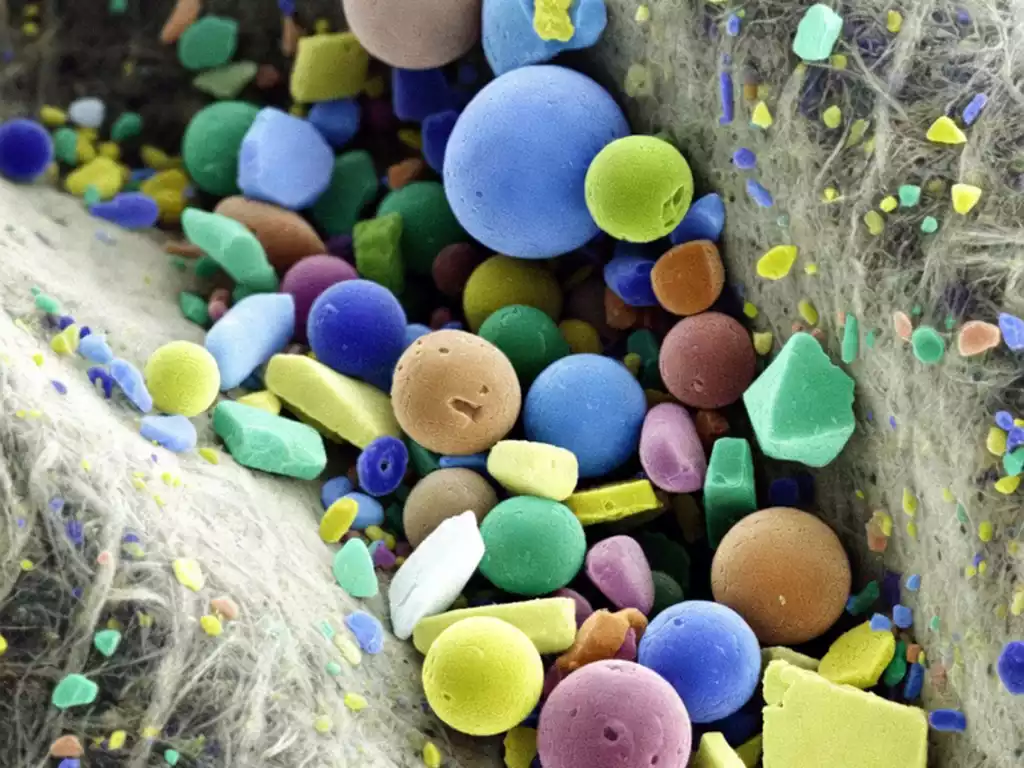
Beyond fannings and tea dust, a growing body of peer-reviewed research has identified a more significant contamination concern for a specific category of tea bag: those made from plastic-based materials — nylon-6, polypropylene (PP), polyethylene terephthalate (PET), and even certain "biodegradable" polylactic acid (PLA) bags marketed as eco-friendly.
What the Research Shows
A widely-cited 2019 study from McGill University (Hernandez et al., published in Environmental Science & Technology) found that steeping a single plastic tea bag at 95°C released approximately 11.6 billion microplastic and 3.1 billion nanoplastic particles per cup — orders of magnitude higher than most other food sources studied at the time. Particle sizes ranged from roughly 100 nm to over 1 mm. Importantly, the study used PET and nylon bag materials specifically; results differ by bag polymer, and cellulose paper bags were not tested in this protocol. The full study is available open-access at ACS Publications.
A 2024 study published in Chemosphere (Universitat Autònoma de Barcelona) extended the analysis across multiple plastic bag types — nylon-6, polypropylene, PET, and PLA — and confirmed polypropylene bags as the highest emitters (mean particle diameter ~137 nm, concentrations reaching ~12 billion particles/mL at peak). The study also found that the released nanoparticles were small enough to be taken up by intestinal epithelial cells and detected in systemic circulation in in-vitro models. The 2024 Chemosphere paper (DOI 10.1016/j.chemosphere.2024.142078) is publicly accessible.
Both studies converge on the same practical finding: the polymer type and mesh architecture of the bag are the dominant variables. Paper and cellulose bags perform substantially better — but they remain relevant to the tea-dust and fannings problem discussed above, independently of microplastics.
Plastic-based bags include nylon pyramid bags (common in premium supermarket ranges), polypropylene sachets, and PET mesh bags. Many are marketed as "silky" or "pyramid" style and present as upmarket alternatives to flat paper bags. Traditional paper tea bags made from cellulose or abaca fibre do not release microplastics, though they may carry a small glued-seam of polypropylene — check the packaging.
Whole leaf tea brewed directly in a cup or glass, with no plastic bag involved, releases zero microplastic particles by definition — there is no plastic in the brewing process.
The Regulatory Context in 2026
As of 2026, microplastic contamination in food and beverages is under active review by multiple authorities. The European Food Safety Authority (EFSA) published a formal scientific opinion in 2024 classifying microplastic ingestion as a concern requiring further dose-response characterisation, and flagged food-contact plastic materials — including beverage bags — as a specific exposure pathway under review. The WHO microplastics fact sheet similarly notes that current evidence is insufficient to set safe exposure limits, and recommends exposure reduction as a precautionary measure.
Neither EFSA nor the US FDA has issued a specific numerical limit for tea bag plastic emissions yet. But the precautionary framing is the same across regulators: reduce exposure where alternatives exist. Whole leaf tea in a glass or ceramic cup is one such alternative — and it introduces zero plastic into the brewing process by design.
Grandpa Style: The Oldest Filter-Free Method in the World
If brewing whole leaf tea in an open cup without a filter sounds like a workaround or compromise, consider who has been doing it the longest: professional tasters, tea masters, and the farmers who grow the leaf itself.
The method has a name. In Chinese tea culture, it is 爷泡法 (yé pào fǎ) — "grandfather's brewing style." In English-speaking tea communities, it has gone viral on Reddit's r/tea and TikTok under the label "Grandpa Style": whole leaf dropped into a glass or mug, hot water added, refilled continuously as you drink throughout the day, no filter at any stage.
The method is not a trend. It is the original. The infuser, the strainer, and the tea bag are all newer inventions designed to make tea more convenient for markets unfamiliar with whole leaf behaviour. The original Chinese approach — still practiced daily by most tea drinkers in Yunnan — simply trusts the leaf to do what it naturally does: sink.
Why Professional Tasters Never Use Strainers
When we taste tea at origin in Yunnan — evaluating new harvests, comparing processing batches, checking storage — no one reaches for a filter. The standard tool is a white porcelain tasting cup with a lid: leaves go in, boiling water goes in, the lid holds the leaves back as you decant, and the cup is assessed. It is faster, more informative, and more direct than any strainer-based method.
The reason is not tradition for its own sake. It is that a filter imposes a physical and sometimes chemical barrier between you and the tea. Nylon mesh can carry residual odour. Metal infusers can interact with delicate high-mountain oolongs. The cleanest way to evaluate a tea — or simply to enjoy one — is without anything between the leaf and the cup.
The best tea has nothing to hide. Strainers are for teas that do.
Why the 2g Precision Ratio Makes This Even Cleaner
The physics work in your favour at any dose of whole leaf tea — but the 2g golden ratio (2g per 250–300ml) optimises those physics specifically for the office mug or home glass format.
Crowding Creates Chaos
Add 5g of whole leaf tea to a 250ml mug and you have created a crowding problem. The leaves have insufficient space to fully expand and lie flat. They stack on each other, create irregular layering, and — crucially — the leaves near the top of the pile cannot fully rehydrate and sink because the already-settled lower leaves are physically blocking them. The result is a floating, churning mass near the surface that is far more likely to contact the rim of the cup as you drink.
At 2g, every leaf has what might be called its own "personal space" within the cup — enough volume of water to fully open, fully hydrate, and settle flat without competition from neighbouring leaves. The cup stratifies cleanly: clear liquor above, still leaf layer below.
Precision Also Means Consistency
The 2g mini cake format removes the single most common cause of an unclean mug brew: an accidental overdose. When you scoop loose leaf tea by eye, a slightly generous hand produces 3g, then 4g, then the crowded-cup problem above. A pre-portioned 2g cake drops into the mug as a single measured unit — every session starts from the same calibrated point.
The engineering rationale behind why 2g specifically — not 1.5g or 3g — was chosen as the standard is detailed in Why We Compressed Tea into 2g Cakes.
Quick Fixes for the Stubborn Floaters
Even with correct technique and the right dose, occasionally a single leaf will catch the surface tension and stay afloat past the expected settling window. Here are three immediate solutions:
Gently blow across the surface of the cup — not into it, but horizontally across the top. The airflow disrupts the surface tension that is holding the leaf up. The leaf immediately loses its buoyancy support and sinks. This is the fastest and most satisfying fix, and it works on the most stubbornly floating leaves. Alternatively, a light tap on the side of the cup (not a shake — a single knock) creates a pressure wave that has the same effect.
If you have a gaiwan lid, a small saucer, or even a spoon, press the very tip gently onto the floating leaf to break its contact with the surface. Once the surface tension seal is broken, the leaf hydrates quickly and drops. This is the traditional gaiwan technique — the lid does double duty as a leaf-deflector when decanting.
Sometimes the leaf is simply mid-rehydration and will sink on its own if you leave the cup undisturbed for another half minute. The tendency to intervene immediately is the enemy — set the cup down, let the process complete, then pick it up. Most persistent floaters resolve themselves within 45 seconds total from the moment water hits the leaf.
Worth noting: if you occasionally swallow a small leaf fragment, there is no health concern whatsoever. Tea leaves are non-toxic, contain dietary fibre, chlorophyll, and trace minerals. The concern is entirely aesthetic — and the techniques above make it a non-issue in practice.
The No-Strainer Challenge
Ready to ditch the messy infusers and fiddly strainers? Try our 2g Precision Packs with a simple glass mug. If you end up with a mouthful of leaves, the next round is on us.
Explore 2g Precision Packs →Frequently Asked Questions
Will I actually swallow tea leaves when drinking loose leaf tea?
No, not with whole leaf tea and correct technique. High-quality large-leaf tea rehydrates, increases in density past 1.0 g/cm³, and sinks within 10–20 seconds of contact with hot water. Drinking from the top of the cup and leaving the final 5–10% of liquid in the bottom is sufficient to avoid any leaf contact entirely.
Is it safe to accidentally eat tea leaves?
Completely safe. Tea leaves are non-toxic, contain dietary fibre, chlorophyll, and trace minerals. Accidentally swallowing a fragment or two carries zero health risk. The concern is aesthetic — and entirely solvable with the techniques in this article. Some people deliberately eat the leaves of delicate Japanese teas for the nutrition.
Why do tea bags seem cleaner if they are worse?
Because the particles they release are invisible. Tea bags contain fannings and tea dust — particles of 0.05–1.5mm that pass straight through the woven mesh into your cup, invisibly, with every brew. You cannot see them or taste them individually, but you are consuming them. Whole leaf tea shows you exactly where the leaf is and lets you manage it consciously. One is transparent; the other hides what you are drinking.
How do I brew loose leaf tea without a strainer?
Add 2g of whole leaf tea directly to a 250–300ml mug. Pour hot water at the correct temperature (95–100°C for pu-erh; 90°C for black tea). Wait 10–20 seconds for the leaves to sink. Drink from the top of the cup. Stop drinking when the cup is approximately 90% empty. That is the complete method — no strainer, no infuser, no additional equipment.
Do plastic tea bags release microplastics into the cup?
Yes — for bags made from plastic-based materials (nylon, polypropylene, PET, PLA). A 2019 McGill University study (Hernandez et al., Environmental Science & Technology) found that a single plastic bag at 95°C can release billions of micro- and nanoplastic particles per cup. A 2024 UAB Barcelona study in Chemosphere confirmed polypropylene bags as the highest emitters, with nanoparticles small enough to enter intestinal cells. Traditional flat paper tea bags (cellulose or abaca fibre) do not release microplastics — though they still contain fannings-grade leaf. Whole leaf tea brewed directly in a glass or ceramic mug releases zero plastic particles.
What is the safest type of tea bag to use if I cannot switch to loose leaf?
Unbleached flat paper tea bags made from cellulose or abaca fibre (with no polypropylene heat-seal seam) are the safest option among bagged teas. Avoid nylon pyramid bags, polypropylene sachets, and PET mesh bags — all of which have documented microplastic release at brewing temperatures. Check the packaging: if it says "nylon," "silky," or "pyramid" without specifying paper, it is almost certainly a plastic-based material. The EFSA microplastics overview provides further context on food-contact plastic exposure pathways.
What is Grandpa Style brewing?
Grandpa Style (爷泡法 / yé pào fǎ) is the traditional Chinese method of brewing whole leaf tea directly in a cup or glass — leaves in, water in, refilled continuously, no filter at any stage. It is the oldest brewing method in Chinese tea culture and the daily practice of most Yunnan tea drinkers. It has recently become popular in English-speaking tea communities on Reddit and TikTok as a reaction against the over-engineering of Western tea preparation. The name is affectionate: it is how Chinese grandfathers drink tea, because it works.
What if a leaf is still floating after 20 seconds?
Use the Bubble Trick: blow gently across the surface of the cup. The airflow breaks the surface tension holding the leaf afloat and it sinks immediately. Alternatively, tap the side of the cup once to create a pressure wave, or touch the leaf's surface with the tip of a spoon or gaiwan lid. These techniques resolve the issue in under three seconds.
Is it okay to search "brewing tea in a mug without a strainer"?
That is exactly what this article is for — and yes, it is not only okay but arguably the optimal way to brew high-quality Yunnan tea at your desk or at home. The absence of a strainer removes equipment, removes cleaning, and removes a potential barrier between the leaf's flavour and your cup. See our Office Tea Brewing Guide for the full desk-brewing method.
Real-time demo: Pour hot water → leaves float → sink naturally. Proof that whole leaf tea needs no strainer.
🌿 Continue Reading
- Method Office Tea Brewing: The Mug Method — No Equipment Required
- Product Why We Compressed Tea into 2g Cakes
- Compare Raw vs Ripe Pu-erh: Complete Guide & Flavor Comparison Chart
- Rescue How to Fix Over-Steeped Tea at Your Desk
- Sensory How to Write Your Own Tea Tasting Notes
- Science Why Raw Pu-erh Helps Weight Loss: The Oil-Cutting Science
Steeped Roots articles are written by tea educators with sourcing experience in Yunnan. Nothing here constitutes medical or nutritional advice. For health-related questions, consult a qualified professional.


Won't the tea leaves get into your mouth?
— r/tea, every few weeksI don't want to feel leaves sticking to my lips. That sounds gross.
— Common new-buyer concernLoose leaf tea seems so messy. At least tea bags stay contained.
— Customer email, paraphrased