
Office Mug Brewing: The 3-Cup Protocol
How Many Times Can You Really Refill — and When Should You Stop?
Office mug brewing (Grandpa Style) realistically supports 3 quality refills — not because the leaves are chemically exhausted, but because aroma compounds evaporate by infusion 3–4 while sweetness persists longer. The optimal dose is 2 g per 250–300 ml mug. Use 100°C / 212°F water for all Yunnan large-leaf teas (Sheng Puerh, Dian Hong, Shou Puerh) — including the first pour (full temperature guide →). If the first cup tastes bitter, the fix is dosage (reduce to 2 g), not temperature. After the third refill, leave 1/3 of liquid as "root water" before adding fresh water to maintain flavor continuity.
Brewing loose leaf tea directly in a mug — often called Grandpa Style (爷爷泡法) — is the most practical, friction-free method for a real workday. No teapot to wash, no timer to set, no dedicated tea space required. But one question rises above all others:
How many times can I realistically refill this same cup — and when does intentionality require me to stop?
The answer is not merely a number. It is a sensory arc.
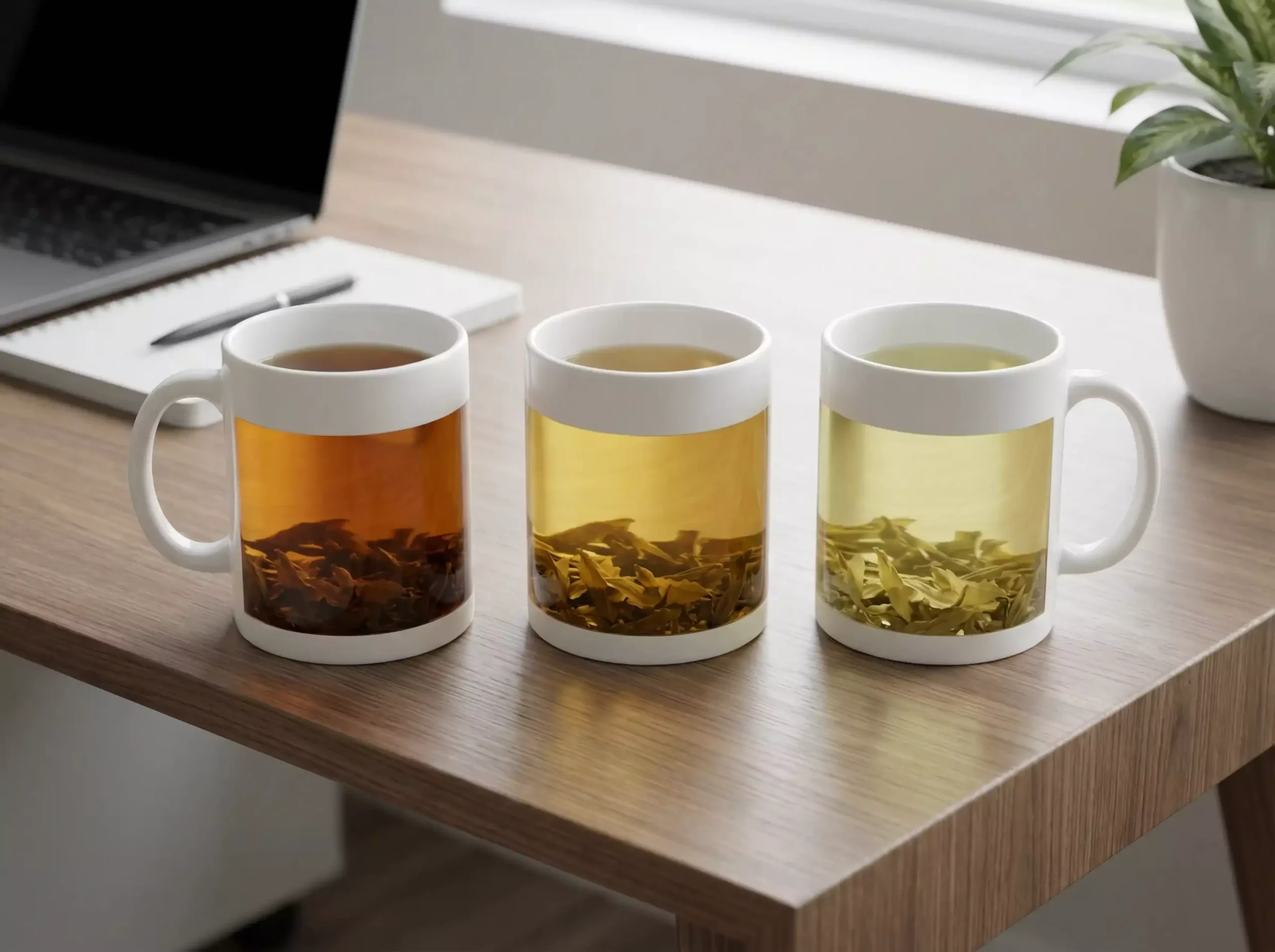
Why Mug Brewing Extracts Faster Than Gongfu
The defining characteristic of mug brewing is that leaves remain in continuous contact with water. There is no decanting, no temperature control, no timed separation of leaf and liquor. This produces specific, predictable extraction dynamics:
| Compound Type | Extraction Speed (Mug) | Duration of Presence | What You Taste |
|---|---|---|---|
| Aromatic Volatiles | Fast — first 5–10 min | Short — evaporate rapidly from open mug | The distinctive "soul" of the tea — floral, fruity, woody notes |
| Amino Acids (L-Theanine) | Medium — 10–20 min | Medium — degrades slowly in heat | Umami depth, smooth mouthfeel |
| Sugars & Sweetness | Slow — 20+ min | Long — persists through multiple refills | The residual sweetness of late refills |
| Tannins / Polyphenols | Builds over time | Can increase if water stays hot | Astringency — managed by correct dosage |
The Open Mug Effect: A standard mug has an opening 3–4× wider than a Gongfu Gaiwan's lid gap. This means aromatic volatile compounds escape continuously into ambient air — not just during sipping, but throughout your entire workday. The aroma you smell rising from your mug is, literally, the flavor leaving before you drink it. This is why the aroma-to-sweetness ratio inverts so quickly in mug brewing relative to a closed brewing vessel.
The Steeped Roots 3-Cup Protocol
Three refills is not a limitation — it is a designed experience. We don't just refill; we observe the evolution of the leaf. Each cup is a distinct chapter in the same story.
"We don't just refill; we observe the evolution of the leaf. The Three Cups are not three repetitions — they are three different teas from the same leaves."
💼 The Three Cups as a Career Energy Protocol: Each cup maps to a different cognitive mode — The Awakening (focus sprint), The Core (deep work), The Echo (reflection). Master the three-phase tea schedule to transform your workday from a caffeine-cycle grind into a focused ritual. From NYC to Menghai: Managing Career Energy with a 2 g Tea Rhythm →
And for the hardest hour of the workday: The 3 PM Micro-Reset: How Tea Molecules Rebuild Your Gut Barrier and Mindset →
The Flavor Evolution Table: Three Cups at a Glance
| Dimension | 🍵 Cup 1 — The Awakening | 🫖 Cup 2 — The Core | 🌙 Cup 3 — The Echo |
|---|---|---|---|
| Aroma | ★★★★★ | ★★★☆☆ | ★☆☆☆☆ |
| Sweetness | ★★★☆☆ | ★★★★★ | ★★★★☆ |
| Body / Structure | ★★★★★ | ★★★★☆ | ★★☆☆☆ |
| Energy (Cha Qi) | High | Medium | Gentle |
| Overall Pleasure | ★★★★★ Unforgettable | ★★★★☆ Harmonious | ★★★☆☆ Peaceful close |
Why Aroma Fades Before Sweetness: The Physics
This is not a quality problem. It is a matter of molecular behavior. Aromatic compounds are volatile — they evaporate, oxidize, and dissipate far more rapidly than dissolved sugars or soluble solids. In an open, hot mug, they escape continuously from the moment water touches the leaves.
Sweetness compounds — primarily glucose, fructose, and the amino acid L-theanine — are water-soluble rather than volatile. They linger in solution far longer than the aroma that announced them. This is why the final refills taste like "sweet water with a shadow of tea" — technically accurate, but capturing the wrong half of the picture. That sweetness is not a consolation prize; it is the Hui Gan (回甘) of the leaf.
Surface Area & Heat Dissipation: A standard 250–300 ml mug with an 8–9 cm opening loses heat significantly faster than a closed Gaiwan. This accelerated cooling actually benefits large-leaf Yunnan teas (like Sheng Puerh) — the temperature drops from the initial 100°C pour toward 70–75°C within 8–10 minutes, naturally reducing the risk of over-extracting bitter catechins as the session progresses. The open mug, paradoxically, self-corrects its own temperature to a gentler infusion range within one work-email's time.
Understanding the physics of volatile compounds helps explain why your open mug loses its fragrance profile while holding its sweetness — and why a lidded Gaiwan or Yixing pot produces a categorically different experience from the same leaves. Why Office Tea Loses Aroma Faster Than Gongfu Tea — the full chemistry →
Curious how different vessel shapes change extraction beyond just aroma? Gaiwan vs. Yixing Teapot vs. Metal Tea Ball: Brewing Differences Explained →
The 2 g Golden Rule: Why This Dose Is Not Arbitrary
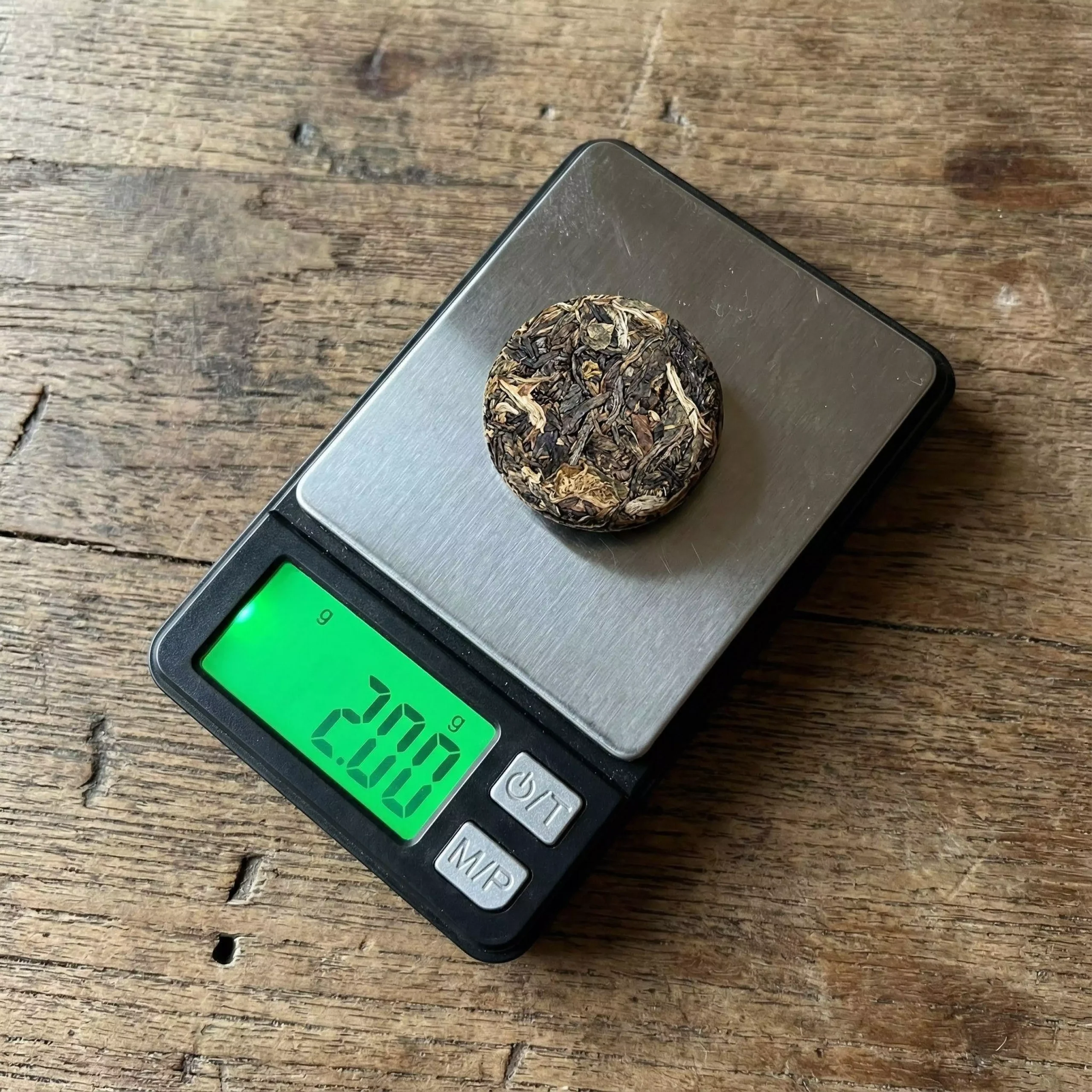
Two grams is the precise dosage calibrated for the spatial dynamics of a 250–300 ml office mug. This is the physics of why it works:
🍃 2 g of loose-leaf tea, when fully hydrated, expands to approximately 4–6× its dry volume — enough to cover the mug base in a single leaf layer without stacking. This distributes extraction evenly across the full water column. Under-dosing (1 g) produces a thin cup. Over-dosing (4+ g) accelerates tannin over-extraction, front-loads bitterness in the first cup, and collapses the 3-cup arc into a 1-cup spike followed by flat water. The 2 g rule preserves the arc.
Adding more leaves does not increase the number of quality refills. It only compresses the arc — concentrating extraction into the first cup at the cost of every cup after. More leaves means faster depletion, not longer endurance.
Why 2 g specifically — and not the traditional 5 g loose-leaf standard? The answer comes from a decade of reformulation across 40+ tea types. Discover the experiment that led us to the 2 g golden ratio for office brewing →
A precisely portioned 2 g portion creates the optimal 3-cup arc: peak aroma → sweet balance → gentle close. Every session begins identically. No measuring, no guesswork, no bitter first cups.
The 3-Cup Protocol: Step-by-Step
This is a system, not a habit. Each of the four actions below has a specific physiological or chemical rationale — not just a "best practice."
Measure — place exactly 2 g of leaf in a clean, dry mug
Use a 2 g pre-portioned serving if available, or a small kitchen scale. The weight is calibrated to a
250–300 mlmug. For a larger 400 ml travel mug, increase to2.5–3 gto maintain the same leaf-to-water ratio. Do not eyeball by volume — leaf shapes vary wildly in density; a teaspoon of silver-tipped Dian Hong buds is 0.8 g; a teaspoon of compressed Sheng Puerh is 2.5 g.Pour — add
100°C / 212°Ffreshly boiled water and wait 2–3 minutes before your first sipFirst pour: allow
2–3 minutesfor initial extraction — this is longer than a Gongfu first steep but appropriate for mug brewing's lower leaf-to-water ratio. For all Yunnan large-leaf teas — Sheng Puerh, Dian Hong, Shou Puerh — use full boiling water100°C / 212°F. Do not baby the leaves with lower temperatures. The thick cell walls of Yunnan large-leaf assamica require that thermal energy to mobilize the complex aromatic oils that define Cup 1. Pouring at 90°C often leaves the best part of the tea locked in the leaf. If the cup tastes bitter, the solution is less leaf (2 g strictly), not less heat. Drink the first cup while it has aroma — do not let it cool untouched.Refill — leave 1/3 of liquid as "root water" before adding fresh water
This is the single most important technique in office mug brewing. When your cup reaches 1/3 full, do not drain it before refilling. The residual liquid — "root water" (根水) in Chinese tea culture — acts as a flavor bridge between infusions, preventing the sharp drop in concentration that makes refills taste suddenly thin. Add fresh hot water into this base. The blend of residual and fresh maintains continuity across all three cups.
Escalate — use a freshly re-boiled kettle for each refill
Since you are already at the
100°Cbaseline from Cup 1, escalation is no longer about a higher number on a thermometer — it is about oxygen and kinetic energy. Re-boil your kettle to a full rolling boil for each refill rather than using water that has been sitting in the kettle since the first pour. The turbulence and freshly dissolved oxygen in a rolling boil force-extract the residual sweetness and mineral echo that hides deep within the progressively spent leaves. Still, hot, de-gassed water produces a flat refill. A fresh boil does not.
Which Teas Endure the 3-Cup Arc Best?
Not all teas are architecturally suited for mug brewing. The following four are the most dependable office companions — rated by refill endurance and astringency risk.
Sweet potato notes and rich body hold firmly across all three cups. Honey sweetness is the last compound standing. Low astringency risk.
Wild fruit notes fade early (by Cup 2), but the honey-like sweetness is remarkably persistent. The most aromatic Cup 1 of any mug tea.
Contrary to common advice, high-quality Sheng Puerh thrives at 100°C. If the 2 g dosage is respected, you get explosive floral notes in Cup 1 without bitterness. Best for morning focus sessions.
The office champion. Lowest bitterness risk regardless of steep duration, forgives neglect, and produces a comforting earthy sweetness that holds through a full afternoon.
The Threshold of Pleasure: Knowing When the Session Ends
Office tea is not about pushing leaves to their absolute chemical limit. It is about maintaining conscious pleasure with minimal friction. The question is never "has the leaf given everything?" — the leaf always has something left. The question is: "Is what remains worth my attention?"
After the third refill, the drink transitions into what we might call "background warmth" — the shadow of tea rather than its presence. Some people find genuine comfort in this gentle residual sweetness through a long afternoon. That is a valid choice. But for those seeking flavor, the session ends with Cup 3.
"When the aroma fades, don't view it as waste — view it as a signal. The leaf has offered its full arc. Honor the Echo, and know when to begin again."
Ready to systematize your entire workday tea practice? Our complete Efficient Office Tea Brewing Guide covers dosage, scheduling, storage, and cold-brew extensions.
Frequently Asked Questions: Office Mug Brewing
Should I drain the cup completely before refilling?
No — this is the most common mistake in office mug brewing. Always leave approximately 1/3 of the liquid as "root water" (根水) before adding fresh water. This residual liquid acts as a flavor bridge, maintaining concentration continuity and preventing the sudden flatness that comes from starting with bare leaves and fresh water. The root water blends with each new pour and significantly improves Cup 2 and Cup 3 quality.
Does water temperature matter for refills — or should I use the same temp each time?
Use 100°C / 212°F freshly boiled water for every pour — including the first. For all Yunnan large-leaf teas (Sheng Puerh, Dian Hong, Shou Puerh), boiling temperature is not a risk; it is a requirement to unlock the aromatic oils in thick-leafed assamica. The escalation across refills is not about a higher number — it is about freshness of the boil. Re-boil your kettle to a rolling boil for each refill; the turbulence and dissolved oxygen in fresh boiling water force-extract the residual sweetness that hides in progressively spent leaves. Still, sitting, de-gassed water produces flat refills even at the same temperature.
My tea tastes bitter from the first cup. What went wrong?
For Yunnan large-leaf teas, temperature is almost never the culprit — dosage is. Check these in order: (1) Too much leaf — reduce to exactly 2 g per 250–300 ml. Over-dosing concentrates tannins and collapses the flavor arc; this accounts for the vast majority of bitter first cups. (2) Water left too long on the leaves — if your meeting ran longer than expected and the tea sat undisturbed for 15+ minutes at near-boiling temperature, tannin extraction crossed into astringency territory. The fix is not cooler water for next time — it is finishing Cup 1 within 10 minutes. Exception: if you are brewing green tea (Dragon Well, Gyokuro) rather than Yunnan large-leaf, lower to 80–85°C. Got pulled into an emergency call? Here are 5 proven methods to rescue a bitter mug of over-steeped tea in under 30 seconds →
Why does my mug tea lose aroma so much faster than Gongfu tea?
Two physical reasons: (1) Open vessel — a standard mug has a 3–4× wider opening than a closed Gaiwan. Volatile aromatic compounds continuously escape into ambient air throughout your workday, not just during sipping. (2) Constant submersion — in Gongfu brewing, leaves are briefly immersed and then drained completely, concentrating the extraction event. In mug brewing, leaves remain submerged continuously, releasing aromatic volatiles slowly and steadily into water that keeps evaporating from the open top. Both factors combine to deplete aroma significantly faster than in any closed brewing method.
Can I push beyond three refills if I still taste sweetness?
Yes — but calibrate your expectations. Beyond Cup 3, the experience transitions from "tea" to "background warmth" — dissolved sweetness without aromatic identity. Some people enjoy this gentle residual presence during focused work. Others find it unsatisfying. The practical test: if you can close your eyes, sip, and clearly identify which tea you are drinking, the session is still alive. If it tastes like warm sweet water with no distinct character, the session has ended. Start a new cup with fresh leaves.
🌿 Continue Your Tea Education
- Why We Compressed Tea into 2 g Cakes — the decade-long design story
- Why Office Tea Loses Aroma Faster Than Gongfu Tea — the full chemistry
- Gaiwan vs. Yixing Teapot vs. Metal Tea Ball: Brewing Differences Explained
- How to Fix Over-Steeped Tea at Your Desk (5 Proven Rescue Methods)
- Mastering Water Temperature for Brewing Tea: The 2026 Guide
- From NYC to Menghai: Managing Career Energy with a 2 g Tea Rhythm
- The 3 PM Micro-Reset: How Tea Molecules Rebuild Your Gut Barrier and Mindset
- What Is Cha Qi? — why Cup 1 hits differently than Cup 3
- Raw Pu-erh vs. Coffee — which is better for a long workday?

