Tea House VS Coffee Shop
"Key Differences in Culture, Vibe, Psychology & Etiquette — which space is actually built for your mind right now?"
Tea houses offer Zen-quiet, mindfulness-first environments optimized for flow states and divergent thinking via L-theanine + caffeine (tea = 20–50 mg caffeine / cup, meditative alpha-wave enhancement). Coffee shops deliver energetic "third place" productivity fuel via pure caffeine (espresso = 60–90 mg / shot), lively social interaction, and laptop-friendly infrastructure. Neither is objectively better — they optimize for different cognitive states.
Master Comparison Table: Tea House vs. Coffee Shop (2026)
The definitive at-a-glance reference — the format most likely to appear as a Google Featured Snippet or AI direct answer.
| Feature | 🍵 Teahouse (Traditional) | ☕ Coffee Shop (Modern) |
|---|---|---|
| Primary Vibe | Zen, Quiet, Meditative | Energetic, Social, Bustling |
| Main Purpose | Mindfulness, ritual, sensory immersion | Productivity, community, "the third place" |
| Social Rule | Soft voices; presence over conversation | Lively chatter; laptop & meeting-friendly |
| Primary Drink | Loose-leaf tea (oolong, Pu-erh, green) | Espresso-based (latte, flat white, drip) |
| Caffeine / Serving | 20–50 mg + L-theanine (alpha-wave balance) | 60–90 mg (espresso); 150–200 mg (drip) |
| Session Length | 45 min – 3 hours (Gongfu: multiple infusions) | 15 min – 2 hours (grab-and-go to sit-in) |
| Food Culture | Light: dried fruit, seeds, rice crackers | Fuller: pastries, sandwiches, cakes |
| Historical Origin | China, 3rd century BCE; East Asian monasteries | Ethiopia → Arabia, 9th century CE; Ottoman qahveh khaneh |
| Cognitive Mode | Divergent thinking, creativity, deep focus | Convergent thinking, logic, task execution |
| Sensory Design | Bamboo, water sounds, floral/grassy aromas | Dark wood, espresso roast aroma, jazz or lo-fi |
| Best For | Digital detox, deep conversation, meditation | Remote work, quick meetings, catching up |
| Sells Coffee? | Traditional: rarely. Modern tea cafés: often | Yes — occasional tea available too |
* Caffeine values per standard serving. Tea values vary widely by variety and brewing method.
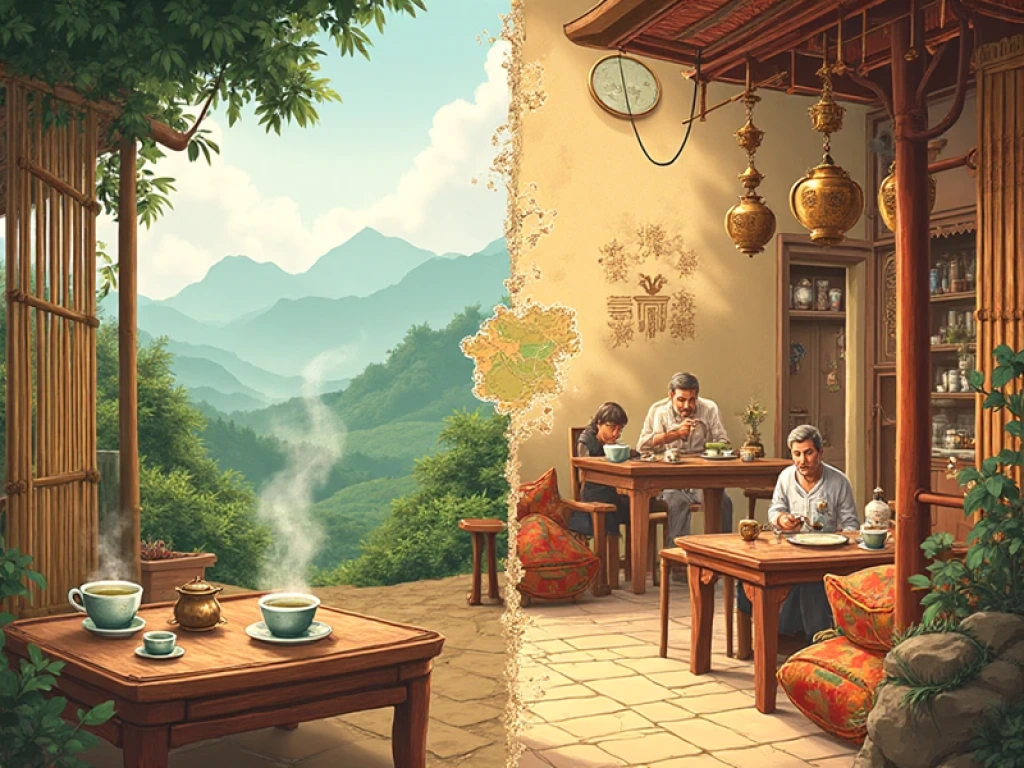
Origins: Two Beverages, Two Civilizations
3rd Century BCE Origins
- Legend: Emperor Shen Nong — leaves drifted into boiling water, sparking a cultural phenomenon
- First use: medicinal, then monastic ritual for Buddhist focus and clarity
- Lu Yu's Tea Classic (~760 CE) codified tea as a vehicle for self-cultivation and harmony
- Spread via Silk Road to Japan (matcha culture) and Korea (darye)
9th Century CE Origins
- Legend: Kaldi — goats danced after eating red coffee berries in Ethiopia's highlands
- First adopted by Sufi mystics in Yemen for nighttime prayer alertness
- Ottoman qahveh khaneh became "schools of the wise" — centers for politics, chess, storytelling
- Spread to Europe's coffeehouses, fueling the Age of Enlightenment
"Tea calms, coffee energizes — but both awaken a cultural consciousness that spans millennia."
Psychology: Creativity vs. Productivity — The Brain Chemistry Difference
The tea house / coffee shop choice is not merely aesthetic — it is pharmacological. The two spaces optimize for fundamentally different cognitive states, driven by their primary active compounds.
The L-theanine:caffeine synergy in tea creates alpha brain wave activity (8–12 Hz) — the frequency of meditative flow states and divergent, creative thinking. Ideal for: long-form writing, ideation, contemplative problem-solving.
Espresso's pure adenosine-blocking caffeine (60–90 mg / shot) drives the beta wave state — logical, sequential, task-focused thinking. Ideal for: coding sprints, deadline work, analytical tasks.
| Task Type | Tea House Advantage | Coffee Shop Advantage |
|---|---|---|
| Creative writing / ideation | ✓ Alpha wave flow state via L-theanine | — (caffeine may create anxiety in creative work) |
| Analytical / logic work | — (too calming for rapid iteration) | ✓ Pure caffeine sharpens convergent reasoning |
| Deep reading / study | ✓ Quiet environment + sustained focus | ✓ Ambient noise (70 dB) enhances abstract thinking |
| Networking / meetings | — (quiet etiquette limits group energy) | ✓ Social design, "third place" energy |
| Meditation / journaling | ✓ Ritual, sensory mindfulness | — (high stimulation environment) |
The Third Place Theory: Community vs. Sanctuary
Sociologist Ray Oldenburg coined the "Third Place" concept in The Great Good Place (1989): the space between home (first place) and work (second place) where community identity is formed. Both tea houses and coffee shops serve as Third Places — but they serve radically different human needs.
Inward Community
- Solitude within presence: you share space with others while maintaining interior silence
- Connection through shared ritual, not shared conversation
- Encourages deep one-on-one dialogue when conversation does occur — less surface-level social performance
- In East Asia, tea houses are venues for poetry, philosophy, calligraphy, and musical appreciation
Outward Community
- Ambient social energy: even solo workers feel connected to collective activity
- Democratizes public intellectual life — the laptop generation's library
- Oldenburg's original ideal: neutral ground where hierarchy dissolves, conversation flows freely
- Modern coffee shops are explicitly designed for serendipitous connections and professional networking
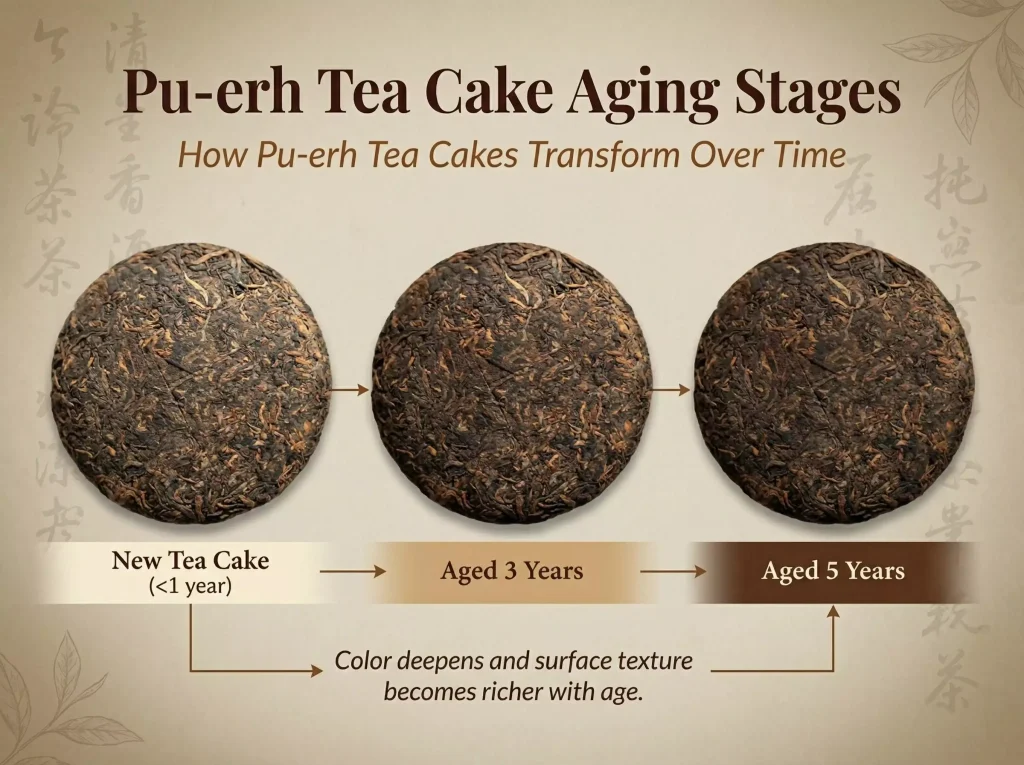
While coffee beans are best enjoyed fresh, certain teas like aged Pu-erh gain extraordinary complexity over decades — much like a fine wine. The tea house that serves 30-year-old Pu-erh is offering something no coffee shop equivalent can match: a time-capsule experience, a taste of preserved history.
Sensory Design: How Environment Shapes Your Taste
Research in psychoacoustics and sensory science confirms that ambient environment directly influences perceived flavor — a phenomenon called crossmodal correspondence. The spaces are engineered (consciously or not) to prime your palate before the first sip.
🍃 Floral, grassy, warm earthen notes — bamboo and wood with age
☕ Roasted, caramel, smoky — the smell of Maillard reaction chemistry
🍃 Soft light, natural materials, negative space, water features or garden views
☕ Dark wood, warm Edison bulbs, exposed brick — controlled warmth and energy
🍃 Silence or flowing water; occasional guqin (古琴) or shakuhachi; ~40–50 dB
☕ Jazz, lo-fi hip-hop, conversation hum — optimal ~65–70 dB for abstract thought
🍃 Rough ceramic Gaiwan, warm porcelain, natural wood grain, slow deliberate movement
☕ Smooth paper cup, polished surfaces, efficiency of transaction
"In a world addicted to acceleration, tea reminds us to slow down. Coffee keeps us sprinting. Both are vital — just for different hours of the soul."
How to Navigate Tea House & Coffee Shop Etiquette — A 4-Step Guide
Many Western visitors avoid traditional tea houses because they fear "not knowing the rules." This is unnecessary — but some context transforms the experience from awkward to extraordinary.
🍵 Tea House Etiquette
- Koubei Ritual (叩指礼): When someone pours tea for you, tap two bent fingers on the table as silent thanks — rooted in a Qing Dynasty legend of a disguised emperor who could not bow publicly
- The Aroma Cup (闻香杯): In formal Taiwanese Gongfu style, tea is poured into a tall aroma cup first — smell it, then transfer to the drinking cup
- Never fill your own cup first: pour for others before yourself. Reciprocity is the ceremony
- Phones and laptops: keep them away unless explicitly in a modern tea café context
- Silence is participation: quiet presence is not anti-social — it is the highest form of respect for the space
☕ Coffee Shop Etiquette
- Order before you sit: in most independent coffee shops, ordering first is expected — not doing so signals unfamiliarity with the space
- The laptop-to-table ratio: at peak hours, limit to 2 hours per seat if the space is filling; some shops have posted policies
- Grab-and-go culture: chains are optimized for throughput — no social judgment for a 5-minute visit
- Headphone signal: headphones on = do not disturb, universally understood in the culture
- Tip policy: 10–15% is standard in sit-down independent shops; less expected at chains
Choose your space based on cognitive intention, not habit
Before leaving home, ask: what mode does this session require? If you need
creative flow, writing, or calm reflection— a tea house or quiet tea café is the better environment. If you needdeadline focus, networking, or a quick productivity sprint— a coffee shop's ambient social energy will serve you. The space you choose literally primes your neurochemistry before you order.Order according to the chemistry you need
At a tea house: specify the tea type to match your goal —
Young Raw Pu-erh or Wuyi Rock Oolongfor the deepest Cha Qi experience;High Mountain Oolong or Dian Hongfor a gentler, beginner-friendly session. At a coffee shop: espresso / flat white for short, intense focus; drip filter coffee for longer sustained work sessions. The dose and format of caffeine shapes the next 2–4 hours.Participate in the etiquette of the space — it amplifies the experience
In a tea house: use the
Koubei (叩指礼)finger-tap to acknowledge pours. Hold the Gaiwan correctly (thumb and middle finger on rim, index on lid). Smell before sipping. In a coffee shop: respect the laptop norms and headphone signals. Both environments have unwritten contracts that, when honoured, create belonging rather than awkwardness.Notice how the environment modifies your sensory perception
Tea drunk in silence tastes different from tea drunk in noise. The same cup of
Wuyi Da Hong Paoin a quiet tea house and a busy café will register as two different teas. This is not imagination — it is crossmodal sensory science. Once you recognize this, you stop choosing spaces by default and start choosing them by design.
Expert FAQ — 2026 Edition
-
Do traditional tea houses sell coffee?
Most traditional tea houses — especially in East Asia (China, Japan, Korea, Taiwan) — focus exclusively on tea to preserve aromatic purity. Serving coffee in a space where prized oolongs or Pu-erh are brewed would contaminate the ambient scent environment that forms part of the sensory experience. However, modern "tea cafés" (a hybrid format increasingly popular in the West and in Chinese urban centers since the 2010s) frequently offer both — with tea occupying the premium menu and coffee serving as an accessibility bridge for newcomers. The rule of thumb: the more traditional and ceremony-focused the space, the less likely it carries coffee. -
Is a tea house or coffee shop better for studying?
The answer depends on the type of studying. For creative or conceptual work — essay writing, ideation, reading dense theory — a tea house environment (low ambient noise, ~40–50 dB, L-theanine + caffeine alpha-wave enhancement) produces better outcomes. For problem-set work, coding, or deadline-driven review — a coffee shop's moderate ambient noise (~65–70 dB, confirmed by research from the University of Illinois as optimal for abstract thinking) and pure-caffeine energy boost is better suited. The emerging 2026 consensus in cognitive science: match your environment to your cognitive modality, not to your preference. -
What is the Koubei (叩指礼) finger-tap gesture in Chinese tea culture?
Koubei (叩指礼) is the practice of tapping two bent fingers on the table as silent thanks when someone pours tea for you. The gesture originates from a Qing Dynasty story: the Qianlong Emperor, traveling incognito among commoners, could not bow publicly without revealing his identity — so he bent two fingers to simulate a hidden bow of gratitude. Tea companions adopted it as a discreet acknowledgment. In modern tea houses, tapping once with one finger indicates casual thanks; two fingers bent is the traditional full gesture. It is one of the most universally recognized etiquette signals in Gongfu Cha and Taiwanese tea ceremony contexts. -
What did the first coffeehouses look like — and why were they banned?
The first coffeehouses were the Ottoman qahveh khaneh, emerging in Constantinople (modern Istanbul) in the 1550s. They were vibrant, egalitarian public spaces — customers from all classes sat together, played chess, listened to musicians, debated politics, and heard storytellers called meddahs. They were called "schools of the wise." They were banned multiple times — by Ottoman sultans concerned about political sedition, and briefly by King Charles II of England in 1675 — precisely because they were too effective at generating public discourse. The coffeehouse was the original democratic forum, and its intellectual energy directly contributed to the Enlightenment.