
Storage Is Depreciation:
How to Protect Your High-Value
Tea from Systematic Oxidative Collapse
The moment a premium leaf leaves its source environment, it begins an irreversible chemical entropy. Your $50 tea is not bad. It's dead. Understanding why takes five minutes. Fixing it costs less than a decent lunch — but only if you act before the Arrhenius equation finishes the job for you.
Tea is an extremely hygroscopic and oxidation-sensitive biological material. The core mechanism of storage failure is Arrhenius acceleration: for every 10°C rise in storage temperature, chemical degradation accelerates by 3–5×. Gold standard: opaque, double-lid airtight container at 15–25°C and 50–60% relative humidity, isolated from odors and light. Critical exception: Sheng Pu-erh (Raw Pu-erh) requires controlled microventilation to maintain its post-fermentation microbial aging — airtight sealing halts its development entirely. All other Pu-erh rules differ fundamentally from any other tea category. Most time-sensitive: Matcha — use within 4–6 weeks of opening. Most resilient: aged Shou Pu-erh. Green tea loses primary value within 6 months of opening under suboptimal conditions.
The $50 Mistake You've Already Made
Here's the scene: you splurged. A spring-harvest ancient-tree Yunnan Dian Hong at $0.80 per gram. Or a high-mountain Sheng Pu-erh cake from a specialty importer who swore the Cha Qi would restructure your afternoons. The energy was real — until it wasn't.
Two weeks later you brewed it with care — correct temperature, good water, calibrated grams. And it tasted like dried autumn leaves. Flat. Dusty. A ghost of the vendor's promise.
You didn't get scammed. You stored it wrong.
Your $50 didn't disappear. It converted — irreversibly — into flavourless cellulose and degraded polyphenols. At Steeped Roots, we treat premium Yunnan Assamica as a precision cognitive supplement. The same compound complexity that produces Cha Qi, sustained Alpha-state focus, and the distinctive hui gan of aged Sheng is also the reason these teas are acutely vulnerable to the five degradation pathways below. Understanding them takes five minutes. Ignoring them costs you every subsequent purchase.
The Physics: Arrhenius Acceleration and Why Heat Is the Silent Multiplier
Most tea drinkers know vaguely that "heat is bad." Few understand the magnitude. The Arrhenius equation governs the rate of virtually all chemical reactions in food systems — including the Maillard browning, EGCG oxidation, and volatile aromatic evaporation that destroy your tea:
→ Tea stored at 30°C (a warm kitchen counter) degrades 3–5× faster than tea stored at 20°C.
→ Tea inside a hot car at 45°C degrades 9–25× faster than optimal storage.
→ The space above your refrigerator compressor: routinely 30–35°C. Not storage space. It is a degradation accelerator.
This is not tea philosophy — it is physical chemistry. The volatile aromatic esters that give Yunnan Dian Hong its cocoa-honey character, the L-Theanine that produces Alpha-state focus, the EGCG (C22H18O11) that provides neuroprotection — all are subject to Arrhenius kinetics. The target storage temperature of 15–25°C is not arbitrary. It is the range at which degradation rates are slow enough to be functionally negligible across a normal consumption window.
The Five Enemies: Threat Assessment by Degradation Speed
Ranked by speed of first measurable damage under typical mis-storage conditions. Each enemy has a specific countermeasure. None is optional.
The Sheng Pu-erh Exception: Controlled Respiration vs. Airtight Sealing
Everything above applies to every tea except one. Pu-erh tea — both raw Sheng and ripe Shou — follows almost entirely inverted rules. Understanding why requires understanding that Pu-erh is not a static product. It is a living fermentation system.
Controlled Respiration Architecture
Raw Sheng Pu-erh undergoes continuous post-fermentation driven by bacteria, fungi, and enzymatic activity — the same microbial complexity responsible for its distinctive Cha Qi activation and the theabrownin compound depth that makes aged Sheng one of the most complex beverages on earth. This biological process requires the precise conditions that would destroy any other tea.
- Airtight sealing (halts all fermentation)
- Refrigeration (suppresses all microbial activity)
- Below 20°C (thermal suppression of enzymatic activity)
- Below 55% RH (desiccation arrests microbial development)
- Stagnant, unventilated space (promotes anaerobic bacteria)
- Proximity to strong odors (porous cake structure = extreme absorption)
- Microventilation: tea breathes slowly with ambient air
- 20–30°C stable temperature — warmer accelerates beneficial activity
- 60–75% RH — microbial activity requires moisture
- Darkness — UV is still destructive even for Pu-erh
- Dedicated, odor-free ventilated cabinet or clay crock
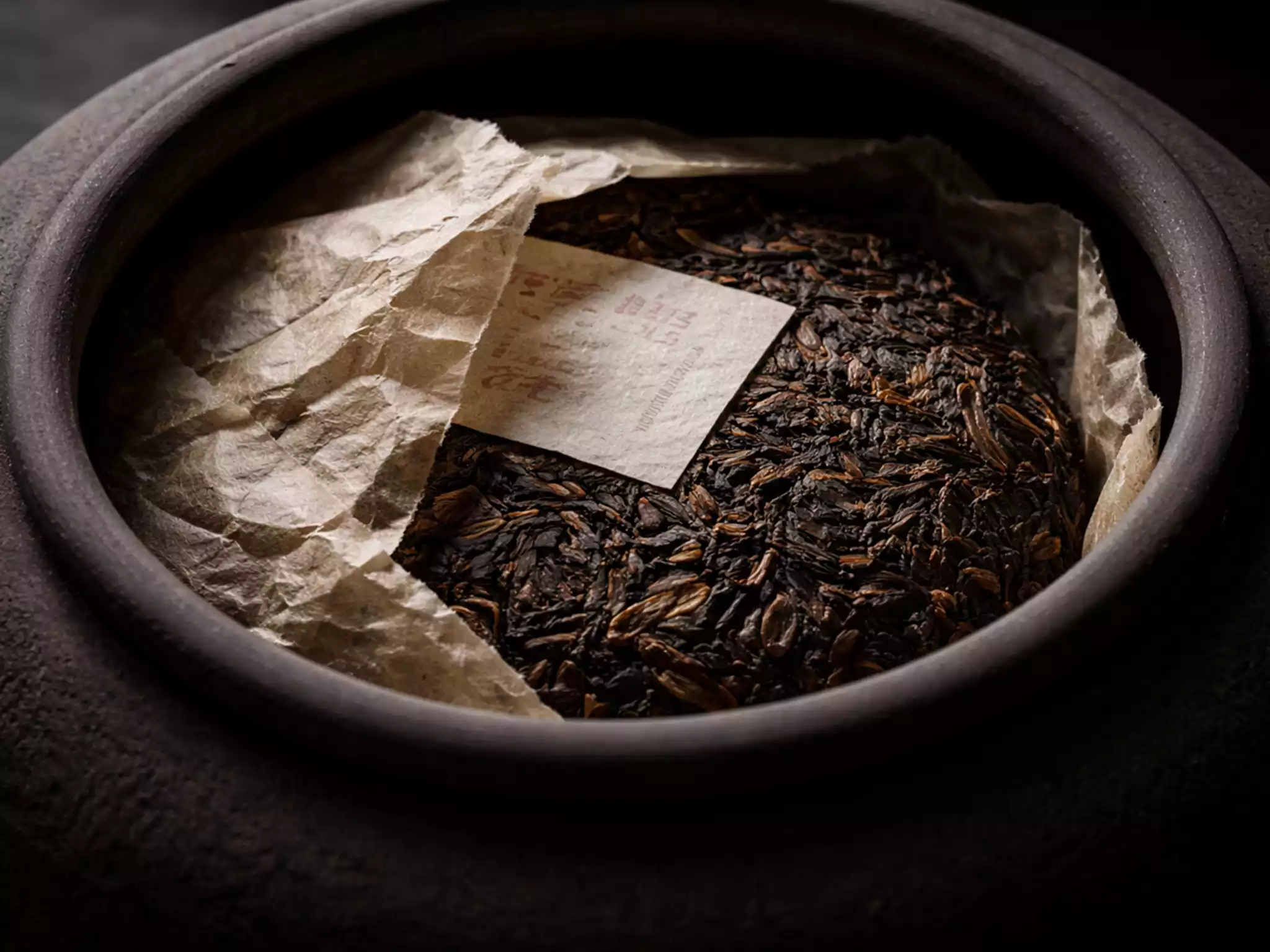
- Original compressed cake format — maximizes surface/mass ratio for controlled respiration
Shai Hong (Sun-Dried Black Tea) occupies an interesting middle ground: like Sheng Pu-erh, its sun-drying process preserves active enzymes and some post-fermentation potential. While it doesn't require the same microventilation protocol as Pu-erh cake, it benefits from slightly more breathable storage than heavily oxidized black teas — avoiding fully vacuum-sealed conditions for cakes intended for short-term aging (1–3 years).
The 2026 Tea Storage Matrix — Complete Reference
| Tea Category | Storage Location | Temp | RH | Container | Opened Shelf Life | Primary Enemy |
|---|---|---|---|---|---|---|
| Matcha (powder) ⚠ Most time-sensitive | Sealed fridge | 2–8°C | <50% | Double-sealed airtight tin + equalization 30–60 min before opening | 4–6 weeks | Oxygen + Light |
| High-grade Japanese Green Gyokuro, Shincha | Cool dark cabinet or fridge (with equalization) | 5–15°C | 50–60% | Vacuum-sealed or double-lid tin; no glass | 3–6 months | Oxygen + Light |
| Green Tea Sencha, Longjing, Dragonwell | Cool, dark cabinet | 10–18°C | 50–60% | Opaque airtight tin; avoid glass | 3–6 months | Light + Oxygen |
| High-Mountain Oolong Ali Shan, Li Shan, Green Oolong | Cool cabinet or fridge-sealed | 10–18°C | 50–60% | Airtight double-lid tin | 6–9 months | Light + Heat |
| White Tea Silver Needle, Bai Mu Dan | Cool, dark, dry cabinet | 15–20°C | 50–60% | Opaque tin or ceramic with gasket seal | 12–18 months | Moisture + Odors |
| Yunnan Dian Hong 🏔 Steeped Roots — Assamica | Cool, dark interior cabinet | 15–22°C | 50–60% | Opaque ceramic or double-lid tin; no glass | 12–18 months | Moisture + Odors |
| Black Tea (CTC, Darjeeling, Assam, Keemun) | Cool, dark cabinet | 15–25°C | 50–65% | Opaque airtight tin or sealed ceramic | 1–2 years | Moisture + Odors |
| Roasted Oolong / Hojicha Wuyi Rock, dark Oolong | Cool, dark cabinet | 15–25°C | 50–65% | Double-lid tin; roast character is robust | 12–18 months | Moisture + Odors |
| Sheng Pu-erh (Raw / Ancient Tree) 🏔 Steeped Roots — Requires microventilation | Ventilated, dedicated cabinet or clay crock | 20–30°C | 60–75% | Original wrapper or porous paper; NOT airtight | Ages indefinitely | Stagnant air + Odors |
| Shou Pu-erh (Ripe / 2g Mini Cakes) 🏔 Steeped Roots | Ventilated, stable environment | 20–28°C | 60–70% | Original wrapper or breathable ceramic storage | Improves with age | Stagnant air + Odors |
| Shai Hong (Sun-Dried Black) Aging potential 1–3 years | Cool, dark, slightly breathable storage | 15–25°C | 55–65% | Porous paper wrap or partially-vented tin for cakes; standard tin for loose leaf | 1–2 years | Heat + Stagnant air (for cakes) |
"Shelf life" = maintains primary flavor profile. Tea rarely becomes unsafe; it becomes unworthy of what you paid for.
The 3-Step Asset Protection Protocol — Implement Today
You cannot un-oxidize a leaf. But you can stop further damage in the next five minutes.
- 01Tiered Deployment — Working Portion vs. Sealed Reserve
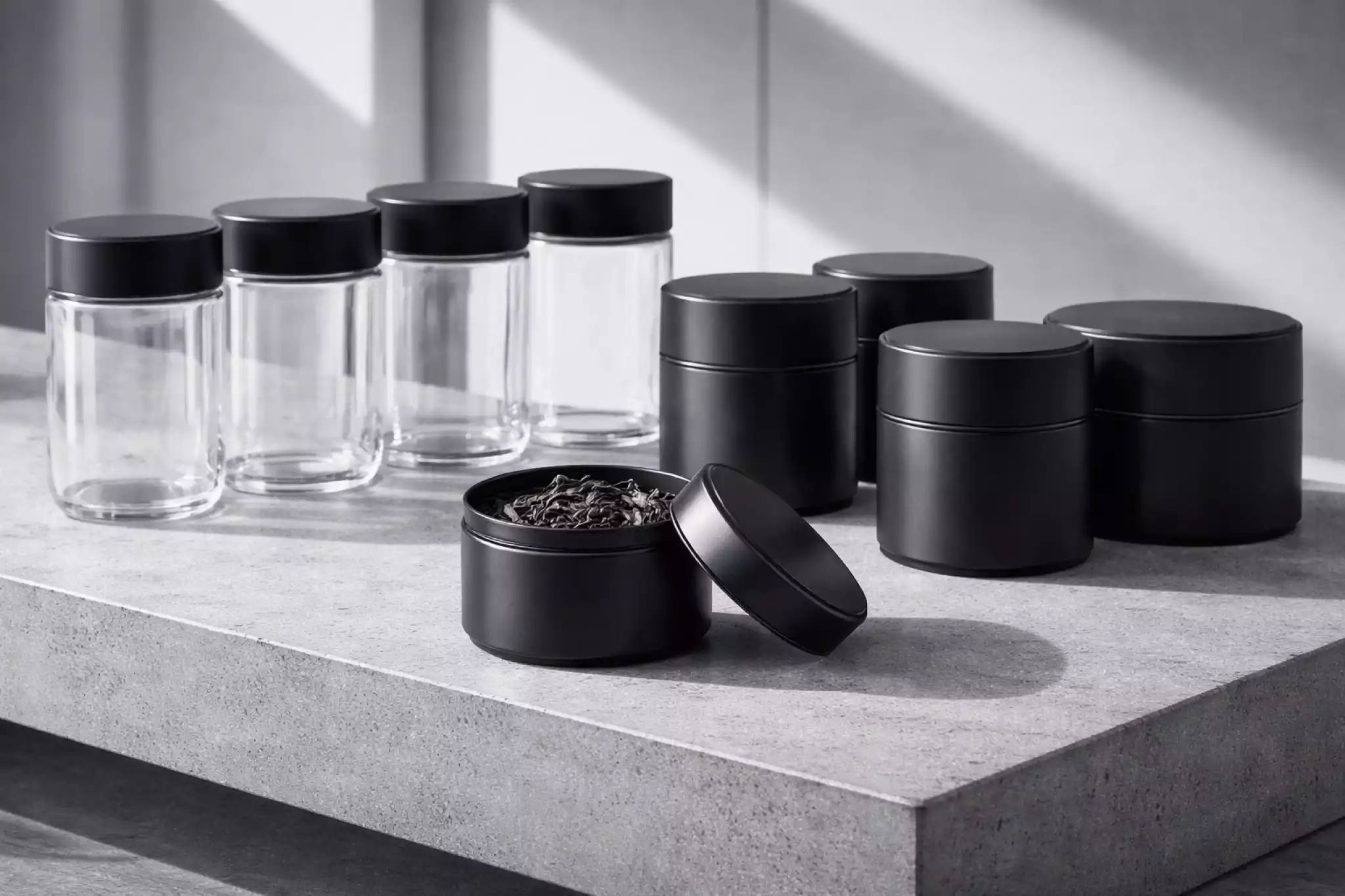
Do not take tea directly from a 100g or 200g primary storage tin multiple times daily. Every opening introduces a fresh oxygen and humidity charge — repeated "atmospheric shocks" that progressively collapse the headspace chemistry in the tin. The professional approach, used by both specialty roasters and serious tea importers: split your inventory.
Primary reserve: 80–90% of your stock in an airtight, opaque tin — opened no more than once per week to replenish the working portion
Working portion: 5–15g in a small daily-use tin — opened freely throughout the week, replaced weekly from reserve
Exception: Sheng Pu-erh cakes — the compressed format is self-portioning; break off a 5–7g portion per session, re-wrap the cake in its original paper and return to ventilated storageThis is identical to the coffee "working bag vs. storage bag" protocol. The logic is the same: the opened daily-use container absorbs the degradation pressure so the reserve does not.
- 02Physical Environment Monitoring — Don't Guess, Measure
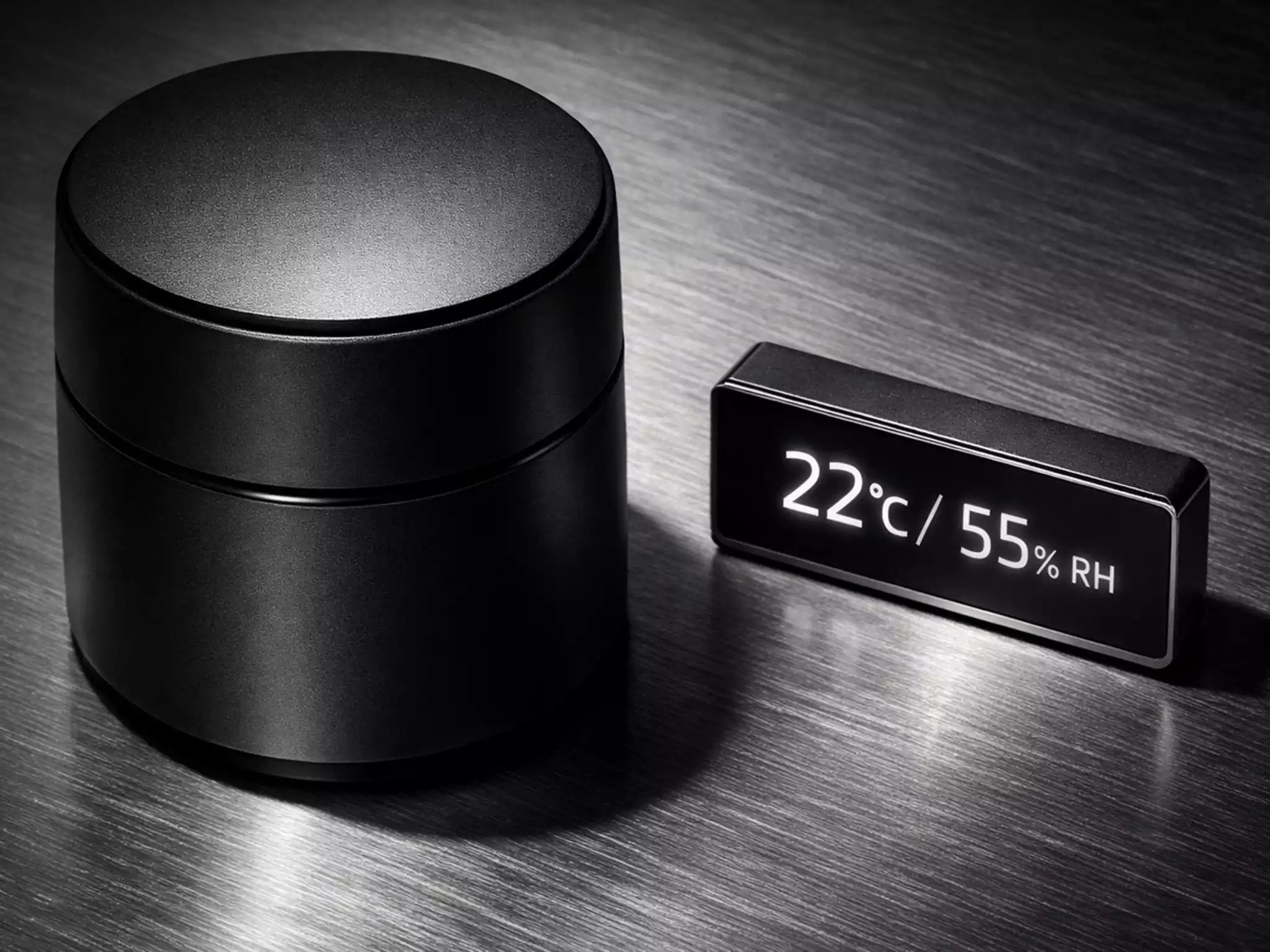
A digital thermometer/hygrometer costs $8–12 and takes 30 seconds to set up. Place it inside your tea storage cabinet for 24 hours. The reading will tell you definitively whether your chosen space is viable — no assumptions required.
Temperature target: 15–25°C. If summer temperatures push your kitchen cabinet above 28°C → move high-value green teas and light Oolongs to a cool interior room, a wine fridge set to 15°C, or a dedicated tea refrigerator
Humidity target: 50–60% RH for all non-Pu-erh teas · 60–75% for Sheng/Shou Pu-erh
Refrigerator protocol (matcha and Japanese greens only): place the sealed tin in the fridge, allow to reach room temperature for 30–60 minutes before opening — this prevents condensation on the cold leaf. Never skip this step.If your cabinet is on an exterior wall, it will have meaningful seasonal temperature swings. Measure in summer and winter. The worst-case reading determines your storage decision.
- 03Olfactory Isolation — Zero Tolerance for Shared Space
The porous hygroscopic structure of tea leaves means odour absorption is not a slow background process — it is an active, fast, and irreversible one. A shared cabinet with coffee, spices, or cooking oils is not a minor suboptimal condition. For any tea with a delicate aromatic profile, it is active destruction.
Minimum requirement: tea occupies its own dedicated shelf, with no open spice containers, coffee bags, cleaning products, or scented objects within the same enclosed space
If shared space is unavoidable: place the sealed tin inside a zip-lock bag — this provides a meaningful secondary odour barrier
Critical for Sheng Pu-erh cakes: the compressed, porous structure absorbs odour even faster than loose-leaf formats. A single nearby garlic bulb stored for two weeks can taint a $60 cake beyond recovery.
Never store different teas together in a single tin without a hermetic barrier — a Silver Needle stored near a heavily roasted Wuyi Rock Oolong will absorb its char notes within weeksA dedicated, odour-free storage zone is not a luxury for serious tea drinkers. It is the minimum viable condition for protecting the investment you made when you bought the leaf.

2026 Preservation Gear — Worth Buying vs. Marketing Noise
Expert FAQ
The refrigerator creates one serious risk that overrides its temperature benefit: condensation. Every time you remove a cold tin from the fridge and open it at room temperature, humid air rushes in and condenses on the cold leaf surface. A single condensation event can introduce enough moisture to begin microbial activity within days.
When refrigeration is appropriate: Matcha powder and high-grade Japanese greens (Gyokuro, Shincha) — where the oxygen sensitivity is acute enough to justify the condensation management required. Store in a double-sealed airtight container. Allow the sealed container to reach room temperature for 30–60 minutes before opening. Never skip the equalization step.
When refrigeration is actively harmful: Pu-erh — both Sheng and Shou. Refrigeration suppresses the microbial activity that drives pu-erh aging. For cakes being stored for long-term development, a single extended refrigeration period is a meaningful setback to the aging process.
When refrigeration is unnecessary: Black tea, Oolong, White tea — these have sufficient natural stability at 15–20°C cool room temperature. The condensation risk outweighs the marginal temperature benefit. A well-chosen cool interior cabinet is a better real-world solution for the majority of tea categories.
A properly sealed Mason jar (new lid, correctly torqued band) stored in a completely dark cabinet addresses four of the five enemies: light ✅, oxygen ✅ (reasonably), heat ✅ (assuming the cabinet is cool), and odors ✅. Glass is a notable advantage here — unlike tins, glass is entirely non-reactive and non-porous, meaning there is zero metallic transfer risk even over years. Some specialty tea importers prefer glass specifically for this reason when storing valuable aged teas long-term.
The caveat: Mason jars are not hermetically sealed in the same way as pressure-lid tins or vacuum canisters. The two-piece lid allows slow gas exchange over days to weeks. For black teas, aged Pu-erh, and dark Oolongs, this is entirely acceptable — their stability at room temperature makes the slow oxygen ingress manageable. For high-grade green tea or matcha, where EGCG shows measurable degradation within 48–72 hours of sustained air exposure, upgrade to a vacuum canister or pressure-seal double-lid tin.
Practical verdict: Mason jar in a dark cabinet = an excellent free or low-cost solution for most home tea storage situations. Do not let perfect be the enemy of good.
Pu-erh's unique character comes from its continuous microbial aging — driven by bacteria, fungi, and enzymatic activity that transform the leaf's chemistry over years and decades. This process requires exactly the conditions that would destroy any other tea: airflow, moderate-to-high humidity, and warmer temperatures.
What this means practically: the ventilated wooden cabinet or unglazed clay crock concept is not romantic tea culture mythology. It is the correct technical solution for a biological system that requires gas exchange to function. Airtight storage halts aging. Refrigeration suppresses all microbial activity. These are not suboptimal choices — they are the end of the aging process.
For single-origin ancient-tree cakes purchased for long-term appreciation: this storage distinction is financially significant. A properly stored 10-year Sheng Pu-erh cake from a noted mountain can appreciate considerably in value and complexity. The same cake stored airtight for 10 years has simply aged in a stunted, incomplete way — it will taste flat and disconnected, missing the full aromatic evolution that the correct environment would have produced.
The honest answer: a 3-year-old poorly stored green tea will not poison you. But the EGCG (C22H18O11) will have substantially degraded, the L-Theanine will be diminished, and the complex top notes — the entire reason you spent $50 — will be entirely gone. You're brewing polyphenol-depleted leaf water. Not dangerous. Not valuable.
The exception — tea that can become genuinely unsafe: tea stored at high humidity (above 65% RH) for extended periods. Aspergillus mould species that can develop under these conditions produce mycotoxins. This is not a theoretical risk — it is a documented occurrence in improperly warehoused teas, particularly compressed Pu-erh cakes stored in excessively wet conditions. If your tea shows visible mould, smells musty beyond normal aged-Pu-erh earthiness, or has an acrid chemical note, discard it.
The practical takeaway: proper storage (50–60% RH for non-Pu-erh; 60–75% for Pu-erh with controlled airflow) keeps you well below the humidity threshold where microbial risk begins. The flavour degradation from poor storage will alert you to problems long before safety becomes a concern — if you're paying attention to what's in your cup.
Further Reading
- What Is Pu-erh Tea? — The complete science of fermentation, aging, and why storage is everything for this category
- Pu-erh Taste Guide: From Earthy Notes to Dealing with Storage-Related Off-Notes
- What Is Mountain Origin Tea? Decoding Single-Origin Pu-erh — and why storage quality matters more for these cakes than any others
- Yunnan Dian Hong vs. Global Black Teas — the compound profile worth protecting in the first place
- What Is Cha Qi? — The multi-alkaloid energy experience that correct storage of ancient-tree Sheng preserves
- Sun, Time, and Leaves: The Secret Life of Shai Hong — storage considerations for sun-dried black teas with aging potential
- Mastering the Brew: The Beginner's Handbook — because proper storage is only half the equation
References: Tea Research Association Japan — Storage & Preservation Guidelines (2025) · Food Chemistry Journal: Polyphenol Degradation Kinetics in Camellia sinensis (2024) · Arrhenius Equation Applications in Food Preservation Science (standard reference) · International Pu-erh Tea Association Storage Standards (2025).