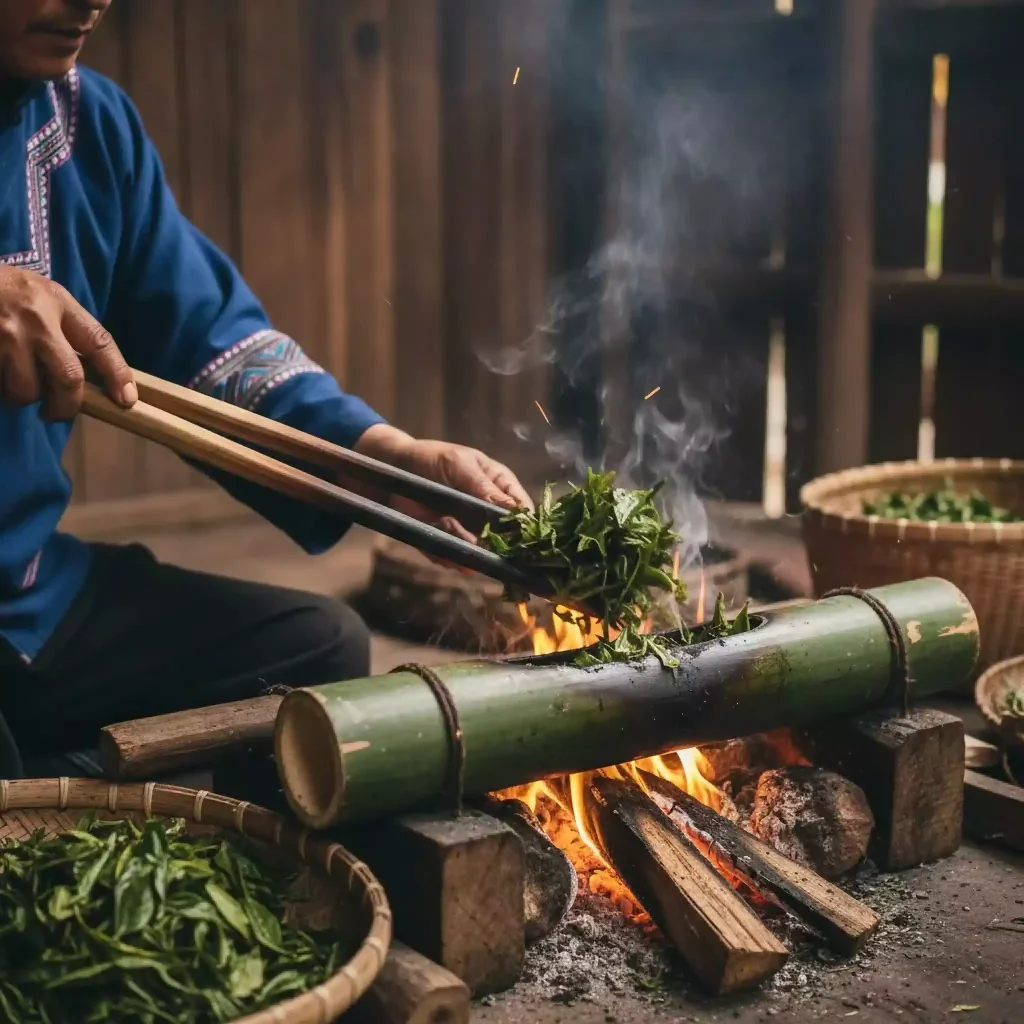
What Is Mountain Origin Tea?
Decoding the Geography of Single-Origin Pu-erh
A cup of Pu-erh from Lao Banzhang versus one from Lao Man'e, just 10 kilometers apart—yet the price can differ by 5-10 times. This isn't hype; it's the profound logic of geography, ecology, and cultural history behind "mountain origin tea."
In the world of Yunnan Pu-erh tea, "mountain origin" (山头, shāntóu) is more than a geographic coordinate—it's a precise flavor encoding system. When we say "Lao Banzhang," "Bingdao," or "Yiwu," we're not just naming places. We're describing the unique terroir created by specific elevations, soils, climates, tree varieties, and human management practices.
This article will help you deeply understand the essence of mountain origin tea—starting from the concept of single-origin, analyzing how geographical factors shape flavor, explaining the geographical distribution of Yunnan's Pu-erh regions, and using Lao Banzhang versus Lao Man'e as a case study to reveal the rationality behind seemingly absurd price differences. Finally, we'll trace the historical formation of the mountain origin concept to understand why "mountain" became Pu-erh tea's most important quality label.

Ancient tea gardens in Menghai tea region—every leaf carries the terroir code of its specific mountain
What Is Mountain Origin Tea? From Single-Origin to Micro-Terroir
Core Definition of Single-Origin
Mountain origin tea is essentially the ultimate expression of "single-origin tea." It means tea leaves sourced entirely from one specific geographical area—whether a village, a mountain slope, or even a particular ancient tea garden—without blending with tea from any other origin.
Similar to coffee's "single estate" and wine's "appellation" concepts, mountain origin tea emphasizes:
- Geographical Traceability: Origin identification down to the village level (e.g., "Hekai Village, Menghai Township, Menghai County")
- Flavor Purity: Undiluted by tea from other origins, fully expressing local terroir
- Vintage Uniqueness: Each year's climate variations leave their mark in the tea
Quick Understanding of Mountain Origin Tea
Mountain Origin ≠ Brand Name
"Lao Banzhang" and "Bingdao" are geographical concepts, not trademarks. Any tea picked in these areas that meets standards can be called by that mountain name.
Mountain ≠ Administrative Village
One administrative village may contain multiple natural villages or groups, with vastly different tea quality. For example, "Bingdao Laozhai" and "Bingdao Nanpo" both belong to Bingdao Village Committee, but their flavors and prices are completely different.
Evolution from "Major Regions" to "Micro-Mountains"
Pu-erh tea origin labeling has undergone continuous refinement:
| Precision Level | Scope Examples | Degree of Difference | Flavor Distinguishability |
|---|---|---|---|
| Level 1: Major Regions | Lincang, Banna, Pu'er | Extreme | Obvious (e.g., Banna vs. Lincang) |
| Level 2: County/Tea Area | Menghai, Mengla, Shuangjiang | Significant | Discernible (requires some experience) |
| Level 3: Mountain Range | Bulang Mountain, Yiwu, Bangdong | Moderate | Requires professional tasting |
| Level 4: Village (Mountain) | Lao Banzhang, Mahei, Xigui | Subtle but important | Expert-level discernment |
| Level 5: Tea Garden/Group | Specific Lao Banzhang garden | Extremely subtle | Top connoisseur pursuit |
Today's "mountain origin tea" mainly refers to Level 4 (village) and Level 5 (garden) precision origin labeling. This refinement isn't a tea merchant's marketing gimmick—it's based on real terroir differences.
Steeped Roots' Perspective: Why We Focus on Village-Level Mountain Origin Tea
At Steeped Roots, we insist on providing teas with village-level clear identification, because only at this precision does "single-origin" truly matter.
A product labeled "Menghai tea" might contain blended material from dozens of villages—Xin Banzhang, Lao Man'e, Hekai, Nannuo Mountain—all vastly different from each other. But a product labeled "Lao Banzhang Village Ancient Tree Spring Tea" provides flavor certainty and traceability.
As we explored in How Terroir Shapes Tea Flavor, subtle differences in micro-geography are the true source of Pu-erh tea's diversity.
How Geographical Factors Shape Mountain Origin Tea's Uniqueness
Why can two villages just 10 kilometers apart produce radically different teas? The answer lies in subtle differences across four geographical dimensions: elevation, ecological environment, human intervention, and tree genetics. These four factors interact to create each mountain's unique "flavor fingerprint."
Bulang Mountain's terraced tea gardens—where elevation, soil, and climate converge to create distinctive flavors
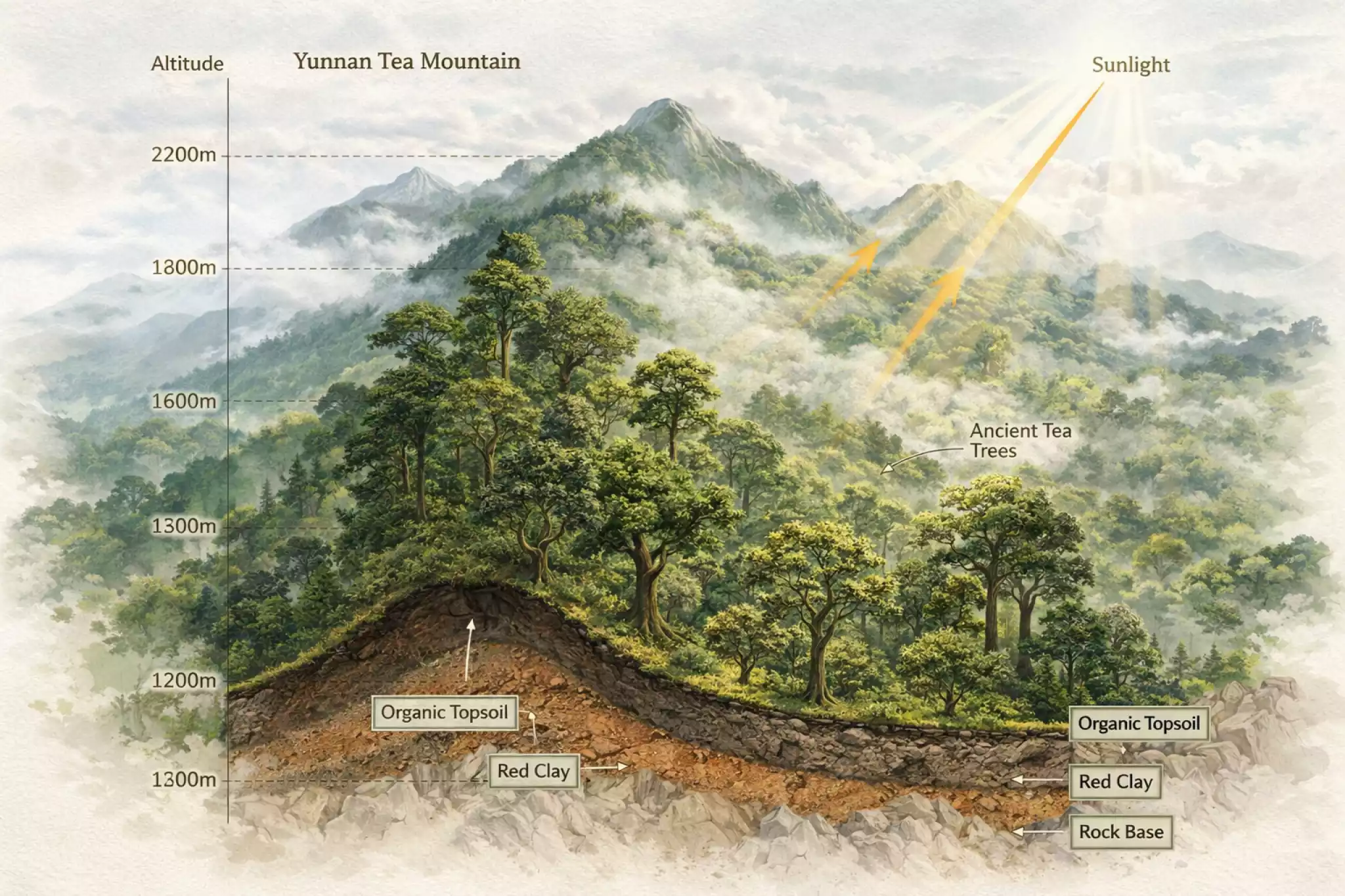
1. Elevation: The Balancer of Temperature, Light, and Internal Compounds
Elevation isn't just a height measurement—it's a comprehensive expression of temperature gradient, UV intensity, day-night temperature differential, and cloud cover.
How Elevation Affects Tea Leaf Chemistry
- 1200-1600m (Mid-elevation):
- Mild climate, stable tea tree growth
- Moderate polyphenols, controlled bitterness
- Representative: Yiwu (1200-1400m)—soft and sweet
- 1600-2000m (High elevation):
- Large day-night temperature differential (15°C+), ample sugar accumulation
- Strong UV exposure, high polyphenols and catechins
- Abundant cloud cover, increased amino acids, enhanced freshness
- Representative: Lao Banzhang (1700-1900m)—intense power with sweet aftertaste
- 2000m+ (Very high elevation):
- Cool temperatures, slow growth, extremely concentrated compounds
- Soaring aromatics, complex layers
- Representative: Kunlu Mountain Royal Garden (2000m)—pronounced orchid fragrance
Scientific Basis: According to a 2019 Yunnan Agricultural University study of Menghai tea region, tea polyphenol content increases by an average of 2.3% per 100m elevation gain, while amino acids increase by 1.8%. This explains why high-elevation teas often exhibit "bitterness with freshness, astringency followed by sweetness"—high polyphenols provide strength, high amino acids provide brightness.
2. Ecological Environment: The Symphony of Soil, Vegetation, and Microclimate
Soil Types: The Invisible Flavor Enhancer
Yunnan tea regions' soils fall into three main categories, each leaving a distinct "mineral signature" in the tea:
| Soil Type | Primary Distribution | Characteristics | Impact on Tea |
|---|---|---|---|
| Red-yellow Soil | Banna low elevation (Yiwu) | Iron-rich, pH 4.5-5.5 | Sweet, silky tea liquor |
| Brick-red Soil | Bulang Mountain (Lao Banzhang, Lao Man'e) | Good permeability, high organic content | Intense flavor, distinct layers |
| Purple Soil | Localized limestone areas | Extremely mineral-rich, high calcium-magnesium | Pronounced rocky character, similar to Wuyi rock tea |
Vegetation Cover: The Forest Garden's "Aroma Library"
One of ancient tree tea's most enchanting qualities is the "wild aromatics" that appear and vanish in the tea liquor—orchid, wild fruit, honey, medicinal herbs. These fragrances largely come from surrounding vegetation's volatile organic compounds (VOCs).
"Lao Banzhang's ancient tea trees grow intermixed with camphor and chestnut trees. The tea leaves absorb camphor compounds from the air, forming a unique 'camphor fragrance.' Meanwhile, Yiwu's tea gardens are surrounded by orchid family plants, which is why Yiwu tea often carries orchid honey notes."
This phenomenon is ecologically termed "vegetation cross-contamination"—one of the core reasons single-origin tea cannot be artificially replicated.
Microclimate: The Precise Recipe of Fog, Wind, and Rain
Two mountains 10 kilometers apart may have completely different microclimates due to valley orientation and slope aspect:
- Lao Banzhang: Located on Bulang Mountain's northwest side, afternoon fog, high humidity, shorter UV exposure for tea trees, slower polyphenol oxidation, more persistent bitterness
- Lao Man'e: Located on Bulang Mountain's southeast side, about 2 hours longer sunlight, more photosynthesis, higher tea bitterness but faster transformation
3. Human Management: Intervention Level Determines the Balance of "Wild" and "Domesticated"
Even with identical natural conditions, human management methods significantly affect tea quality:
Ancient Tea Garden vs. Terrace Tea Garden Management Differences
| Management Aspect | Ancient Tree Gardens (e.g., Lao Banzhang) | Terrace Tea Gardens (Modern Dense Planting) |
|---|---|---|
| Planting Density | Sparse (30-100 trees/mu) | Dense (3000-6000 trees/mu) |
| Fertilization | Zero fertilization (any fertilization is disaster) | Chemical fertilizers for yield maximization |
| Pruning | Zero pruning, natural growth | Regular pruning to control shape |
| Picking Frequency | Spring & autumn tea (1-2 times/year) | Year-round multiple harvests (5-8 times/year) |
| Root Depth | Reaches 5-10 meters | Usually 0.5-1 meter |
| Flavor Characteristics | Complex layers, profound depth | Simple flavor, high irritation |
Key Insight: Lao Banzhang became Lao Banzhang not only because of geographical location, but because villagers have maintained traditional management through generations—zero fertilization, no dense planting, no pruning, no excessive harvesting.
Wise tea farmers understand: ancient tea trees have grown naturally in pristine environments for hundreds of years, forming perfect ecological balance. Any human intervention—whether fertilization, pruning, or dense planting—destroys this balance and is disaster. Fertilization alters soil microbial communities, pruning interrupts the tree's natural metabolic rhythm. These "well-intentioned" interventions actually strip the tea of its wildness and depth.
This "restraint" is the true value of ancient tree tea—something terrace tea can never replicate.
4. Tree Genetics: The Overlooked Core Variable
This is the most easily overlooked yet possibly most important factor: tea trees from different mountains are actually different population varieties.
Yunnan large-leaf tea isn't a single cultivar but a gene pool evolved through hundreds of years of natural hybridization. Each mountain's tea trees carry unique genetic information:
- Lao Banzhang: Menghai large-leaf "Xibao No. 4" type, thick leaves, 28-34% polyphenol content
- Yiwu: Yiwu green bud tea type, relatively slender leaves, 22-26% polyphenol content
- Bingdao: Mengku large-leaf variety, combining high aromatics with sweetness, 24-28% polyphenol content
Genetic Differences: Evidence from 2020 Genome Sequencing
The Chinese Academy of Sciences Kunming Institute of Botany conducted full genome sequencing of ancient tea trees from 15 major Yunnan mountains in 2020, finding:
- Despite being only 10km apart, Lao Banzhang and Lao Man'e tea trees share only 89.3% genetic similarity (Note: humans and chimpanzees share 98.8% genetic similarity)
- The "PAL gene family" related to polyphenol synthesis shows 37% higher expression in Lao Banzhang trees than Lao Man'e
- The "TPS gene" related to floral compound synthesis has unique mutation sites in Yiwu tea trees
These genetic differences directly translate to flavor differences in the cup—mountain origin tea's uniqueness is partly "innate".
Yunnan Pu-erh Tea Regions Explained: Three Major Regions and Core Mountains
Yunnan Pu-erh tea is primarily distributed in southwestern and southern Yunnan between 21°-26°N latitude and 98°-105°E longitude. Divided by the Lancang River, three core production regions have formed.
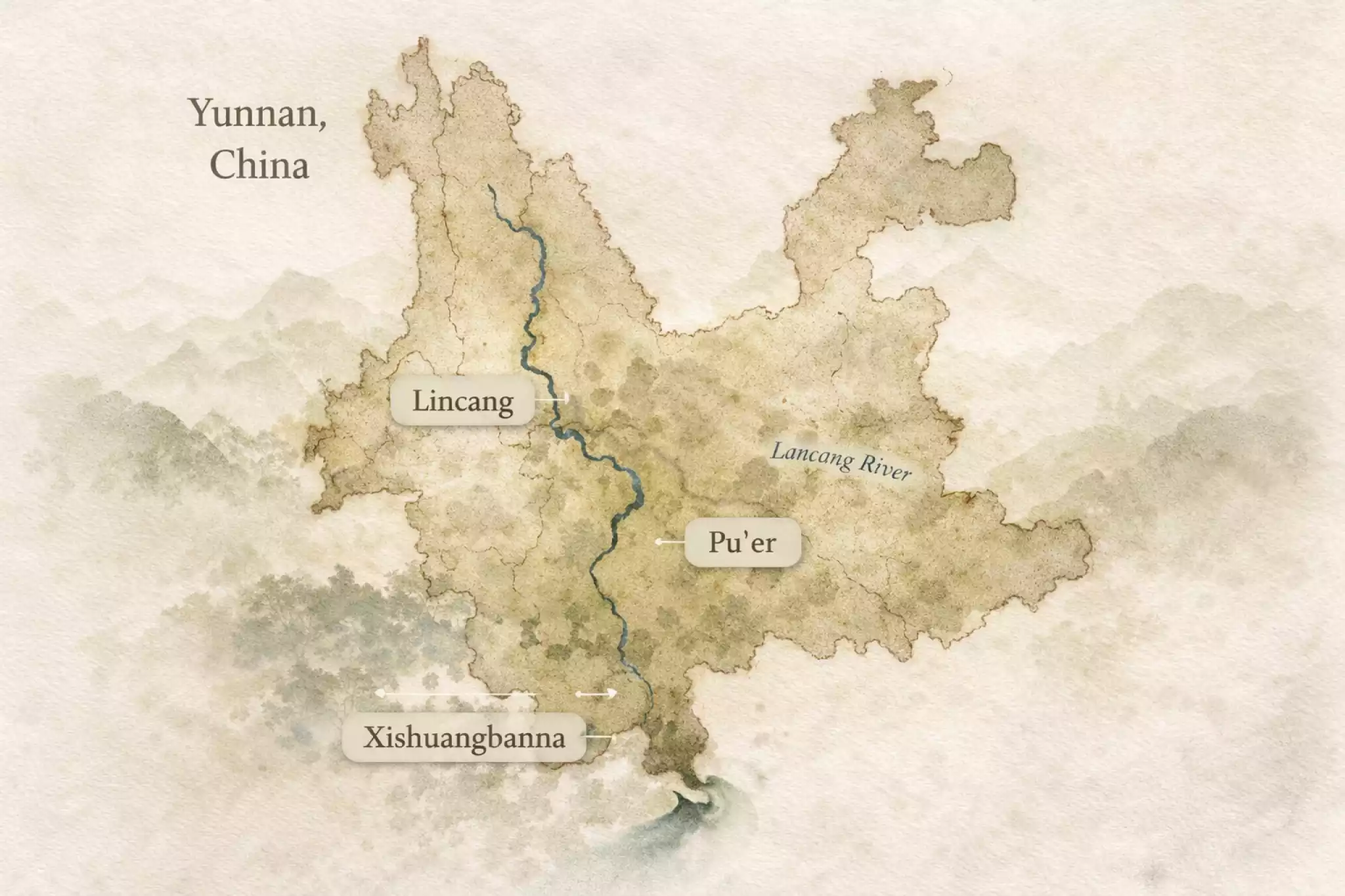
Three major tea regions divided by the Lancang River, forming different flavor systems on east and west banks
Quick Overview of Pu-erh's Three Major Regions
Xishuangbanna Region: Most renowned, richest in ancient tree tea resources
Pu'er Region (formerly Simao): Largest production volume, mainly terrace tea
Lincang Region: Home to top-tier mountains like Bingdao and Xigui
I. Xishuangbanna Tea Region
Location: Southern Yunnan, bordering Myanmar and Laos
Core Counties: Menghai County, Mengla County
Elevation Range: 1200-2000m
Average Temperature: 18-22°C
Characteristics: Tropical rainforest climate, largest ancient tea garden area
Menghai Tea Area (Bulang Mountain System) Core Mountains
| Mountain Name | Elevation | Flavor Profile | Price Tier |
|---|---|---|---|
| Lao Banzhang | 1700-1900m | Powerfully bold, strong bitterness with quick sweetness, robust tea energy | Top tier (16,000-30,000 yuan/kg) |
| Lao Man'e | 1650-1800m | Extremely high bitterness, persistent but slow sweetness, "King of Bitter Tea" | Mid-high (3,000-6,000 yuan/kg) |
| Xin Banzhang | 1600-1750m | Between Lao Banzhang and Lao Man'e | Mid-high (4,000-8,000 yuan/kg) |
| Hekai | 1400-1700m | Balanced harmony, pronounced floral notes | Mid-tier (1,200-2,400 yuan/kg) |
| Pasha | 1500-1800m | Intensity between Lao Banzhang and Hekai | Mid-tier (1,600-3,000 yuan/kg) |
Mengla Tea Area (Yiwu Mountain System) Core Mountains
| Mountain Name | Elevation | Flavor Profile | Price Tier |
|---|---|---|---|
| Bohetang | 1800-2100m | Exceptional honey fragrance, excellent sweetness, full body | Top tier (20,000-40,000 yuan/kg) |
| Guafengzhai | 1200-1950m | Robust tea energy, wild character, pristine forest tea | High (6,000-12,000 yuan/kg) |
| Mahei | 1200-1400m | Classic Yiwu representative, soft and sweet | Mid-high (2,400-5,000 yuan/kg) |
| Luoshuidong | 1200-1500m | Soaring aromatics, refined texture | Mid-high (3,000-6,000 yuan/kg) |
II. Lincang Tea Region
Location: Southwest Yunnan, west bank of Lancang River
Core Counties: Shuangjiang County, Linxiang District, Yongde County
Elevation Range: 1450-2500m
Characteristics: High-elevation region, soaring aromatics
Core Mountains
| Mountain Name | Elevation | Flavor Profile | Price Tier |
|---|---|---|---|
| Bingdao Laozhai | 1670-2200m | Pronounced rock sugar sweetness, rich aromatics, "Queen of Pu-erh" | Top tier (40,000-80,000 yuan/kg) |
| Xigui | 750-900m | Orchid fragrance, powerful tea energy, low-elevation miracle | Top tier (12,000-24,000 yuan/kg) |
| Banuo | 1500-1800m | Vine tea representative, sweet harmony | Mid-tier (1,200-2,400 yuan/kg) |
III. Pu'er Tea Region (formerly Simao)
Location: South-central Yunnan
Core Counties: Jingmai Mountain (Lancang County), Jinggu, Zhenyuan
Characteristics: Large terrace tea production, Jingmai Mountain as ancient tree representative
Core Mountains
| Mountain Name | Elevation | Flavor Profile | Price Tier |
|---|---|---|---|
| Jingmai | 1400-1700m | Rich orchid fragrance, ecological tea exemplar | Mid-high (2,000-5,000 yuan/kg) |
| Kunlu Mountain | 1900-2100m | Royal tea garden, elegant refined aromatics | High (5,000-10,000 yuan/kg) |
The Price Mystery: Why Is Lao Banzhang 5-10x More Expensive Than Lao Man'e?
Lao Banzhang and Lao Man'e, less than 10 kilometers apart in a straight line, both part of the Bulang Mountain system, both ancient tree tea—why did Lao Banzhang reach 24,000 yuan/kg during 2024 spring tea season while Lao Man'e was only 3,000 yuan/kg?
The answer reveals the core pricing logic of mountain origin tea: Price ≠ Cost, Price = Scarcity × Quality Perception × Market Demand × Cultural Premium.
The golden liquor of premium mountain origin tea—a visual testament to terroir and craftsmanship
Case Analysis: Lao Banzhang vs. Lao Man'e
🏆 Lao Banzhang
Location: Lao Banzhang Village, Banzhang Village Committee, Bulang Township, Menghai County
Elevation: 1700-1900m
Ancient Tea Garden Area: ~4,490 mu
Population: ~200 households (Hani ethnic group)
Flavor: Powerfully bold, strong bitterness with rapid sweetness, robust tea energy, deep throat resonance
🌿 Lao Man'e
Location: Lao Man'e Village, Banzhang Village Committee, Bulang Township, Menghai County
Elevation: 1650-1800m
Ancient Tea Garden Area: ~3,200 mu
Population: ~180 households (Bulang ethnic group)
Flavor: Extremely high bitterness, persistent but slow sweetness, "King of Bitter Tea"
Seven Core Reasons for Price Differences
1. Palatability Differences (Most Direct Reason)
Lao Banzhang: Though highly bitter, it transforms quickly—sweetness begins 3-5 seconds after entry, with bitterness mostly dissipating within 15 seconds, leaving lasting sweetness. This "bitter-then-sweet" drama aligns with popular notions of "good tea."
Lao Man'e: Bitterness is higher and more persistent—bitter notes can last 30+ seconds, requiring 10-15 minutes to fully transform into sweetness. This "extreme bitterness" style only seasoned tea drinkers can appreciate, limiting market acceptance.
"Lao Banzhang is 'powerful but not domineering,' Lao Man'e is 'domineering through and through.' The former is the protagonist of a martial arts novel, the latter the villain boss—everyone respects both, but not everyone enjoys both."
2. Production Volume and Scarcity
- Lao Banzhang: Though it has 4,490 mu of ancient tea gardens, high elevation and old tree age mean low per-tree yield. Annual dry tea production ~50 tons (spring tea ~25 tons)
- Lao Man'e: 3,200 mu of ancient tea gardens, but some trees are younger with relatively higher per-tree yield. Annual dry tea production ~60-70 tons
Key point: Lao Banzhang's "effective supply" (premium spring tea matching market preferences) is more scarce.
3. Brand Effect and Market Recognition (Cultural Premium)
Lao Banzhang has been promoted by tea merchants since the early 2000s. After 20 years of market education, it has become synonymous with "King of Pu-erh Tea." This brand value itself is valuable.
In contrast, though Lao Man'e has excellent quality, its marketing success pales compared to Lao Banzhang. Many consumers don't even know the two are so close.
Quantifying Brand Premium
According to 2023 Pu-erh tea market research data:
- "Lao Banzhang" keyword Baidu index: 8,000+ daily searches
- "Lao Man'e" keyword Baidu index: 300+ daily searches
- Gap: 26 times
Brand awareness directly converts to purchase intent, which drives up prices.
4. Investment and Collection Value Differences
Pu-erh tea has "better with age" characteristics. Many people buy tea for long-term storage appreciation. Lao Banzhang, with high recognition and good liquidity, is easier to liquidate in secondary markets, making it "hard currency."
Though Lao Man'e has good quality, it has poor liquidity—it's difficult to sell a batch of Lao Man'e at a satisfactory price 5 years later, but Lao Banzhang always has buyers.
5. Tree Age Structure and Quality Consistency
Lao Banzhang: Ancient tea trees average 300-500 years, some exceeding 800 years. Old trees have low yield but stable quality with small vintage variation.
Lao Man'e: Ancient tea tree age distribution is broader, from 100 to 500 years. This causes greater quality fluctuation—good Lao Man'e can match Lao Banzhang, but average Lao Man'e is just "very bitter tea."
The market pays a premium for quality certainty.
6. Harvesting and Processing Costs
Despite proximity, Lao Banzhang's harvesting costs are higher:
- Tree height: Many Lao Banzhang ancient trees exceed 10m, requiring scaffolding for picking, high labor costs
- Low yield: Same picking day, Lao Banzhang might yield 2-3kg, Lao Man'e 4-5kg
- Strict sorting: Lao Banzhang villagers exercise stricter quality control, discarding leaves with poor appearance
7. Consumer Psychology: "Expensive = Good" Self-Fulfillment
An interesting market phenomenon: once Lao Banzhang's price far exceeded other mountains, high price itself became proof of quality. Consumers experience psychological suggestion when tasting—"such expensive tea must be good"—amplifying its merits sensorially.
Psychology calls this the "price anchoring effect." Lao Banzhang's high price actually reinforces people's confidence in its quality, forming a positive feedback loop.
Conclusion: Price Differences Are Rational Market Selection
The Nature of Price Differences
The price gap between Lao Banzhang and Lao Man'e, seemingly absurd, is actually the result of multiple factors working together:
- ✅ Palatability: Lao Banzhang's "bitter-to-sweet" better matches mass aesthetics (40%)
- ✅ Market Recognition: 20 years of brand building formed a moat (25%)
- ✅ Scarcity: Less effective supply of premium spring tea (15%)
- ✅ Investment Attributes: Good liquidity, value preservation (10%)
- ✅ Quality Consistency: Superior tree age structure (10%)
This isn't hype—it's genuine supply-demand relationships and value perception. If you enjoy extreme bitterness experiences, Lao Man'e offers better value. But if you pursue mainstream-recognized "powerful sweetness," Lao Banzhang's premium makes sense.
Historical Origins of the Mountain Concept: From "Hao-Level Tea" to "Single-Tree Tea"
The mountain origin concept didn't appear from nowhere—it's a product interwoven with Pu-erh tea's commercial history, consumption culture history, and geographical knowledge history. Understanding this history helps us better grasp mountain origin tea's essence.
Phase One: Qing Dynasty to Republic—"Hao-Level Tea" Era (Origin Ambiguity Period)
Timeline: 1700s-1949
Core Characteristic: Branding by tea house names (hao), ambiguous origin information
During this period, Pu-erh tea's business model was the "tea house system"—old establishments like Tongqing Hao, Songpin Hao, and Fuyuan Chang purchased raw tea from various areas, blended it, and sold under their house names. Consumers cared about "which tea house produced it," not "which mountain the tea came from."
Why Wasn't Origin Emphasized Then?
- Transportation Limitations: Tea regions like Yiwu and Yibang were deep in mountains with extremely difficult access; tea merchants could barely reach individual villages
- Blending Tradition: To ensure quality consistency, tea houses habitually blended tea from different mountains—"take Yiwu's softness, Yibang's fragrance, Manzhuan's thickness"
- Market Demand: Mainstream consumer markets then (Tibetan areas, Southeast Asian Chinese communities) cared more about tea house reputation than subdivided origins
Phase Two: 1950s-1990s—"Mai Hao Tea" Era (Planned Economy Standardization)
Timeline: 1950-1996
Core Characteristic: State factory monopoly, "mai hao" coding, further origin ambiguity
After the People's Republic was established, private tea houses were nationalized, forming the "Four Major Tea Factories" system: Menghai Tea Factory, Xiaguan Tea Factory, Kunming Tea Factory, Pu'er Tea Factory. Tea production became highly standardized, with "mai hao" codes (like 7542, 7572) replacing origin information.
Mai Hao Examples:
- 7542: 1975 recipe, grade 4 tea material, Menghai Factory (code 2)
- 8582: 1985 recipe, grade 8 tea material, Menghai Factory
During this period, "mountain" concept nearly disappeared—all teas were industrialized blended products emphasizing process consistency rather than origin uniqueness.
Phase Three: 2000-2010—Mountain Concept Awakening (Market-Driven Revival)
Timeline: 2000-2010
Core Characteristic: "Banzhang is king, Yiwu is queen" slogan emerges, mountain tea begins differentiation
This decade was critical for mountain tea concept formation, with several important events driving the process:
1999-2000: Lao Banzhang's "Discovery"
In 1999, Menghai Tea Factory technicians collected tea at Lao Banzhang, discovering exceptionally high quality from local ancient tea trees. In 2000, select tea merchants began specifically purchasing Lao Banzhang tea and separately labeling its origin. This was the first time anyone paid a premium for "single mountain origin".
2003-2007: Pu-erh Tea Market Explosion
From 2003-2007, the Pu-erh tea market experienced crazy appreciation. Amid speculation, scarcity became the core selling point—mountain names like "Banzhang," "Yiwu," "Bingdao" began frequently appearing on tea cake packaging.
"In 2005, Menghai County government began promoting geographical indicators like 'Bulang Mountain Tea' and 'Nannuo Mountain Tea.' But what consumers actually remembered was 'Lao Banzhang' rather than 'Bulang Mountain'—the market educated the government, not vice versa."
Post-2007 Market Collapse: Quality as King
After the 2007 Pu-erh tea bubble burst, massive quantities of inferior blended tea collapsed. But mountain tea with clear origin labels proved more resistant—because consumers could trace sources and build trust.
After this crisis, the market consensus of "mountain tea > blended tea" began forming.
Phase Four: 2010-Present—Ultra-Refinement Era (Village, Garden, Single Tree)
Timeline: 2010-present
Core Characteristic: From "mountain" refined to "hamlet," "garden," "single tree"
Entering the 2010s, mountain tea concepts continued subdividing:
2010-2015: Village-Level Mountain Explosion
- Bingdao Five Hamlets Differentiation: Bingdao Laozhai, Nanpo, Bawai, Nuowu, Dijie prices began differentiating
- Yiwu Micro-Region Rise: Small micro-regions like Bohetang, Guafengzhai, Wangong gained market recognition
- Banzhang Village Committee Differentiation: Lao Banzhang, Xin Banzhang, Lao Man'e, Bakalongdeng began independent pricing
2015-Present: Garden-Level, Single-Tree Tea Emergence
The most elite mountain teas began refining to "specific gardens" or even "specific trees":
- Bohetang "Heishui Liangzi" Area: 30-50% more expensive than regular Bohetang
- Lao Banzhang "Tea King Tree": 2019 spring tea 680,000 yuan/kg (single tree picking)
- Bingdao Laozhai "Queen Tree": Single-tree tea can reach million-yuan levels
Drivers of Mountain Subdivision
1. Consumption Upgrading: High-end consumers pursue more scarce, unique experiences
2. Social Media: WeChat and Douyin allow "stories of specific gardens" to spread precisely
3. Enhanced Tasting Ability: Seasoned tea drinkers can genuinely taste differences between gardens in the same mountain
4. Investment Demand: "Single-tree tea's" absolute scarcity meets collectors' needs
Historical Lessons: Why Does the Mountain Concept Hold?
Reviewing this history reveals: Mountain tea's rise wasn't artificial hype but the market's natural demand for "quality traceability".
Three Necessary Conditions for Mountain Concept to Hold
1. Real Flavor Differences: If teas from different mountains tasted identical, the mountain concept wouldn't exist
2. Reduced Information Asymmetry: The internet allows consumers to learn and verify mountain information
3. Enhanced Consumption Capacity: Only when people can afford to pay premiums for "better tea" can subdivided markets exist
Mountain tea's history is essentially a process from "standardized industrial product" back to "agricultural terroir product"—like wine moving from bulk wine to AOC regional certification, coffee from instant to single-estate beans.
Frequently Asked Questions
Is mountain origin tea necessarily better than blended tea?
To each their own. Mountain origin tea and blended tea represent two different philosophies, with no absolute superiority:
Mountain Origin Tea: Distinctive character, pursuing flavor purity and uniqueness, expressing a single origin's terroir characteristics. Like listening to a solo concert, you can clearly feel one instrument's unique charm—suited for tea enthusiasts who enjoy exploration and tasting.
Blended Tea: Balanced moderation, pursuing flavor coordination and consistency, achieving "complementary strengths" through combinations of different origins. Like a symphony orchestra, all sections harmonize—suited for daily drinking.
Many classic Pu-erh teas (like Dayi 7542) are blended teas with equally excellent quality. Your choice depends on whether you currently seek "character" or "harmony."
How can you determine if tea truly comes from a specific mountain?
Ensuring complete authenticity is difficult, but you can reduce risk through these methods:
- 1. Choose Trustworthy Channels: Reputable tea merchants, brands with traceability systems
- 2. Learn Tasting: Understand that mountain's typical flavor characteristics—Lao Banzhang's power, Yiwu's softness, etc.
- 3. Price Common Sense: If price is far below market average, there's likely a problem
- 4. Packaging Details: Legitimate products label detailed origin information (e.g., "Lao Banzhang Village, Banzhang Village Committee, Bulang Township, Menghai County")
Most reliable method: Find first-hand tea merchants like Steeped Roots who are deeply rooted in Yunnan. We can take you to tea farmers' homes, sit beside ancient tea gardens, watch farmers pick and process fresh leaves on-site, personally taste "tree-to-cup" fresh tea—this experience cannot be replaced by any certificate.
Why do different years from the same mountain have vastly different prices?
Three main reasons:
1. Climate Affects Quality: Drought years concentrate internal compounds in tea leaves, improving quality but reducing yield, raising prices (like 2022 Menghai tea). Rainy years increase yield but relatively dilute flavor, lowering prices.
2. Market Enthusiasm Changes: A mountain might suddenly gain popularity due to media coverage or celebrity endorsement, driving up prices.
3. Aging Appreciation: Teas stored 5-10 years, with good aging effects, might cost 2-3x new tea prices.
Which mountain should beginners start with?
Three recommended directions:
1. Gentle Introduction: Yiwu Mahei
Soft and sweet flavor, low bitterness, won't "scare" newcomers—an excellent entry point to Pu-erh tea's "gentle side."
2. Bold Experience: Pasha or Hekai
Intensity between Yiwu and Lao Banzhang, experiencing "Bulang tea system's" strength without excessive stimulation, allowing gradual adaptation to Pu-erh's bold style.
3. Aroma Focus: Jingmai or Bingdao Nanpo
Pronounced orchid fragrance and rock sugar sweetness, easily identifiable and appreciable, experiencing Pu-erh tea's "fragrant sweet" dimension.
Suggestion: Don't immediately pursue top-tier mountains (Lao Banzhang, Bingdao Laozhai) as beginners. Taste sensitivity isn't yet sufficient to distinguish subtle differences. Like learning music—first understand melody, then appreciate harmony's subtleties—gradual progression truly captures mountain origin tea's charm.
What's the relationship between "ancient tree tea" and "mountain origin tea"?
These are concepts from two different dimensions:
Ancient Tree Tea: Age standard (usually trees over 100 years old)
Mountain Origin Tea: Origin standard (specific geographical region)
They can combine in crossover:
- Lao Banzhang ancient tree tea: Both mountain origin and ancient tree tea
- Lao Banzhang terrace tea: Mountain origin tea but not ancient tree tea
- Unknown mountain ancient tree tea: Ancient tree tea but not famous mountain tea
Generally, famous mountain + ancient tree combination commands highest value.
Will mountain origin tea's price bubble burst?
There may be adjustments, but unlikely to collapse like 2007 overall, because:
1. Real Demand Exists: China's middle-class consumption upgrading is a long-term trend
2. Limited Supply: Ancient tea garden area cannot increase significantly (many are protected)
3. Market Stratification: Top mountains' (Banzhang, Bingdao) core customer base is affluent collectors with strong risk resistance
However, excessively hyped niche mountains (like certain newly discovered micro-regions) may face price corrections. Rational consumption, choosing flavors you enjoy, matters more than chasing trends.
Why do some tea merchants say "mountain doesn't matter, only craftsmanship matters"?
This viewpoint has some merit but isn't comprehensive enough:
Mountain Determines: Tea's foundational quality and flavor potential (raw material ceiling)
Craftsmanship Determines: Whether this potential can be fully realized (production level)
Using an analogy: mountain is "ingredients," craftsmanship is "cooking skill." Top ingredients meeting poor cooking get wasted; ordinary ingredients meeting top cooking can exceed expectations. But top ingredients + top cooking combination achieves the highest realm.
Some tea merchants downplay mountains because their raw material sources aren't good enough—they can only compensate with craftsmanship. Truly confident tea merchants emphasize both mountain and craftsmanship.
🍵 Honest Truth: About Steeped Roots' Teas
Some friends might wonder: does Steeped Roots sell mountain origin tea?
Honestly speaking, mostly no.
We primarily sell blended teas sourced within Menghai tea region—not from one specific village, but coordinated recipes combining quality raw materials from different areas like Bulang Mountain system, Nannuo Mountain system, etc.
Why? Because price determines quality accessibility. As you've seen in this article, top mountain origin tea prices have reached staggering levels—Lao Banzhang 24,000 yuan/kg, Bingdao Laozhai 40,000-80,000 yuan/kg. We don't directly sell these teas through product links for fear of scaring you with prices (half joking, but it's true).
Our philosophy: let more people drink good Pu-erh tea, rather than "tea kings" only a few can afford. Through carefully blending quality raw materials from Menghai tea region, we can offer flavor-balanced, quality-consistent daily teas at more reasonable prices.
Of course, if you genuinely need specific mountain origin tea—wanting to collect Lao Banzhang, experience Bingdao's rock sugar sweetness, or conduct mountain tea comparison tastings—we can help you directly source from tea farmers, even take you to origins for personal selection. After all, we've been deeply rooted in Yunnan for years with these resources and channels readily available.
Mountain origin tea has its unique value; blended tea has its place. Your choice depends on your current needs and budget. We just hope that whatever you choose, you drink genuinely good tea.
Epilogue: Mountain Origin Tea—Geography's Poetry, Time's Song
When you raise a cup of Lao Banzhang, you're drinking more than tea—you're experiencing Bulang Mountain's northwest slope at 1700-1900m elevation, minerals from brick-red soil, Hani villagers' traditional management wisdom, genetic codes from 300-800-year-old ancient tea trees, that perfectly timed spring 2024 rain—and twenty years of market selection's collective consciousness.
Mountain origin tea's value lies in providing a "spacetime positioning" tea drinking experience—each cup records a specific place, specific moment.
This isn't mysticism but a comprehensive presentation of science, history, culture, and economics. Understanding mountain origin tea means understanding Pu-erh tea's essence—it has never left the land, never departed from time.
View Our Ancient Tree Pu-erh Collection →
📌 Price Note: All prices mentioned in this article are reference prices for the Chinese domestic market (Yunnan origin, Guangzhou tea markets, Beijing/Shanghai tea cities). If purchasing these mountain origin teas in other countries or regions, due to import tariffs, logistics costs, middleman markups, and other factors, prices will only be higher. For example, in North American or European markets, equivalent quality Lao Banzhang might cost an additional 50-100%. Therefore, if you have channels to purchase directly from Yunnan, it's the most economical choice.