
Beyond the Earl Grey Trap: Why Your Western Tea Habits Are Muting Chinese Red Tea
You've invested in premium Dian Hong or delicate Zheng Shan Xiao Zhong. But are you brewing it like Earl Grey? If so, you're missing the entire story hidden in those leaves.
The Afternoon Tea Reflex: Stop Right There
Picture this: You've just unboxed a beautiful tin of premium Dian Hong (Yunnan Gold) or a rare batch of Zheng Shan Xiao Zhong (Lapsang Souchong). The leaves are gorgeous—whole, golden-tipped, aromatic. You're excited.
So you reach for your trusty large porcelain teapot. You boil water to a rolling 100°C. You measure out a generous tablespoon. You set your timer for five minutes. You wait. You pour. You taste.
And something is... off.
The tea is dark. Almost opaque. It's strong, yes, but also somehow one-dimensional. Bitter edges that milk might soften. A flatness where you expected complexity. You think: "Maybe this tea isn't as special as they said."
⚠️ The Problem Isn't the Tea—It's the Method
You've just applied Western black tea brewing logic to Chinese red tea. It's like trying to play a delicate violin piece with a heavy cello bow. Technically possible, but you'll miss every nuance the composer intended.
Western tea culture is built on what I call the "One-and-Done Philosophy"—extracting maximum strength in a single steep, often to be softened by milk and sugar. This works beautifully for CTC (Crush-Tear-Curl) teas like English Breakfast or Earl Grey.
But Chinese red tea (Hong Cha, 红茶) was never designed for this treatment.
To truly taste the soul of Chinese red tea, we must unlearn the Earl Grey Trap and embrace the art of layered release.
Breaking the "CTC" Mindset: Full Leaf vs. Dust
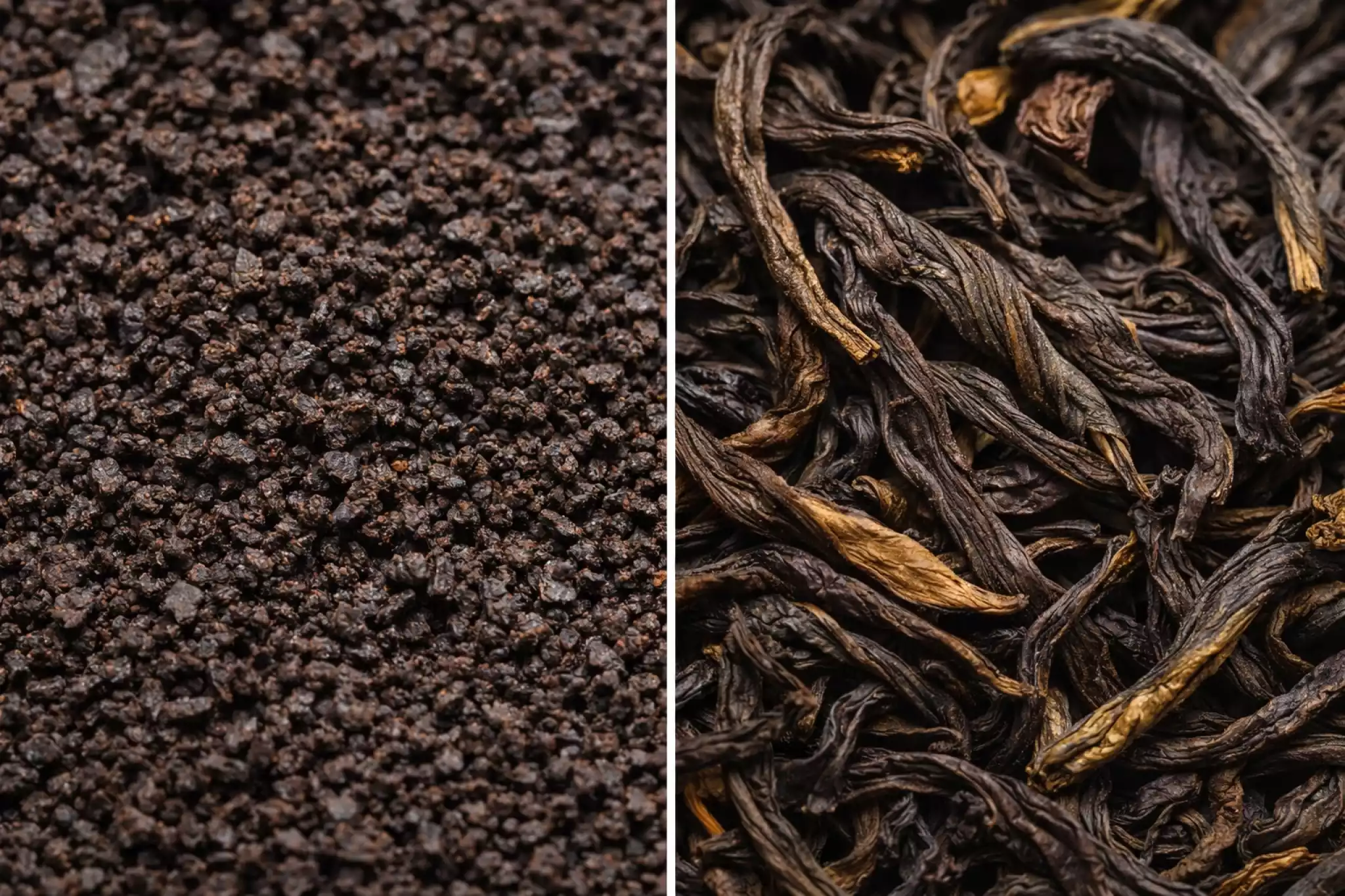
Let's start with the fundamental structural difference that changes everything:
Western CTC Tea
Structure: Crushed, torn, and curled into tiny fragments
Surface Area: Massive—like sand particles
Extraction Speed: Instant, violent release
Designed For: Single 3-5 minute steep, maximum tannin punch
Examples: English Breakfast, Earl Grey, most bagged teas
Chinese Whole Leaf Tea
Structure: Intact leaves, carefully twisted or rolled
Surface Area: Minimal when dry, expands gradually
Extraction Speed: Slow, controlled unfurling
Designed For: Multiple short steeps, layered complexity
Examples: Dian Hong, Jin Jun Mei, Zheng Shan Xiao Zhong
The Physics of Extraction: Why This Matters
CTC tea processing was invented in the 1930s to solve a commercial problem: how to extract maximum flavor quickly from cheaper tea material. The method works through mechanical violence—crushing leaves into thousands of fragments, exponentially increasing surface area.
Think of it like this:
- Whole leaf: Like a sponge—absorbs water gradually, releases compounds in stages
- CTC fragments: Like confetti thrown in water—instant saturation, immediate release
CTC tea is designed for the tannin wallop that pairs well with Earl Grey's citrus bergamot or English Breakfast's malty robustness. A five-minute steep in boiling water? That's exactly what CTC wants. It surrenders everything at once.
The Critical Insight
When you steep high-grade Chinese whole leaf tea for 5 minutes in a large pot with boiling water, you aren't getting "more flavor"—you're drowning the tea's nuances in a sea of over-extracted tannins.
It's like listening to a symphony orchestra at maximum volume with all instruments playing simultaneously. Yes, it's loud. But can you hear the individual sections? The dialogue between instruments? The dynamic range?
You've compressed a multi-movement symphony into one overwhelming blast of sound.
The Brewing Dialectic: Linear vs. Layered
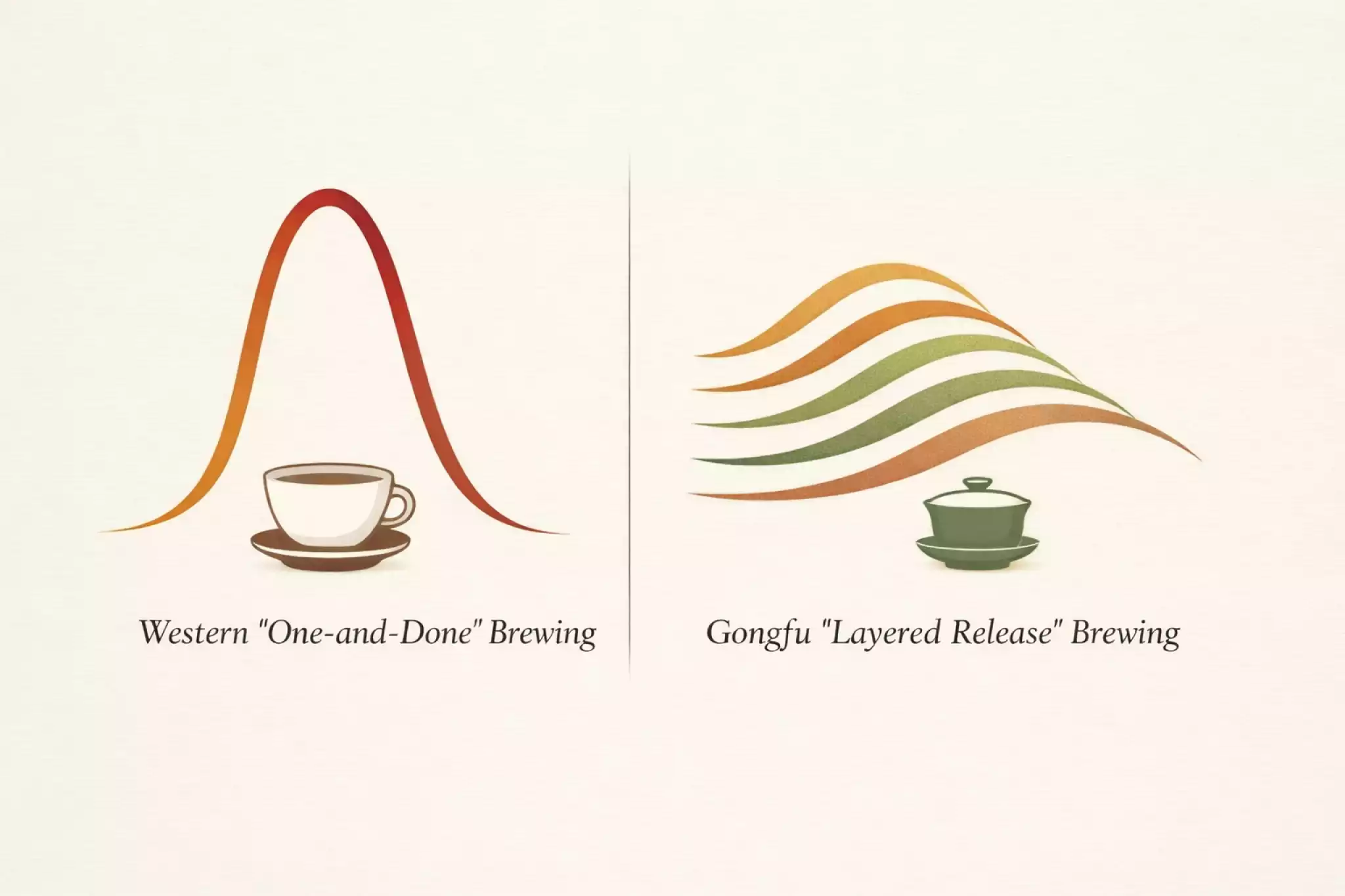
Here's where we get to the heart of the matter: Western and Chinese tea brewing operate on fundamentally different temporal philosophies.
The Western Pot: The Sprint
Western brewing is linear. You extract once. You extract completely. The flavor profile you get in that five-minute steep is static—a single snapshot of what the tea contains.
Typical Western Method:
- Large pot (600-1000ml capacity)
- Boiling water (100°C)
- 1 tablespoon tea per cup (~6-8g for the whole pot)
- Steep: 3-5 minutes
- Result: Dark, strong, one-dimensional liquor
This is a sprint to the finish line. Get everything out. Pour. Done. Move on with your day.
For CTC breakfast blends destined for milk? Perfect. For delicate whole-leaf Chinese red tea? Disaster.
The Gongfu Way: The Marathon
Chinese Gongfu Cha (功夫茶, "skill tea") brewing is layered. You don't extract everything at once. You coax the tea open across multiple infusions, each revealing a different character.
Typical Gongfu Method:
- Small vessel: Gaiwan (盖碗) or Yixing pot (100-150ml)
- Water temperature: 85-95°C depending on tea delicacy
- Tea-to-water ratio: High (5-7g for 100-120ml)
- Steep times: 10-30 seconds per infusion
- Result: 6-10+ infusions, each with distinct character
The Journey Through Infusions
🌸 Infusion 1-2: The Awakening (10-15 seconds)
What's happening: Leaves begin to unfurl, releasing surface aromatics.
Flavor profile: Delicate, floral, bright. Think honeysuckle, fresh hay, gentle sweetness.
Color: Light amber, transparent, glowing.
🍯 Infusion 3-5: The Body (15-25 seconds)
What's happening: Leaves fully open, releasing body and malt.
Flavor profile: Rich chocolate, caramel, dried fruit. This is the tea's heart.
Color: Deep burgundy-red, still clear.
🌿 Infusion 6-8: The Sweetness (20-40 seconds)
What's happening: Deep cellular compounds emerge slowly.
Flavor profile: Lingering sweetness (Hui Gan, 回甘), mineral notes, subtle woodiness.
Color: Lighter again, golden-amber.
💫 Infusion 9+: The Echo (40+ seconds)
What's happening: Final whispers, contemplative finish.
Flavor profile: Soft, meditative, clean sweetness.
Color: Pale gold.
Why would you want to experience the whole story in one overwhelming sentence when you could read it chapter by chapter, savoring each page?
This is the marathon approach. You're not extracting—you're conversing with the tea. Each infusion is a reply, a different facet of the same leaf revealing itself as it opens fully.
The Invisible Enemy: Hard Water & The Tannin Clash
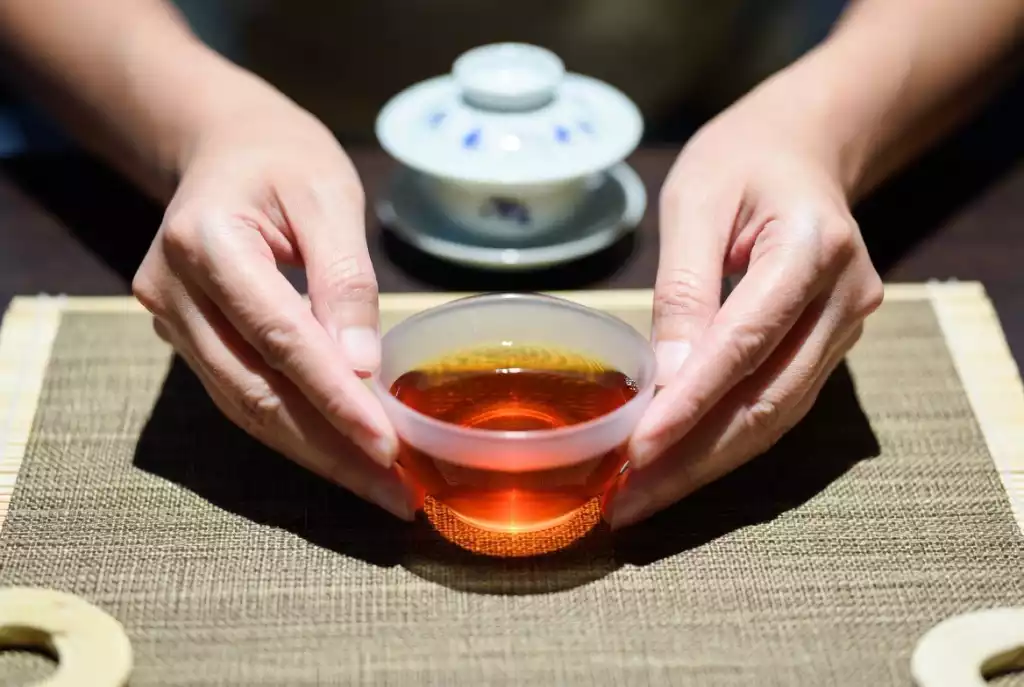
Even if you switch to shorter steeps, there's another silent saboteur in most Western kitchens: hard water.
The Water Problem
Most households in Europe and North America have moderately to severely hard water—meaning high concentrations of dissolved minerals, primarily calcium and magnesium ions.
Hardness Levels (mg/L CaCO₃):
- Soft: 0-60 mg/L
- Moderate: 61-120 mg/L
- Hard: 121-180 mg/L
- Very Hard: 180+ mg/L
If you live in cities like London, Los Angeles, Phoenix, or large parts of the American Midwest, your tap water likely falls into the "hard" or "very hard" category.
The Chemistry: What Hard Water Does to Tea
Here's where it gets technical—but stay with me, because this explains why your expensive tea might taste dull:
The Polyphenol-Mineral Reaction
Tea's flavor compounds—particularly the delicate polyphenols and catechins that create nuanced sweetness and floral notes—are negatively charged.
Hard water's calcium (Ca²⁺) and magnesium (Mg²⁺) ions are positively charged.
What happens: These positive ions bind with tea's flavor compounds, creating larger molecular complexes that:
- Precipitate out of solution (the film you see on the surface)
- Taste metallic and flat
- Mask delicate aromatics
- Turn the liquor muddy instead of clear
The Visual Test
Pour premium Dian Hong with hard water vs. soft water:
Hard Water Result
- Dark, opaque brown
- Oily film on surface
- Metallic, flat taste
- Astringent bite
- Sediment in cup
Soft Water Result
- Brilliant burgundy-amber
- Crystal clear
- Sweet, clean mouthfeel
- Smooth, round body
- No sediment
🌊 Steeped Roots Water Solution
Immediate fix: Use filtered water. A simple carbon filter (Brita, etc.) removes chlorine and reduces some mineral content.
Better solution: Bottled spring water with low mineral content. Look for total dissolved solids (TDS) under 100 ppm.
Optimal solution: Remineralized reverse osmosis water or naturally soft spring water (TDS 50-80 ppm with balanced mineral profile).
The difference: Night and day. You'll unlock aromatics you didn't know existed—honeyed sweetness, stone fruit notes, floral complexity—that hard water literally "cages" through chemical binding.
From "Black" to "Red": A Mindset Shift
Before we conclude, let's address the terminology confusion—because language shapes how we think about tea.
Why "Red" Tea in Chinese?
In China, what Westerners call "black tea" is called Hong Cha (红茶, literally "red tea"). The name refers to the color of the brewed liquor—a bright, clear red-amber when properly prepared.
True "black tea" (Hei Cha, 黑茶) is a different category entirely—fermented teas like Pu-erh that brew dark brown or nearly black.
The naming tells us something crucial: Chinese tea culture judges Hong Cha by its liquor's clarity and color, not its strength or opacity.
Cultural Philosophy Behind the Name
The term "red tea" reflects an aesthetic preference: transparency, brilliance, life. A properly brewed Chinese red tea should glow when held to light—like backlit amber or fine red wine.
The Western term "black tea" reflects a different priority: strength, robustness, boldness. The darker and stronger, the better for cutting through milk and sugar.
Same leaf. Different philosophy. Different outcome.
The Milk Question: Breaking the Earl Grey Habit
Let's address the elephant in the teacup: milk.
Adding milk to Western black tea makes perfect sense. CTC processing creates aggressive tannins that need buffering. The bergamot in Earl Grey is punchy and benefits from dairy's fat content. English Breakfast is malty but astringent—milk rounds it beautifully.
But high-grade Chinese red tea is fundamentally different:
- Naturally sweet: Whole leaf processing preserves sugars and amino acids
- Inherently smooth: Controlled oxidation creates "roundness" without harshness
- Complex aromatics: Honey, chocolate, dried fruit, flowers—subtle notes milk would obliterate
Adding Milk to Premium Dian Hong or Jin Jun Mei is Like...
...putting ketchup on wagyu beef. You're using a condiment designed to improve mediocre ingredients on something that's already perfect. The milk isn't enhancing—it's masking.
If you feel your Chinese red tea needs milk to be palatable, one of three things is happening:
- You're over-extracting (too long, too hot)
- Your water is too hard (minerals creating metallic bitterness)
- The tea quality is genuinely low (in which case, milk might help, but consider buying better tea)
Try this experiment: Brew your Chinese red tea gongfu-style with soft water. If it still tastes harsh and you "need" milk, you probably need different tea—not different technique.
Practical Transition Guide: Your First Gongfu Session
Ready to break free from the Earl Grey Trap? Here's your step-by-step transition plan:
What You'll Need
- Small brewing vessel: 100-150ml Gaiwan or small teapot (search "gongfu tea set" online)
- Filtered or soft water: Test with bottled spring water first
- Quality whole-leaf Chinese red tea: Start with Dian Hong (forgiving, sweet) or Jin Jun Mei (more delicate)
- Small serving cups: 30-50ml capacity
- Timer or phone: For tracking steep times
The Method
| Step | Action | Why |
|---|---|---|
| 1. Warm Vessel | Pour hot water in gaiwan, swirl, discard | Prevents temperature shock to leaves |
| 2. Add Tea | 5-6g for 100-120ml vessel | High ratio enables multiple infusions |
| 3. Rinse (Optional) | 5-second pour, discard immediately | Awakens dry leaves, removes dust |
| 4. First Infusion | 90-95°C water, 10-15 seconds | Gentle opening—floral notes emerge |
| 5. Subsequent Infusions | Add 5-10 seconds each round | Gradual deepening of body |
| 6. Observe | Watch leaves unfurl, color changes | Visual meditation, quality indicator |
| 7. Continue | 6-10 infusions typical for good tea | Each round reveals new dimension |
What You'll Notice
First infusion: "Wow, this is delicate. Almost too light?"
Third infusion: "Oh, there's the body. Chocolate. Honey. This is lovely."
Sixth infusion: "The sweetness lingers. And it's still going?"
Ninth infusion: "I can't believe these leaves are still giving flavor. And no bitterness."
That's the journey. That's what you were missing.
A New Ritual: Beyond Drinking to Experiencing
Here's what I'm not saying: throw away your teapot, abandon your Western tea traditions, or feel guilty about enjoying Earl Grey with milk and scones. Those traditions are beautiful and valid in their own context.
What I am saying: give your Chinese tea leaves a chance to breathe.
When you've invested in premium Dian Hong from ancient trees, or rare Jin Jun Mei from Wuyi Mountain, or smoky Zheng Shan Xiao Zhong from Tongmu Village—these teas were grown, picked, and processed with a specific brewing method in mind.
To brew them like English Breakfast is to read poetry as a technical manual. The words are there, but the meaning is lost.
The Invitation
Try this: Set aside 30 minutes. No distractions. No milk. No sugar. Just you, a small gaiwan, soft water, and quality Chinese red tea.
Brew it gongfu-style. Six infusions minimum.
Notice how the tea changes. How it develops. How layers reveal themselves like chapters in a story you're reading for the first time.
That's when you'll understand: stepping out of the Earl Grey Trap isn't just about brewing technique. It's about moving from "drinking tea" to "experiencing tea."
The leaves are the same. The water is H₂O. But the encounter—that changes everything.
Frequently Asked Questions
Can I still use my Western teapot for Chinese red tea if I adjust the timing?
Technically yes, but you'll get suboptimal results. The issue isn't just timing—it's the tea-to-water ratio. Large Western pots (600-1000ml) make it nearly impossible to achieve the high ratio (5-7g per 100ml) needed for proper layered extraction. With low ratios, even short steeps won't unlock the tea's full complexity. Think of it like trying to make espresso in a French press—wrong tool for the job.
Is gongfu brewing only for expensive tea?
No! Gongfu method actually helps you extract maximum value from any whole-leaf tea. Even mid-grade Chinese red tea shows dramatic improvement with proper technique. That said, CTC tea (tea bags, English Breakfast) won't benefit—it's structurally designed for single extraction. Save gongfu for whole leaves.
How do I know if my water is too hard for good tea?
Visual test: If your tea develops an oily film on the surface and looks murky instead of clear, your water is likely too hard. Taste test: Metallic or flat flavors with high-quality tea suggest mineral interference. Easy fix: Buy one bottle of naturally soft spring water (check label for TDS under 100 ppm) and compare side-by-side. The difference will be immediately obvious.
What if I don't have time for 10 infusions?
Do 3-4 "consolidated" infusions with slightly longer steep times (20-30 seconds each). You won't get the full layered experience, but you'll still extract far more complexity than one 5-minute Western steep. Think of it as reading a book chapter-by-chapter vs. speed-reading—both work, but the experience differs. Even 3 infusions beats 1.
Why does my Chinese red tea taste bitter even with short steeps?
Three likely culprits: (1) Water too hot—delicate teas like Jin Jun Mei need 85-90°C, not boiling. (2) Hard water—minerals amplify bitterness. (3) Low-quality tea—poor processing leaves residual stem bitterness that no technique can fix. Try softer, cooler water first. If still bitter, the tea itself may be the issue.
🍵 Continue Your Journey
- Black Tea or Red Tea: The Cultural Naming Phenomenon of Hong Cha
- Twin Pillars of Yunnan Tea: Decoding the Genetic Code of Dianhong and Raw Pu'er
- Mastering Water Temperature for Brewing Tea: The 2026 Guide
- Differences in Tea Brewing: Gaiwan vs. Yixing Teapot vs. Metal Tea Ball
- How to Taste Chinese Black Tea (Hong Cha): Vividly Describing Mouthfeel & Sensory Layers

