
How to Taste Chinese Black Tea (Hong Cha):
Vividly Describing Mouthfeel & Sensory Layers
To taste Chinese black tea (Hong Cha) with full awareness, evaluate four sequential layers: The First Encounter (initial tongue impact), Mid-palate Unfolding (texture and thickness), Throat Finish & Hui Gan (returning sweetness and coolness), and Body Resonance (Cha Qi — physical warmth and expansion). Use concrete imagery — silk, honey, autumn wind, velvet — rather than abstract adjectives to transform sensory experience into vivid, memorable language.
The very first time you truly savor a cup of high-quality Chinese black tea — known as Hong Cha (红茶), literally "red tea" in Chinese, a naming divergence with its own fascinating cultural history — the moment the liquor touches your tongue often transcends mere "good taste." It becomes a delicate sensory adventure.
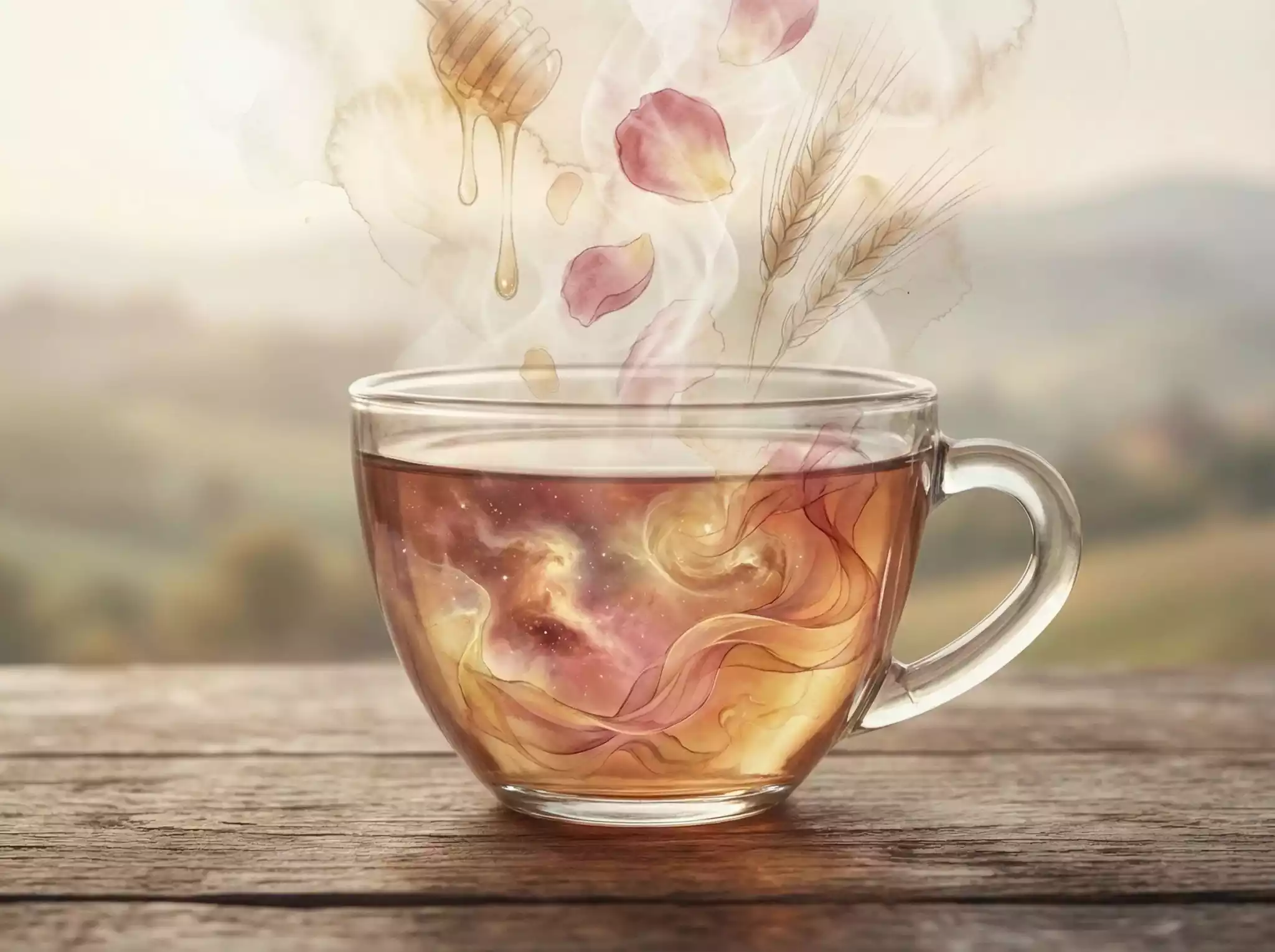
It may glide across the tip of your tongue like silk, carrying a whisper of honeyed sweetness; or envelop you like warm autumn sunlight, rich with the depth of malt and the subtle bitterness of cocoa, slowly blooming across the palate. Even after swallowing, a cool, returning sweetness lingers in the throat — as if a hidden mountain spring quietly rises.
Many people think black tea is "just okay," but in truth, the mouthfeel of truly exceptional Hong Cha is far more captivating than flavor alone. It can be as light as a breeze brushing the face, or as weighty as velvet wrapping the tongue; it can instantly refresh and invigorate, or unfold layer by layer with a long, lingering finish.
This guide will teach you how to describe the mouthfeel of Chinese black tea in vivid, almost literary language — from the initial impact on the tongue, through the mid-palate unfolding, to the throat sensation and returning sweetness. Once you master this, you'll be able to turn an ordinary cup of black tea into a poetic journey on the tip of the tongue.
Core Dimensions of Mouthfeel: From Entry to Afterglow
The mouthfeel of black tea is not a single "taste" — it is a symphony of multiple sensations unfolding in sequence. When tasting mindfully, feel and describe in this order:
- The First Encounter — the very first moment the liquor contacts the tongue: a fresh, sharp prick, or a gentle embrace?
- Mid-palate Unfolding — how the tea spreads and blooms across the mouth: thick, silky, full, or light?
- Throat Sensation & Returning Sweetness (Hui Gan 回甘) — after swallowing, the reaction in the throat, base of the tongue, and cheeks: sweetness rising, coolness emerging, or warm lingering?
- Body Resonance (Cha Qi 茶气) — does the tea energy warm your palms, gently heat your back, or bring a quiet sense of expansion? The biochemistry behind this sensation — L-theanine and caffeine working in concert — is more fascinating than you might expect.
Why do Westerners call it "black tea" while the Chinese call the same tea "red tea" (红茶)? The two traditions describe different things: Chinese observers see the color of the liquor (amber-red); Westerners describe the dry leaf (dark, oxidized). The full cultural divergence behind this naming phenomenon is worth reading.
Sensory Vocabulary Reference: A Tasting Lexicon
Each texture term below is paired with a concrete literary image and the teas where that quality appears most distinctively — so you can match the language to what is actually in your cup.
| Texture Term | Literary Imagery | Layer | Best Exemplars |
|---|---|---|---|
| Silky | A pearl rolled across satin — no friction, barely a sound, only smoothness | First Encounter → Mid-palate | Jin Jun MeiYoung Dianhong |
| Velvety | A plush coat wrapping every surface of the tongue — full, warm, unhurried | Mid-palate | Aged DianhongKeemun Hao Ya |
| Round & Plump | A ripe persimmon pressing gently between palate and tongue — no sharp edges, only sweet weight | Mid-palate | KeemunShou Puerh |
| Light & Transparent | Morning mist through mountain bamboo — present but weightless, carrying floral delicacy | First Encounter | White-Tipped DianhongShai Hong |
| Hui Gan (Returning Sweetness) | An echo in the mountains — tea is swallowed but sweetness rises from the throat, wave after wave | Throat Finish | Zhengshan XiaozhongSheng Puerh |
| Cooling Finish | A summer night breeze arriving in the throat — unexpected and quietly relieving | Throat Finish | High-Mountain DianhongJin Jun Mei |
| Astringent but Clean | A firm handshake with dry palms — present, but not unpleasant; it resolves into sweetness | Mid-palate → Throat | Young KeemunZhengshan Xiaozhong |
| Salivating (Sheng Jin 生津) | Holding a honeyed date under the tongue — saliva wells up involuntarily, sweet and continuous | Throat Finish → Lingering | Jin Jun MeiAncient-Tree Dianhong |
Vivid Vocabulary & Imagery: Layer by Layer
These phrases are organized by the four sensory layers. Use them directly, combine them, or let them inspire your own images — the goal is precision through concreteness.
Layer One — The First Encounter
- Like fine needles gently pricking the tongue tip — fresh and lively with a hint of tart sweetness
- Like warm honey instantly flooding the taste buds — soft yet carrying hidden strength
- As though the wind from an autumn wheat field rushes forward — rich with malty depth
- Melts on entry like silk sliding past, yet conceals a subtle cocoa bitterness beneath
Layer Two — Mid-palate Unfolding (Texture & Thickness)
- The liquor wraps the palate like velvet — thick and full, embracing every inch of the tongue
- Silky and fine, gliding down the throat almost without resistance
- Rich and weighty, like melting dark chocolate slowly dissolving across the tongue
- Light yet not thin — drifting through the mouth like morning mist among mountains, carrying floral-fruity delicacy
- Round and plump — gently filling the mouth without ever feeling heavy
Layer Three — Throat Sensation, Hui Gan & Salivation
- After swallowing, the throat feels bathed in a cool spring — sweetness rising in gentle waves
- The base of the tongue begins to salivate, as though holding a honeyed date — sweetness slowly spreading from the throat
- Returning sweetness deep and long-lasting, like an echo in the mountains — wave after wave
- Throat finish cool and refreshing, like a summer night breeze brushing past, bringing quiet relief
- Aftertaste lingers endlessly, like the resonant notes of an ancient qin — echoing long after the cup is empty
Layer Four — Body Resonance (Cha Qi)
- Tea energy rises slowly, warming the palms, gently heating the back — embracing the whole body like a soft hug
- After drinking, the chest feels open and released — as if stagnant tension is quietly melted by a warm current
- One sip after another, fine sweat appears at the tip of the nose, as though a gentle breeze rises from under the arms
To understand the physiological mechanism behind these sensations — why L-theanine creates warmth without agitation, and how caffeine's effect differs when delivered through tea rather than coffee — see our deep dive on understanding Cha Qi.
Four Teas, Four Portraits
The following apply the vocabulary above to four of China's most celebrated black teas. Each opens with a single-sentence Core Identity — a conceptual key for holding the tea in memory.
🍯 Yunnan Dianhong (滇红)
"If Dianhong is a warm hug, it is the kind that comes from someone who has been standing in the autumn sun all afternoon."
Entry is like melted caramel intertwined with cocoa; the liquor is thick as a velvet coat wrapping the tongue. After swallowing, a honeyed sweetness surges in the throat, returning like warm mountain sunlight — long, unbroken, deeply comforting. Dianhong's exceptional body originates in Yunnan's ancient large-leaf assamica trees, whose thick cell walls hold more extractable compounds than any smaller-leaf variety. The same botanical lineage that makes Dianhong thick also underlies the structural power of Raw Pu-erh.
🌹 Keemun (祁门红茶)
"If Dianhong is a warm hug, Keemun is a scholarly whisper — measured, layered, remembered long after it fades."
The first sip carries light smoke and pine, then unfolds into the quiet fragrance of rose and orchid. The body is round and full, blooming slowly in the mouth like old wine meeting a dry palate. The finish is elegant with a gentle fermented sweetness — intellectually complex in the way great poetry is complex: understood immediately, yet returned to repeatedly.
✨ Jin Jun Mei (金骏眉)
"Jin Jun Mei is the most polished conversation you will ever have with a tea leaf — everything implied, nothing overstated."
The liquor is fine as baby skin. Entry is pure honey and caramel, sliding across the tongue almost traceless — yet the moment it is swallowed, endless clear sweetness wells up from the base of the tongue, as though a hidden honey spring lies in the throat. The salivation (Sheng Jin) is remarkable: involuntary, gentle, continuous — a sign of abundant amino acids preserved by meticulous bud-only harvesting.
🔥 Zhengshan Xiaozhong (正山小种 / Lapsang Souchong)
"Zhengshan Xiaozhong is a campfire story — wild, primordial, and impossible to forget once you have sat beside it."
Entry feels like the lingering warmth of campfire embers. Pine smoke and caramel entwine; the liquor is strong and thick, like winter hearth heat spreading outward. After swallowing, pine resin lingers coolly in the throat, carrying an untamed mineral power. This is not subtlety — it is full declaration, and it demands your complete attention.
How to Practice More Vivid Descriptions
- Begin with complete stillness Close your eyes before the first sip. Take a slow breath. Bring full attention to the present moment. Feel the warmth of the cup before forming any language about the tea.
- Anchor abstractions to physical images Start sentences with "like…" or "as though…" and transform abstract sensations into concrete objects — silk, honey spring, autumn wind, dark chocolate, campfire, mountain breeze. Specific images are always more memorable than general adjectives.
- Record each brew sequentially Note the First Encounter, Mid-palate texture, Throat finish, and Body response for every session. Over time, your vocabulary expands and your memory of the tea's personality deepens.
- Avoid the over-steeping trap The most common error in Western-style mug brewing is over-steeping, which destroys the delicate First Encounter and replaces it with harsh astringency — making vivid description nearly impossible. Understand why the "Earl Grey method" fails fine Chinese black tea, and pair it with a proper water temperature guide for optimal extraction.
- Describe aloud to another person Sharing your description forces precision. You will be surprised at how beautifully you can express what you felt once the social pressure of accuracy replaces the private comfort of approximation.
Final Thought
The mouthfeel of black tea is the shared creation of time, soil, craftsmanship, and human attention. It is not merely a beverage, but a dialogue between the tongue and the soul. Once you learn to describe it in vivid language, you are no longer simply "drinking tea" — you are breathing together with thousand-year-old tea trees, artisans' hands, mountain mists, and flowing streams.
"The tea is already waiting. All that remains is for you to arrive fully at the moment of the first sip."
For those who wish to carry this sensory intentionality into a busy workday — rather than reserving it for weekend ceremonies — the 2 g Tea Rhythm protocol offers a practical framework for transforming three ordinary office refills into three distinct, mindful experiences.
The next time a cup of Hong Cha touches your lips, pause. Feel deeply. Then speak that feeling with the most precise, most beautiful words you can find.
Frequently Asked Questions
What is the difference between "round and rich" and "heavy" in mouthfeel?
"Round and rich" refers to a full, plump, sweet, and layered texture — like comfortable velvet, with no rough edges and a pleasant sweetness throughout. "Heavy" implies weight and sometimes a slight pressure on the palate with a drying sensation; it is more common in heavily fermented Dianhong or aged teas. Round is always pleasant. Heavy can be either powerful or fatiguing depending on the tea and the drinker.
What is the difference between Hui Gan (returning sweetness) and Sheng Jin (salivation)?
Returning sweetness (Hui Gan 回甘) is the natural rise of sweetness specifically from the throat after swallowing — it arrives 5–30 seconds post-sip, like an echo returning. Salivation (Sheng Jin 生津) is the continuous production of saliva on the tongue surface and cheeks — more immediate and at a different anatomical location. High-quality teas produce both simultaneously; great teas sustain both for several minutes after the cup is finished.
Why does some Chinese black tea leave a cooling sensation in the throat?
A cooling throat finish is one of the clearest markers of high-quality black tea — most common in high-mountain material or teas with a high golden-bud ratio (such as Jin Jun Mei or ancient-tree Dianhong). The sensation arises from a combination of factors: high concentrations of amino acids (particularly L-theanine), a balanced polyphenol profile that creates no dryness, and naturally occurring aromatic terpenoids that create a menthol-adjacent impression without any actual menthol present. It indicates rich inner substance and a non-drying tea nature.
How do I accurately describe "Cha Qi" (tea energy)?
Cha Qi (茶气) is the overall physical and energetic response of the body after drinking — distinct from taste or aroma. Common expressions include warming of the palms, gentle heat spreading across the back, light perspiration at the temples or under the arms, and a quiet sense of mental expansion. A vivid description: "The tea energy rises slowly from the center of the body, like a warm current from the dantian, gently soothing outward." For the biochemical explanation of why certain teas produce stronger Cha Qi than others, see our complete guide to Cha Qi.
What is the best way to brew Chinese black tea for tasting practice?
For sensory evaluation, use a Gaiwan or small porcelain cup: 3–4 g of leaf per 150 ml at 95–100°C, for 20–30 seconds for the first steep (Gongfu method). This produces a concentrated, layered infusion that expresses all four sensory dimensions clearly. Avoid over-steeping in a large mug, which flattens the First Encounter and makes mid-palate texture indistinguishable. Use a white porcelain cup to observe liquor color and check for the "golden ring" (金圈) at the liquor's edge — a hallmark of quality leaf and high theaflavin content.
🍃 Deepen Your Tea Journey
- Understanding Cha Qi — Beyond taste: the energetic resonance of tea and its biochemical roots
- Black Tea or Red Tea? — The cultural naming phenomenon of Hong Cha explained
- Twin Pillars of Yunnan Tea — The genetic code shared by Dianhong and Raw Pu-erh
- What Is Tea Tasting? — A broader introduction to the practice and vocabulary
- Beyond the Earl Grey Trap — Why Western brewing habits obscure fine Chinese black tea
- Water Temperature Guide 2026 — The precise temperatures for every tea type
- Managing Career Energy with a 2 g Tea Rhythm — Sensory practice integrated into a real workday