
Complete Tea Brewing Guide: Gaiwan, Yixing & Teapot Methods for Every Tea Format
2026 Edition – Master Loose Leaf, Compressed Cakes & Micro-Cakes with Professional Precision
Quick Start: Mastering Tea Brewing (2026)
Universal Parameters: Use a 5g:100ml leaf-to-water ratio for loose leaf tea. For compressed cakes, use 6-8g per 100ml. For 2g micro-cakes, one disc per 100-120ml vessel yields optimal flavor.
Vessel Choice Matters: Gaiwans offer precision and neutrality (best for evaluation). Yixing clay pots enhance aged teas through porosity. Western teapots work for convenience but require adjustment to leaf ratios (2-3g per 200-300ml for single long steeps).
Tea Format Guide: Loose leaf needs no preparation. Compressed cakes require gentle breaking and benefit from longer rinse (8-10s). 2g micro-cakes drop directly into vessel—no breaking needed.
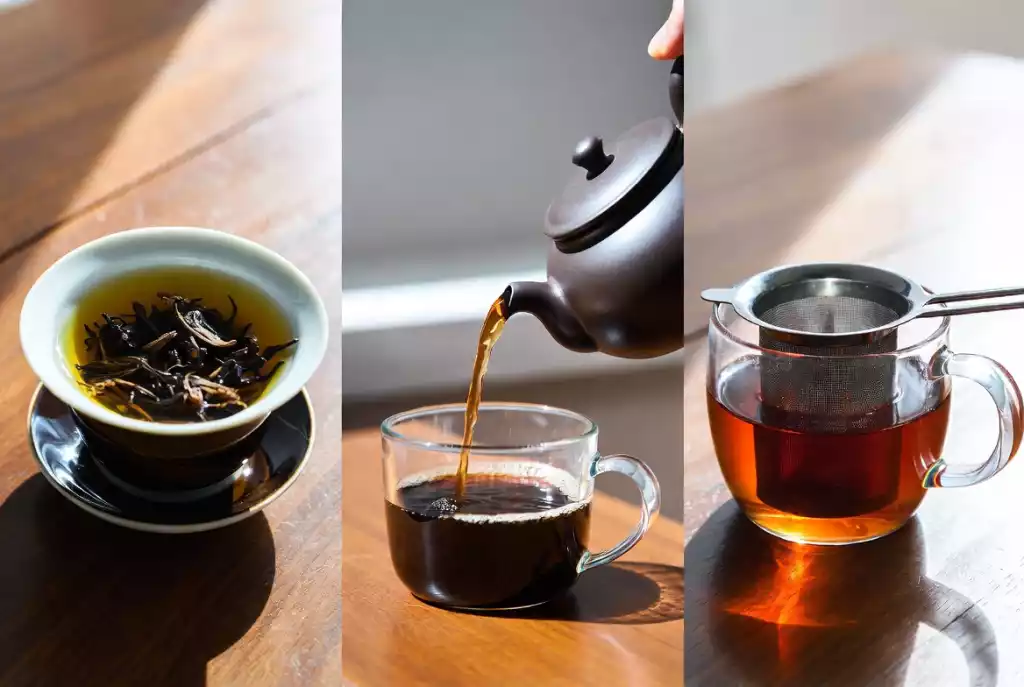
Great tea doesn't require expensive equipment—but understanding how different vessels and tea formats interact transforms your brewing from guesswork into precision craft.
This comprehensive guide covers three essential brewing vessels—the gaiwan (Chinese lidded bowl), Yixing clay pot, and Western teapot—plus how to handle three tea formats: loose leaf, compressed cakes, and modern 2g micro-cakes.
Whether you're brewing delicate white tea in a porcelain gaiwan, aged Pu-erh in a seasoned Yixing pot, or morning black tea in a Western teapot, the principles remain: control temperature, adjust ratios, and respect the leaf.
By the end of this guide, you'll understand not just how to brew, but why each method works—and when to choose one over another.
The Mindset: Brewing as Moving Meditation
In the East, we often say "Tea and Zen are of the same flavor" (Cha Chan Yi Wei 茶禅一味). Brewing tea is not merely a chemical extraction; it is a moving meditation. As you focus on the precision of the water stream and the steady rhythm of your movements, you aren't just "taming" the leaves—you are centering your own mind.
By treating each steep as a deliberate act, the tea responds in kind, revealing layers of flavor that a rushed infusion simply cannot reach.
🫖 Choosing Your Brewing Vessel: Gaiwan, Yixing & Western Teapots Compared
Each vessel type offers distinct advantages. Understanding their differences helps you choose the right tool for each tea and situation.
Gaiwan (盖碗) – The Precision Instrument
Advantages:
- Chemical neutrality: Porcelain doesn't absorb or add flavors—reveals tea's true character
- Visual feedback: Watch leaves unfurl and liquor color develop
- Temperature control: Quick heat dissipation prevents over-extraction
- Easy cleaning: Switch between tea types without cross-contamination
- Gongfu-ready: Designed for multiple short infusions
Limitations: Learning curve for handling; requires attention (can't "set and forget")
Recommended reading: Complete Gaiwan Brewing Technique Guide
Flavor Profile: Expect bright, high-pitched aromatics and a crystal-clear representation of the tea’s original terroir.
Yixing Teapot (宜兴紫砂壶) – The Flavor Enhancer
Advantages:
- Porous clay interaction: Zisha clay has 10-15% porosity that "breathes" with tea¹
- Adsorption of off-notes: Pores capture warehouse smells and harsh volatiles
- Heat retention: Thick walls maintain temperature for sustained extraction
- Seasoning over time: Pot develops patina that enhances specific tea types
- Rounds harsh edges: Smooths young raw Pu-erh or over-roasted oolong
Limitations: Should dedicate one pot per tea category; expensive ($50-500+); masks delicate aromatics
Recommended reading: How Zisha Clay Transforms Tea Flavor
Flavor Profile: Expect a rounder, thicker mouthfeel; the clay softens harsh edges and amplifies the "body" of aged teas.
Western Teapot – The Convenience Champion
Advantages:
- Large capacity: 400-1000ml serves groups efficientFairness pitcherly
- Built-in strainer: No separate fairness pitcher(Gongdao Bei 公道杯) needed
- Familiar format: No learning curve for Western users
- Set-and-steep: Add leaves, pour water, wait 3-5 mAroma cupinutes—done(Wen Xiang Bei 闻香杯)
- Lower leaf cost: Uses 2-3g per 200-300ml (vs. 5-8g gongfu style)
Limitations: Single long steep extracts less complexity than multiple short infusions; difficult to control extraction precisely
Adaptation tip: Can be used for gongfu-style if you reduce capacity usage (only fill 1/4 to maintain proper ratio)
Flavor Profile: Expect a bold, consistent, and singular flavor profile, though with slightly less aromatic nuance than Gongfu methods.
| Feature | Gaiwan | Yixing Pot | Western Teapot |
|---|---|---|---|
| Capacity | 100-150ml | 120-250ml | 400-1000ml |
| Material | Porcelain (inert) | Porous clay (interactive) | Porcelain/glass/ceramic |
| Brewing Style | Gongfu (multiple short) | Gongfu (multiple short) | Western (one long) |
| Leaf Ratio | 5-8g per 100ml | 6-10g per 100ml | 2-3g per 200-300ml |
| Steep Time | 5-30s per infusion | 8-40s per infusion | 3-5 minutes total |
| Total Infusions | 6-15+ | 8-12+ | 1-2 |
| Price Range | $10-150 | $50-500+ | $15-80 |
| Learning Curve | Moderate | Easy (once you own it) | Very easy |
Format Comparison: Convenience vs. Character
Ultimate Convenience & Precision
Balanced Versatility
Deep Character & Tradition
← More Convenience ———— | ———— More Ritual & Aging Potential →
🍃 Tea Formats Explained: Loose Leaf, Compressed Cakes & 2g Micro-Cakes
How you prepare tea depends significantly on its format. Each requires different handling, rinsing protocols, and sometimes adjusted brewing parameters.
Loose Leaf Tea (散茶) – The Standard
Characteristics & Handling
What it is: Individual dried leaves, fully separated and ready to brew
Examples: Most green teas, premium oolongs, single-origin black teas, some white teas
Preparation: None needed—measure directly from container
Typical amount: 5g per 100ml for gongfu; 2-3g per 200-300ml for Western
Rinse requirement:
- Skip rinse: Delicate green tea, premium white tea, tender buds
- Quick rinse (3-5s): Standard oolong, black tea (optional)
- Never rinse: Jasmine pearls or scented teas (wastes aromatics)
Advantages: Immediate brewing; easy to measure precisely; aromatics preserved
Best vessels: Gaiwan (precision), Western teapot (convenience)
Compressed Tea Cakes (茶饼) – Traditional Storage
Characteristics & Handling
What it is: Leaves pressed into cakes (typically 100g, 200g, or 357g) for aging and storage
Examples: Pu-erh (raw and ripe), white tea cakes, Liu Bao hei cha
Preparation Required: Must be gently broken with a tea knife or pick—never crumble by hand, which damages leaves and creates dust
Typical amount: 6-8g per 100ml (compressed leaves expand significantly)
Rinse requirement:
- Always rinse: 8-10 seconds for compressed Pu-erh (longer than loose leaf)
- Purpose: Remove compression dust, awaken dormant leaves, initiate expansion
- Water temp: Full boiling (95-100°C) helps penetrate compression
Why longer rinse: Compression creates tightly packed layers. Research shows compressed tea requires 30-50% longer contact time for complete hydration compared to loose leaf²
Advantages: Better aging potential; traditional authenticity; often higher quality selection
Best vessels: Yixing pot (enhances aged character), Gaiwan (observe expansion)
2g Micro-Cakes (微压茶) – Modern Innovation
Characteristics & Handling
What it is: Individual 2g portions, lightly compressed for convenience. Read more in our Micro Compressed Tea Industry Framework
Examples: Steeped Roots 2g discs, modern single-serve formats
Preparation: Drop entire disc directly into vessel—no breaking required
Perfect dosing: Engineered for 100-120ml vessels (one disc = one session)
Rinse requirement:
- Optional quick rinse (3-5s): Lighter compression than cakes; leaves hydrate faster
- For raw Pu-erh micro-cakes: 5-8s rinse recommended
- For ripe Pu-erh micro-cakes: 5-10s rinse removes any surface fermentation residue
Compression advantage: Optimal density (0.45-0.65 g/cm³) allows faster hydration than traditional cakes but slower than loose leaf—achieving ideal extraction curve³
Advantages: Zero prep; precise dosing; portable; beginner-friendly; no tea knife needed
Best vessels: Any—works perfectly in gaiwan, Yixing, Western teapot, or mug with infuser
Office-friendly: See our guide to brewing 2g cakes at your desk
Quick Reference: Rinse Times by Format
- Loose leaf green/white tea: No rinse (0s)
- Loose leaf oolong/black: Optional 3-5s
- Compressed tea cakes: Required 8-10s
- 2g micro-cakes (raw): 5-8s
- 2g micro-cakes (ripe): 5-10s
Rule of thumb: The more compressed the tea, the longer the rinse needed to properly hydrate and awaken the leaves.
🔥 The Anti-Burn Fundamentals: Why Most Beginners Get Burned
The number one complaint about gaiwans? "It burns my fingers!" This isn't a design flaw—it's user error. Professional tea brewers never burn themselves because they understand heat management.
Never fill your gaiwan above 80% capacity. The water line should sit at least 1-2 cm below the rim. This gap prevents heat from conducting to the edge where your fingers grip. When water touches the rim, you're guaranteed to burn yourself.
Not all gaiwans are created equal. Look for vessels with a 撇口 (pie kou, "flared rim")—where the top edge curves outward and away from the hot interior. This design creates physical distance between your fingers and the hot water. Avoid gaiwans with straight or inward-curving rims.
Ideal rim width: 0.8-1.2 cm of horizontal surface for secure grip without heat transfer.
Thumb + middle finger on rim edge, index finger stabilizing lid. Your fingers should contact only the outermost rim edge—never the side walls. The lid prevents steam from escaping upward toward your hand.
Pro Tip: Confidence is Key
Beyond physical grip, your mental intent matters. Beginners often hesitate, leading to a "slow, shaky pour." This hesitation allows steam to travel upwards and heat to saturate the rim, making burns more likely.
Practice a Decisive Movement. A swift, smooth tilt creates a seal with the lid and directs the heat into the Gongdao Bei (公道杯) rather than your fingers. In tea culture, this fluid confidence reflects your Qi (气)—the vital energy that keeps the tea table harmonious and your fingers cool.
What to Do If Your Gaiwan Still Feels Too Hot
- Lower water temperature: Most teas don't need boiling water; 85-95°C works for most categories
- Pour faster: Don't let water sit in the gaiwan between steeps
- Use thicker porcelain: 3-4mm wall thickness insulates better than thin 1-2mm "competition grade" gaiwans
- Consider a gaiwan with a handle: Some modern designs include a side handle (though purists prefer traditional handleless)
Standard Gongfu Brewing Protocol (Gaiwan Method)
This universal method works for all tea types when using a gaiwan. For complete gongfu tea ceremony guidance, see our detailed tutorial. Adjust water temperature and steep time based on tea-specific parameters in the table below.
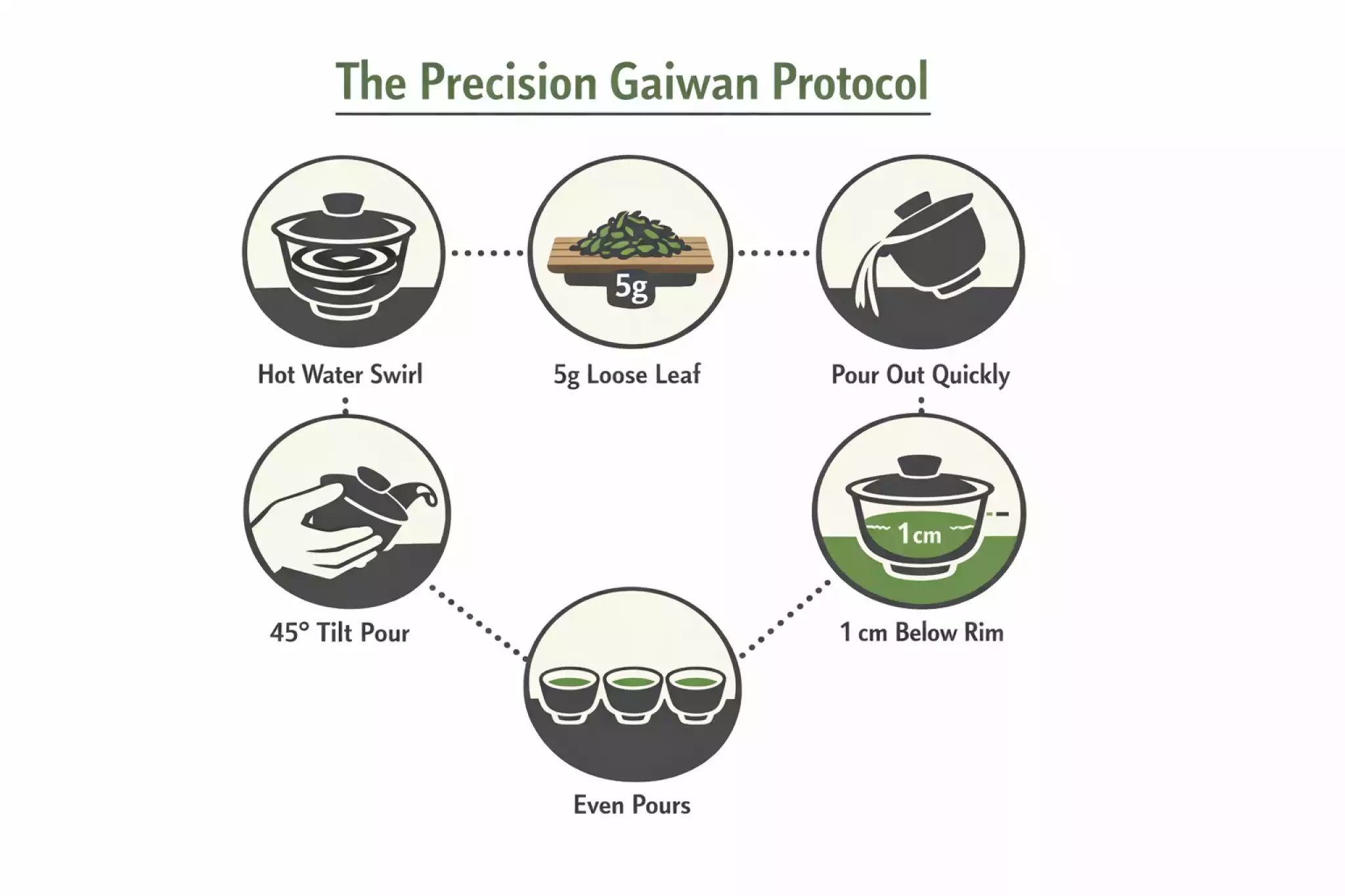
- Preheat: Pour hot water (100°C for most teas) into the gaiwan, lid on, swirl briefly. Also preheat your fairness pitcher (gongdao bei) and tasting cups. Discard water after 5-10 seconds. Why: Temperature stability prevents the first steep from cooling too quickly, ensuring proper extraction.
- Measure Tea: Add tea leaves based on vessel size—typically 5g per 100ml. For a 120ml gaiwan, use 6g. Adjust ±1g based on personal preference and tea density. Pro Tip: Compressed Pu-erh uses slightly more (6-8g per 100ml) because leaves expand significantly.
- Awaken (Optional Rinse): Pour hot water to cover leaves, immediately discard after 3-5 seconds. This "wakes up" compressed or aged teas and removes surface dust. Skip this step for: delicate green tea, high-grade white tea, or any tea you want to preserve maximum aromatics.
- First Infusion: Pour water to 80% capacity—critical anti-burn rule! Place lid at a slight angle (not fully closed) to allow steam escape. Steep for the recommended time based on tea type (see table below). Watch the clock: 5-10 seconds makes a massive difference in flavor intensity.
- The Precision Pour: Grip the rim firmly with thumb and middle finger (three-point grip). Tilt the lid to create a 2-3mm gap at one edge. Pour liquor fully into the fairness pitcher in one smooth motion. The lid acts as a strainer. Common mistake: Leaving tea liquor in the gaiwan between steeps causes over-extraction and bitterness.
- Serve and Repeat: Pour from the fairness pitcher into individual cups, ensuring even distribution. Return leaves to gaiwan, add water, and repeat. Increase steep time by 5-15 seconds each round. Quality tea yields 6-12+ infusions. Each reveals different flavor layers.
📊 Universal Tea Parameters: Gaiwan Brewing Guide
Use this reference table to dial in perfect brewing for any tea type. All parameters assume a 100-120ml gaiwan.
| Tea Type | Leaf Amount (per 100ml) | Water Temp | Rinse? | First Steep | Increase Per Round | Total Steeps |
|---|---|---|---|---|---|---|
| Green Tea (Long Jing, Bi Luo Chun) | 3-4g | 75-85°C | ❌ No | 10-15s | +5-10s | 4-6 |
| White Tea (Bai Mu Dan, Silver Needle) | 4-5g | 85-90°C | ❌ No | 15-20s | +10s | 6-8 |
| Light Oolong (Tie Guan Yin, High Mountain) | 5-6g | 90-95°C | ✓ 3-5s | 15-25s | +5-10s | 6-10 |
| Dark Roast Oolong (Da Hong Pao, Rou Gui) | 6-7g | 95-100°C | ✓ 5s | 10-15s | +10-15s | 8-12 |
| Black Tea (Dian Hong, Jin Jun Mei) | 4-5g | 90-95°C | Optional 3s | 10-15s | +5-10s | 6-10 |
| Young Raw Pu-erh (Sheng, <5 years) | 6-8g | 95-98°C | ✓ 5-8s | 5-10s | +5-15s | 10-15+ |
| Aged Raw Pu-erh (Sheng, 10+ years) | 7-10g | 98-100°C | ✓ 8-10s | 8-15s | +10-20s | 10-15+ |
| Ripe Pu-erh (Shou) | 6-8g | 95-100°C | ✓ 5-10s | 8-12s | +10-15s | 10-15+ |
Note: These are starting points. Adjust based on leaf quality, personal preference, and water hardness. When in doubt, start with shorter steeps—you can always re-steep for longer, but you can't undo over-extraction.
🔧 Troubleshooting Common Gaiwan Problems
Problem: Tea Tastes Too Bitter or Astringent
- Solution 1: Reduce steep time by 5-10 seconds
- Solution 2: Lower water temperature by 5-10°C
- Solution 3: Use less leaf (reduce by 0.5-1g per 100ml)
- Solution 4: Ensure you're fully decanting—leaving liquor in the gaiwan causes continuous extraction
Problem: Tea Tastes Too Weak or Watery
- Solution 1: Increase leaf amount by 1g per 100ml
- Solution 2: Extend steep time by 5-10 seconds
- Solution 3: Raise water temperature (but never exceed recommended max for that tea type)
- Solution 4: Check water quality—hard water or old water can dull flavors
Problem: Can't Pour Without Spilling or Burning Fingers
- Solution 1: Practice the 80% fill rule—most spills/burns come from overfilling
- Solution 2: Perfect your grip: only touch the outermost rim edge
- Solution 3: Pour more decisively—slow tilting lets heat conduct to your fingers
- Solution 4: Consider a different gaiwan with a wider, more flared rim
Frequently Asked Questions
Which brewing vessel should I buy first: gaiwan, Yixing pot, or Western teapot?
Start with a gaiwan. Here's why: (1) It's chemically neutral, so you can brew any tea type without flavor carryover. (2) It teaches you precision—watching leaves expand and color develop trains your palate. (3) It's affordable ($15-40 for quality). (4) Once you master gaiwan technique, you understand the fundamentals that transfer to all other vessels.
Add a Yixing pot later when you have a tea type you drink consistently (e.g., aged Pu-erh) and want to explore how clay interaction enhances it. Use Western teapots for convenience and serving groups.
Why does compressed tea cake require longer rinse than loose leaf?
Physics of compression: When leaves are pressed into cakes, they create tightly packed layers with reduced surface area. Water needs more time to penetrate between layers and fully hydrate the leaves. Studies show compressed tea requires 30-50% longer contact time for complete rehydration².
Practical result: Loose leaf rinses in 3-5 seconds. Traditional compressed cakes need 8-10 seconds. Modern 2g micro-cakes (lighter compression) need 5-8 seconds.
Can I use 2g micro-cakes in a Western teapot?
Yes! 2g micro-cakes are format-agnostic. For Western teapot brewing: Use 2-3 discs per 400-600ml pot, steep 3-4 minutes at appropriate temperature, then re-steep 1-2 more times with extended time. The advantage: precise dosing without measuring scales.
However, you'll extract more complexity and get more total infusions (6-12+) using gongfu style with one disc per 100-120ml gaiwan.
Why is my gaiwan rim too hot to touch?
Two main reasons: (1) You filled it above the 80% line, allowing water to contact the rim area, or (2) your gaiwan has too narrow a rim. The solution: Always leave a 1-2cm gap between the water line and the rim, and consider upgrading to a wide-rim (pie kou) design that creates physical distance between hot water and your grip point.
Should I dedicate my Yixing pot to one tea type forever?
Strong recommendation, but not absolute law. Yixing clay's porosity means it absorbs tea oils that create a "seasoned" patina over time—this enhances future brews of the same tea category. Switching between, say, ripe Pu-erh and green tea will create flavor confusion.
Practical approach: Dedicate pots to broad categories (one for raw Pu-erh, one for ripe Pu-erh, one for roasted oolong). Within categories, you can switch (e.g., different raw Pu-erh origins in the same pot). If you want one vessel for all teas, stick with porcelain gaiwan.
How do I break a tea cake without damaging the leaves?
Essential tool: Tea knife or pick—never crumble by hand. Technique: Insert knife into cake's edge, gently pry apart layers following natural compression lines. Work slowly to separate leaves intact rather than breaking them. See our complete guide: The Art of Breaking Tea Cakes.
Why it matters: Broken leaves release bitter compounds faster. Intact leaves allow controlled, gradual extraction across multiple infusions.
Which material is best for a universal gaiwan?
Porcelain is the gold standard. It's chemically inert (doesn't retain flavors), allowing you to switch seamlessly between green tea, oolong, black tea, and Pu-erh without cross-contamination. Glass gaiwans also work but lack porcelain's heat retention. Avoid clay/Yixing gaiwans if you want one vessel for all tea types—clay absorbs flavors and is best dedicated to a single tea category.
Can I use Western brewing method (long steep) with any tea?
Yes, but with adjusted parameters. Western method uses: Lower leaf ratio (2-3g per 200-300ml), longer steep time (3-5 minutes), fewer total infusions (1-2 max). This works for daily convenience but extracts less complexity than gongfu's multiple short steeps.
Best Western-method teas: Black tea, ripe Pu-erh, heavily roasted oolong. Challenging for Western method: Young raw Pu-erh (becomes too bitter), delicate green tea (over-extracts easily).
How many infusions can I get from 2g micro-cakes vs loose leaf?
2g micro-cakes: 6-12+ infusions (similar to quality loose leaf)
Loose leaf quality tea: 6-15+ infusions
Compressed tea cakes: 8-15+ infusions (density aids flavor retention)
The key difference: micro-cakes offer consistent dosing without measuring, while loose leaf requires scale precision. Quality matters more than format—premium leaves always outperform low-grade regardless of compression.
🛒 Choosing Your First Gaiwan: Buying Guide
Size Recommendations
- 100-120ml: Standard solo/duo brewing. Perfect for learning. (Recommended for beginners)
- 150-180ml: Group sessions (3-4 people). Requires more advanced technique to avoid burns.
- 200ml+: Large gatherings. Difficult to handle—only for experienced users.
Design Features to Look For
- ✓ Wide, flared rim (pie kou) — essential for comfortable handling
- ✓ Thick walls (3-4mm) — better insulation, less finger burning
- ✓ Smooth glaze — prevents sticking and makes cleaning easier
- ✓ Stable saucer — prevents tipping when setting down
- ✓ Lid knob large enough to grip with index finger
Price Ranges (What to Expect)
- $8-20: Basic functional porcelain. Fine for learning. May chip easily.
- $20-50: Quality porcelain with better ergonomics. Sweet spot for most users.
- $50-150: Hand-painted artisan gaiwans, Jingdezhen porcelain. Beautiful but function identical to mid-range.
- $150+: Museum-quality art pieces. Buy for aesthetics, not brewing performance.
Our recommendation: Start with a mid-range ($20-40) 100-120ml wide-rim gaiwan in white porcelain. This gives you professional performance without overspending. Once you've mastered technique, you can explore artistic designs or specialty materials.
Scientific References
- ScienceDirect Topics. "Open Porosity in Ceramics: Zisha Clay Structure." Materials Science and Engineering. View Source
- National Center for Biotechnology Information. "Effect of compression on tea leaf hydration and extraction kinetics." PMC. View Study
- MDPI Foods Journal. "Optimization of Tea Compression: Density Effects on Extraction Efficiency." View Study

